0
0

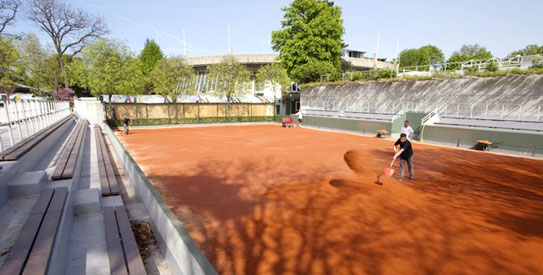
PARIS: Keeping the French Open in Paris has made the claycourt grand slam less vulnerable to rivals because it preserves the uniqueness of the 86-year-old tournament, according to the tournament director.
Gilbert Ysern told Reuters in an interview that remaining in the city was the key to long-lasting success for an event that has always been held in western Paris.
“It's like the Monaco Grand Prix. (Formula One supremo) Bernie (Ecclestone) will not touch to it because it is so singular,” Ysern said in his Roland Garros office as workers outside were already starting to set up the boutiques ahead of next month's French Open.
“It's also like St Andrews or Augusta. It's a cult venue.”
Last February, in a French tennis federation vote, Roland Garros beat off bids from Paris suburbs Versailles, Gonesse and Marne La Vallee to continue hosting the French Open.
Space restrictions mean the French Open will not grow as big as the Australian or U.S. Opens but staying in Paris was the cheapest solution.
“We invested 250 to 270 million euros ($386 million). Had we decided to leave and build a new stadium, it would have cost us between 500-600 million euros,” said Ysern.
The French federation will have to borrow 150 to 180 million euros over 25 years for the renovation of Roland Garros which should be finished by 2016.
RETRACTABLE ROOF
“It was also important to preserve the economic model of French tennis,” Ysern said.
“We could not invest massively and then tell our national technical director that we did not have enough money to develop French tennis.”
The smallest Grand Slam venue, Roland Garros spans 8.5 hectares to Wimbledon's 18.5 hectares, but it will be enlarged to 13-14 hectares by 2016 with a new 8,000-seat arena and a centre court equipped with a retractable roof.
Ysern said that the improvements should increase the number of spectators from 450,000 to 550,000-600,000 over the two-week period of the tournament.
“There is a demand for night sessions and that will bring more spectators to Roland Garros,” he explained.
The onset of night sessions will also lead to an increase in television rights and public relations revenues, Ysern added.
“Staying in Paris was also the desire of our sponsors,” he said. “But it was not a decisive factor.
“It's just that I prefer to do better than more. If we had gone to, let's say, Gonesse where a very big stadium would have been built, we would have been more vulnerable to a project emerging from Qatar, for example,” Ysern said.
“We made the crucial choice to stay in town, in outstanding surroundings. It's history that gives us 'Grand slam' status.
“The players want to come here because it's unlike anywhere else,” he explained.
“We would have been more vulnerable if we had moved from Paris. By staying there, we preserve our identity, our strong personality.”