0
0

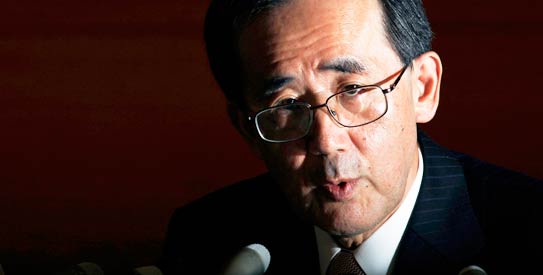
TOKYO: The Bank of Japan on Thursday kept monetary policy steady and launched a new loan scheme for banks in the northeast region hit hardest by last month's devastating earthquake and tsunami.
The central bank also cut its economic assessment and warned of heightening uncertainty over the outlook, signalling its readiness to ease policy further as a nuclear safety crisis and rolling power blackouts hit output and business sentiment.
“Japan's economy is under strong downward pressure, mainly on production, due to the earthquake,” the BOJ said in a statement after its rate review, revising down its view from last month when it said the economy was emerging from a lull.
“The quake led to sharp declines in output in some areas by damaging plants, disrupting supply chains and constraining power supply. Exports and domestic private demand have also been affected significantly,” it said.
Under the new loan scheme, the BOJ will offer 1 trillion yen ($11.7 billion) in one-year loans at 0.1 per cent interest to financial institutions in the quake-hit northeast.
The BOJ will also consider accepting a wider range of collateral for loans to banks in the quake-hit area. Details of the scheme will be worked out by the next rate review on April 28, the BOJ said, and it would start disbursing loans as early as May.
While the move's impact on the overall economy may be slim, it will help banks operating in the area such as Tohoku Bank, Toho Bank, Bank of Iwate and 77 Bank .
As widely expected, the BOJ kept interest rates unchanged at a range of zero to 0.1 per cent by a unanimous vote, and held off on loosening policy further.
Analysts had widely expected the central bank to stand pat on monetary policy after doubling to 10 trillion yen its asset buying scheme just three weeks ago as a pre-emptive measure against the disaster's damage to the economy.
With rolling power blackouts and supply chain disruptions already hitting output, however, analysts say the BOJ may ease policy as soon as its next rate review on April 28, when it will also review its long-term economic and price forecasts.
“At this point, the BOJ doesn't have enough hard economic data to assess the impact of the quake. But I think the BOJ will have enough information by the time of its next meeting,” said Naomi Hasegawa, senior fixed income strategist at Mitsubishi UFJ Morgan Stanley Securities in Tokyo.
She believed a policy easing was possible at the next meeting, with a five trillion yen increase in the asset purchase scheme, which buys assets ranging from government bonds to private debt, considered likely.
“This would help the economy,” she said.
Market players will scrutinise Governor Masaaki Shirakawa's news conference for clues on how soon the central bank will next ease policy.
WORST CRISIS
Japan is facing its worst crisis since World War Two after a 9.0 magnitude earthquake and a tsunami towering more than 10 metres battered its northeast coast.
The BOJ stuck to its view, however, that Japan's economy will resume a moderate recovery once factory output emerges from a temporary hit and supply constrains ease.
But it added that there was great uncertainty over how the quake could affect Japan's economic outlook and stressed that it would take action to support the economy when necessary.
Some analysts wondered whether the BOJ was being too optimistic on the outlook and may be too slow in acting despite mounting signs of the severity of the damage, with pundits warning that power supply shortages could last for years.
“The BOJ sounds rather optimistic on the economy's outlook.
It grew more cautious on the underlying economy than last month, but it basically stuck to its forecast that the economy will head towards a moderate recovery,” said Masamichi Adachi, senior economist at JPMorgan Securities Japan.
“I take it that the BOJ sees no need to ease policy further and will stand pat for the time being, unless the nuclear crisis worsens significantly or production struggles to recover in the coming months.
The government expects material damage from the disaster to reach up to $300 billion, but analysts warn the ultimate cost will be far higher.
In the auto sector, a key driver of Japan's economy, lost production in Japan in the two weeks after the quake topped one-third of a million vehicles.