0
0

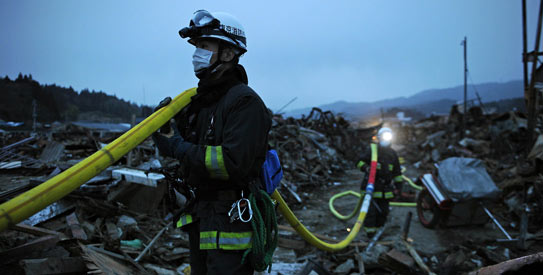
KITAKAMI: Driving rain on Monday disrupted rescue efforts in Japan and compounded the misery of disaster survivors now fearing radioactive fallout from the smouldering wreck of a nuclear plant.
The bad weather forced Prime Minister Naoto Kan to call off a helicopter flight to the battered northeast coast including a trip to a football training centre about 20 kilometres from the crippled Fukushima No. 1 plant.
The centre is now a staging area for emergency personnel working to avert a disastrous radiation release from the atomic plant, whose reactors have been overheating after cooling systems were damaged by an earthquake and tsunami.
The March 11 natural disaster — Japan’s deadliest since 1923 — has left more than 21,000 dead or missing after entire communities were swept away by the horrific tsunami or levelled by the record 9.0-magnitude quake.
The World Bank said the disaster could cost the world’s third-biggest economy up to $235 billion. That would be the equivalent to 4.0 percent of output, in an economy that has already been struggling for years.
But growth should pick up in subsequent quarters “as reconstruction efforts, which could last five years, accelerate”, the bank said in a new report on the Asia-Pacific region.
Tokyo financial markets were closed on Monday for a national holiday. They took a pummelling for most of last week, driving global markets lower, before rallying on Friday when the G7 pledged currency intervention to curb the yen.
Amid the devastation on the splintered northeast coast, there was an astonishing tale of survival with the discovery Sunday of an 80-year-old woman and her 16-year-old grandson alive under the rubble.
They were in the kitchen when their house in Ishinomaki city collapsed but the teenager was able to reach food from the refrigerator, helping them survive for nine days, broadcaster NHK quoted rescuers as saying.
But with half a million tsunami survivors huddled in threadbare, chilly shelters and the threat of disaster at the nuclear plant stretching frayed nerves, the mood across Japan remained grim.
Food contaminated with radiation was found for the first time outside Japan — where milk and spinach have already been tainted by a plume from Fukushima — as Taiwan detected radioactivity in a batch of imported Japanese fava beans.
Traces of radioactive iodine have been found in Tokyo tap water, far southwest of the atomic power plant on the Pacific coast, and authorities told residents of one village near the plant not to drink their tap water.
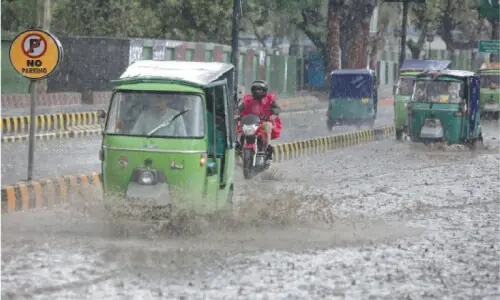
Leaden skies and pounding rain compounded the gloom and hindered search-and-relief efforts in the prefecture of Miyagi, where the police chief believes the final quake-tsunami death toll could reach 15,000.
“We basically cannot operate helicopters in the rain,” Miyagi official Kiyohiro Tokairin said.
“We have been using helicopters to deliver relief goods to some places but for today we have to switch the delivery to places that we can reach by road,” he said.
While authorities in Japan and beyond have played down the threat of radiation from the Fukushima plant, the rain was doing nothing to ease public jitters.
“We have said that radiation levels tend to rise when it rains, and we are monitoring radiation levels that have been announced every hour,” a Fukushima prefecture official said.
“The prefecture is giving advice on how to cope with the rain through newspapers and TV programmes, such as telling people to avoid exposure to rain as much as possible and to wipe dry after getting wet.”
At Fukushima prefecture’s 12 monitoring points, the highest level of radiation was detected in the village of Iitate where a reading of 12.10 microsieverts per hour was recorded at 8am.
The prefecture said the level was elevated but still far below that of an X-ray — 600 microsieverts — and did not pose a danger to health.
At the plant itself, according to Japan’s nuclear safety agency, engineers have restored an external electricity supply to reactor number two in a bid to get the water cooling systems back up.
But power at the reactor unit is not yet restored, agency spokesman Kenji Kawasaki said, and in the meantime fire trucks continue to spray water to help cool reactor fuel pools.
Asked on CNN if the worst was over at the ageing facility, US Energy Secretary Steven Chu said: “We believe so, but I don’t want to make a blanket statement.”