0
0


WASHINGTON: Whether an ordinary US Muslim becomes a violent extremist cannot be determined by the length of his beard or how often he goes to the mosque, experts say, urging Americans to avoid stereotypes.
On the eve of controversial congressional hearings on radicalization that have raised the ire of US Muslims, New York University's Brennan Center for Justice published a report deconstructing the “simplistic theories” that may have led Republican Congressman Peter King to launch the inquiries.
“Rethinking Radicalization” delves into the possible origins of the homegrown extremism whipping up growing panic in the United States after a string of attacks or attempted acts of terror led by Americans.
Concerns are such that Oklahoma passed an amendment to its constitution in November banning courts applying or even considering sharia, an Islamic body of law inspired by the Koran and the Prophet Mohammed's actions and teachings.
A federal judge later granted a temporary injunction against the ban.
But fears that US Muslims are seeking to impose sharia have led other states -- Georgia, South Carolina, Texas and Wyoming -- to introduce legislation against the religious law this year.
And Tennessee is seeking to criminalize the practice of sharia by making it a felony punishable with prison time.
Some Muslims fear the measure could make illegal some of the key practices of their faith, such as praying five times a day in the direction of Mecca, fasting during the holy month of Ramadan and refraining from drinking alcohol.
“A thinly sourced, reductionist view of how people become terrorists has gained unwarranted legitimacy in some counter-terrorism circles,” noted the Brennan center's Faiza Patel, a civil liberties specialist.
“Given the piecemeal and contradictory information that is publicly available, an outside observer can hardly evaluate who is right in this ongoing discourse.” She focused her criticism on the FBI and the New York Police Department, who have suggested law enforcement agents can stop radicalization by looking for the “right signs,” contrary to federal government and social science research.
“The innocuous nature of many of the signatures identified by the NYPD -- such as growing a beard or becoming involved in community activities -- means that they are likely to be found in a large segment of the American Muslim population,” she said.
Such theories may have led King -- who chairs the House Homeland Security Committee -- and other Congressmen to suspect the community as a whole.
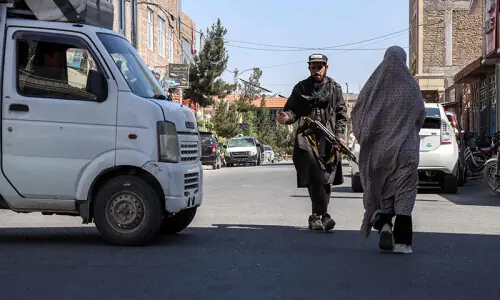
During a training session in Florida, Jordan-born instructor Sam Kharoba told about 60 police officers and other law enforcement officials how to pick out fanatics by their appearance.
“When you have a Muslim that wears a headband, regardless of color or insignia, basically what that is telling you is: 'I am willing to be a martyr,'” he told the group, according to the Washington Monthly.
But Patel argues that intelligence gathered in the years after the September 11, 2001 attacks shows that “there is no profile of the type of person who becomes a terrorist” and that “Islam itself does not drive terrorism.”
A study supported by the Department of Homeland Security found that “there is no one path, no 'trajectory profile' to political radicalization.” “There are many different paths... Some of these paths do not include radical ideas or activism on the way to radical action,” it said.
“The radicalization progression cannot be understood as an invariable set of steps or 'stages' from sympathy to radicalism,” it added.
But once ingrained, reductive perceptions can be translated into policies.
US law enforcement focuses much of its anti-radicalization efforts on surveillance of the Muslim community, including by informants in mosques.
The moves have fueled a backlash at times, generating anger instead of the cooperation that law enforcement seeks.
Fears about radicalization have meanwhile led to arson attempts against mosques in some states.
“The perception that law enforcement's tactics unfairly target American Muslims could have an impact on the willingness of at least some members of these communities to proactively cooperate with law enforcement agencies -- particularly the FBI,” Patel warned.
Last year's anniversary of the September 11 attacks saw bellicose rhetoric against Islam and a furious national debate over whether a proposed Muslim community center should be built two blocks from Ground Zero.