0
0

The federal Ministry of Food, Agriculture and Livestock (MINFAL) has set a track record in imaginative initiatives that are abandoned before they mature. A project for the cultivation of salicornia along the coastline is a case in point.
It is a rare plant that thrives on saline water, absorbs the salt in the water without any harm to the soil on which it grows and actually crumbles when irrigated with sweet water and relishes drought conditions.
Salicornia has tremendous economic value with contents including 30 percent of edible oil- more edible oil can be obtained from its seeds than from soyabean seeds. The oil also provides raw material for a number of cosmetic and pharmaceutical products.
Salicornia's bio mass provides high protein - about 40 percent, forage for livestock, pulp from its straw can be used for producing coarse paper, laminated sheets as water proof roofing in construction of houses and for weaving mattresses. Input costs of salicornia are low and labor required for plantations can be wholly unskilled.
In addition to these contents, salicornia is also eco- friendly plantation as it absorbs carbon dioxide. It is for these qualities that salicornia is often referred to as 'miracle plant'. It is indeed producing miracles in some parts of the world and being rapidly adopted by countries with vast coastlines and saline water.
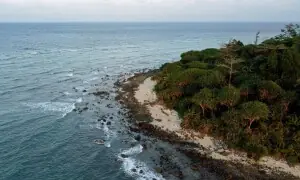
Pakistan's coastline covers about 700 kilometers of Sindh and Balochistan provinces. The population of these areas is mostly an impoverished lot with very little fruitful economic activities and opportunities available to the people. The project for the cultivation of salicornia would have proved a great boon for the people of these areas.
Interestingly, it was launched at a time-1995, when alleviation of poverty wasn't a buzzword in government circles and abandoned by the post October 1999 administration that places great emphasis on combating the spread of poverty.
Planning permission was obtained by MINFAL for cultivating the plant on 10,000 acres in 1995. Next year, salicornia was sown on 200 acres at Hub Chowki in Baluchistan. Needless to say that the project had great potential for improving economic conditions on the coastline of Sindh and Baluchistan; the planners had also envisaged plantations in Thar and Cholistan deserts at a later stage because of high salt contents of water in these regions.But changes in the hierarchy of MINFAL in 1997 placed the project on a back-shelf.
However, more changes helped revive the project in 1998. Salicornia cultivation was not only taken up again but acreage under it was extended to 500. However, the revival proved short lived because the project was abandoned in 2000, as the then minister in charge of Food and Agriculture declared that it did not serve any national need; the government was convinced into scrapping it.
Meanwhile, the Indian government undertook experimental cultivation of salicornia on 125 hectares on the coastal wasteland of Kutch district in Gujrat state with a view to generating economic activities in areas largely comprising a starkly poor population and providing employment to the rural population.
Salicornia cultivation has been increased in India since then and has reportedly flourished. A reportable development of the Indian effort is large number of birds converging on the plantations, a phenomenon described as 'unusual in Kutch part of the Gujrat state'.
The plant has been successfully grown in Saudi Arabia and Mexico; the later has in fact reached a second stage by now and is using saline water around salicornia plantations for breeding and producing prawns, giving a boost to the country's fish exports and opening another door for the population on the coastline.
Pakistan's brief excursion in the promotion of salicornia had identified some of the possible economic benefits from the plant with the export of two tons of its tips to France where they were used as 'base for serving prawns in restaurants'. French importers had sought information on the quantity Pakistan would be able to regularly export but the query went unanswered for obvious reasons.
The project was prepared and launched by Dr Zafar Altaf as Secretary MINFAL after undertaking a study of the plant's possibilities in Pakistan Agriculture Research Council (PARC) and revived by him on his second posting in the ministry; he retired last year. He was however shifted from MINFAL earlier and the authorities god rid of the project soon after his exit.
The argument for salicornia was the plant's potential for contributing towards the country's edible oil needs that cost a hefty sum to the exchequer every year, providing income generating opportunities to people on the coastline, enhancing food for animals kept by these people and developing low cost housing and generally strengthening raw material base of the construction industry.
It was argued that salicornia would not only help ameliorate poverty but also serve as raw material for some industries and exports and, in time, become a player in the breeding of salt water prawns.
Considering that the present government, indeed the management of the country since October 12, 1999 has been on record for reducing poverty in the country, the cancellation of the project seems surprising. But a wrong decision should not hinder the government from accepting its mistake and implementing a project that can improve the conditions of a deprived segment.
People living along the coastline are not just generally poor but they have been further pushed down the survival line. The majority population of these regions comprises fishermen.
Their traditional skills are of little to no value for present day fishing that has become a high investment field that is managed on modern lines and is required to maintain international standards that the local population is not qualified to achieve.
Salicornia cultivation would give them a hope and an option that is currently not available. The government would do well to undertake the project again if it wishes to honor its commitment with the poor.