0
0

NAIROBI: Upon entering a tiny recording studio in a grimy Nairobi building, Felis removes her face veil, slides headphones onto her ears and starts singing in a high voice: “Girls are raped. Warlords are to blame”.
Over a soundtrack of world music and rap, Felis Abdi and the group Waayaha Cusub, made up of some 20 young Somali refugees, crudely slam the war that has torn up their country for 16 years, almost all their lives.
“All the people have been killed. Let us repair the country. There is no school, there is no peace,” sings Waayaha Cusub, which means “New Era” in Somali.
“People listen to you more when you sing than when you speak,” says Abdiwali Ibrahim Garyare, one of the group’s singers, who has lived in Kenya for 17 years.
“We can make a difference because the young generation listens to us,” adds 17-year-old Felis, who has a gap between her teeth.
The group’s choreographer, Djamila Djama, says that five Somali boys, who now live in Nairobi, stopped carrying guns after listening to the anti-war rhetoric of their songs.
The tunes have blasted out of radios in Kenya and Somalia — in Somali, Swahili and English — since the group was created in 2004.Their videos, featuring militias armed with rocket launchers, civilian massacres and burning buildings, are broadcast across the internet.
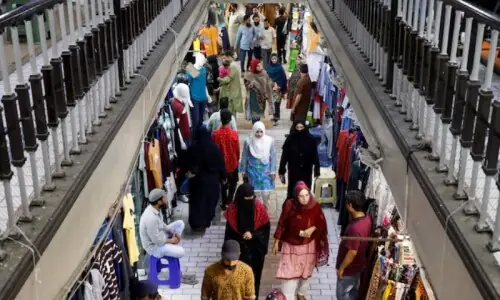
They are often filmed in Nairobi’s Eastleigh neighbourhood, nicknamed “little Mogadishu” due to its large Somali population.
Waayaha Cusub spares no player in Somalia’s war from its criticism: warlords who have imposed their own laws for years; Islamists who controlled south and central Somalia at the end of last year; Ethiopian troops who deployed in Somalia last year to help the government oust the Islamists; and Somali authorities who they accuse of “collaborating” with Addis Ababa.
One song, “Freedom,” rails against the Islamic Courts Union which banned music and imposed a strict dress code for women during its six-month rule at the end of last year. Somalis generally practise a moderate form of Islam.
“We don’t want that religious extremism. We want our freedom, the freedom to listen to what we want. We want to see women’s faces,” the group sings.
Waayaha Cusub claims to preach peace, despite the violent tone of certain songs, such as “Somalia”, which criticises Ethiopian “colonisers”: “The Ethiopians are forming indirect colony with the world watching. May Allah lead them to the grave.” The group’s rapper, Dikriyo Abdi Ilmi, defends the harsh lyrics.
“We wrote that story when we were very angry. We are not telling the Somali people to fight against the Ethiopians but to find a way to work together so that the Ethiopians leave,” explains Ilmi, who is too tall to stand up straight in the tiny, barely soundproofed studio.
A young Ethiopian, who joins the group for several songs, agrees.
“I don’t think it’s okay for a country to go into another country,” says Brian Quincy, wearing a cap to hold in his dreadlocks. But the sensitive themes over contemporary music are shaking up Somali society, more used to love songs and traditional music.
Although popular among the young, the group says it has made many enemies.
Dikriyo says he was recently called to Nairobi’s Ethiopian embassy and threatened to stop singing anti-Ethiopian lyrics.
Felis says she never steps onto the streets of Eastleigh without wearing her veil, for fear of bumping into supporters of the Islamic Courts.
“I can’t walk without the veil. Otherwise, I would be beaten,” she claims.
Meanwhile, the group says that one of its singers, who made videos with her face uncovered, wearing a skirt and tight top, has been banned from going out by her parents.—AFP