0
0

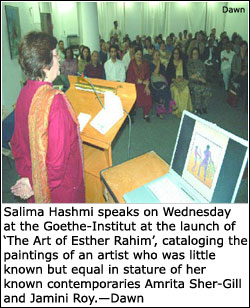 KARACHI, Jan 17: Though never much acknowledged in the annals of mainstream Pakistani art, Esther Rahim, also known as Esmet, was a painter of no small significance.
Speakers at the launching of a book cataloging the art of Esther Rahim at Goethe-Institut on Wednesday agreed that Esther (1904-1963), had equal greatness as that of the South Asian icon Amrita Sher-Gill, being her friend and contemporary as an artist of immense talent and creativity, but her work remained unnoticed for decades.
Salima Hashmi, who co-authored the book “Travels mundane and surreal – The Art of Esther Rahim” along with Naazish Ataullah and Sikander Rahim, the late artist’s son, said since Esther Rahim, the wife of J.A Rahim the well-known civil servant, diplomat, politician and founding member of Pakistan Peoples Party, died over four decades ago, her work was little known. The book pictures of 70 to 80 paintings of the artist.
“First I was told on inquiry of a painting that it was created by J.A. Rahim’s wife in Karachi. Another painting she found in London was credited to late Rahim’s wife while the third which was in Washington where someone told me the artist was Sikander Rahim’s mother.
It took much time for Esther Rahim to be recognised on her own reference,” Ms Hashmi said, introducing the artist and the catalogue. “As usually happened in this country, the woman artists remained anonymous,” she added.
Ms Hashmi went on to say it was only when she contacted her son that she was quite amazed to see the wonderful work done by Esther and that too when he was ailing. In the last two years of her life, she suffered from heart disease.
She said Ms Rahim was equally admired for her creative block-printed khaddar that became a rage in the 1950s in Pakistan.
According to her, Ms Rahim was a pioneer of the Karachi Arts Council along with Zubaida Agha. She was also an enthusiastic patron of block printed textiles and her patronage contributed to their revival and survival in Karachi during the 1950s.
A friend of both Amrita Sher-Gil and Jamini Roy, Esther found her own voice and vision only towards the end of her artistic life. The resulting body of work remains of undisputed value and exceptional maturity.
She hoped the collection of essays would introduce the work of this remarkable woman to the audience which she was denied in her lifetime.
This great artist gets the recognition now, which was long overdue,” she added.
The other co- author of the book, Naazish Ataullah said Ms Rahim was the pioneer of the Karachi Art Council along with Zobaida Agha soon after the Partition. Esther, a friend of both Amrita Sher-Gil and Jamini Roy, the late artist found her voice and vision only towards the end of her artistic life and no one could gauge as who influenced the work of other artist.
Consul General of Germany Hans-Joachim Kiderlen, Ellen Golz of the German Embassy and Director Goethe-Institut Karachi Petra Raymond, also spoke on the occasion.