Democrats seek bipartisan action to curb Trump’s immigration drive
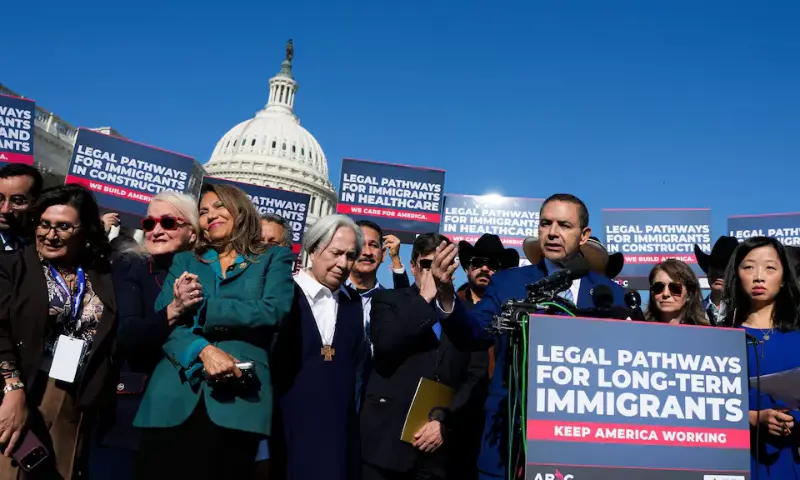
WASHINGTON: Democratic lawmakers have called for a bipartisan immigration deal, seeking changes to President Donald Trump’s enforcement policies and legal status for long-settled immigrants.
The appeal came as Democratic officials in several states and cities moved to limit their agencies’ role in federal immigration operations.
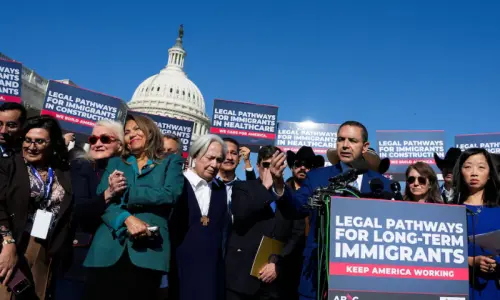
Members of the House and Senate, including lawmakers elected last week, held a news conference outside the US Capitol.
The group included progressive and centrist Democrats who said the election results offered an opportunity to revisit an approach that had become politically costly for Republicans.
Representative Veronica Escobar, whose Texas district includes the border city of El Paso, said she wanted far-reaching reform but recognised that legislation could not pass without Republican support.
“As we continue to have Donald Trump in the White House, and without a supermajority in the Senate, we need Republican support,” she said, adding that comprehensive reform would therefore have to be bipartisan.
Senator Ruben Gallego of Arizona urged both parties to pursue an agreement before the current congressional session ends, or continue negotiations in the next one.
Republicans had long made immigration reform conditional on securing the border, he said.
“We have that right now. We did the job. Now let’s figure out how to right-size our immigration issue. Let’s figure out how to keep families together.”
Representative Sylvia Garcia of Texas proposed starting with the Dream and Promise Act, saying it could provide a basis for broader changes after Democrats assume control of Congress in January.
The lawmakers’ appeal for federal legislation coincided with efforts by Democratic state and local administrations to narrow the role of their police and detention agencies in enforcing federal civil immigration rules.
In Houston, Mayor John Whitmire has also issued an order barring city police from contacting Immigration and Customs Enforcement (ICE) about administrative immigration warrants during routine traffic stops and minor, nonviolent violations.
Police may still contact ICE when a person is being booked into jail for a new offence carrying possible jail time and also has an administrative immigration warrant.
The order also removes earlier provisions requiring officers to wait for extended periods for ICE agents to attend traffic stops or detention scenes.
Whitmire said he had consulted Texas’s newly elected governor, lieutenant governor and comptroller before acting. He described the move as an attempt to ease anxiety in immigrant communities and said he hoped other cities in the state would follow.
“This is the right thing to do at the right time,” he said. “I do this to begin a healing process.”
Whitmire opposed a 2017 Texas law prohibiting sanctuary-city policies when he was a state senator. Houston’s move follows major Democratic gains in the state: Gina Hinojosa defeated Republican Governor Greg Abbott, while James Talarico won a Senate seat.
Abbott had earlier threatened to hold back more than $110 million in public safety grants from Houston over its limits on cooperation with ICE. Austin and San Antonio are also reviewing their arrangements with federal immigration authorities.
Similar changes are underway elsewhere. Virginia Governor Abigail Spanberger has ordered state law-enforcement agencies to end their agreements with ICE under the 287(g) programme, which authorises participating local and state officers to carry out specified immigration enforcement duties.
Maryland Governor Wes Moore has signed legislation ending formal 287(g) partnerships between ICE and state or local law-enforcement agencies.
The change requires nine sheriffs’ offices to withdraw from their agreements.
In New York, legislation signed by Governor Kathy Hochul requires existing arrangements involving local detention facilities and federal civil immigration detention to end by November 25.
California, meanwhile, continues to apply its California Values Act, which restricts the use of local police resources for federal civil immigration enforcement.
In January, Democrats are expected to use their new congressional committee leadership to scrutinise the Department of Homeland Security, which oversees ICE, investigate enforcement practices and detention conditions, and seek testimony and records.
But a Democratic majority will not by itself enable lawmakers to undo the president’s central immigration policies. Trump can veto legislation, while Senate rules will make it difficult to pass major measures without broader support.
Trump conceded after the Republican losses that his administration had been “too tough” on immigration in some respects. Yet his appointment of Stephen Miller, a leading architect of the crackdown, to a senior White House post points to continued resistance to a substantial change in direction.
Vice President JD Vance, seen as a possible Republican presidential candidate in 2028, has suggested that enforcement tactics could be adjusted, including through a greater focus on businesses that hire undocumented workers.
His comments indicate that debate over how the administration applies its immigration policy may continue, even as Trump retains its central objectives.