AMERICAN WASPs have lost their sting. The recent US midterm elections results are balm to the pain felt after Donald Trump’s return to the White House two years ago.
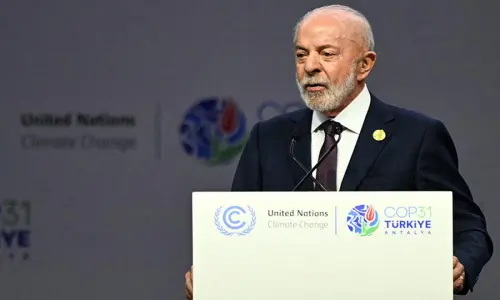
This November, that surge of fickle popularity changed allegiance from a Republican red to a Democratic blue. Almost overnight, individual candidates emerging from among the leaderless Democrat Party have wrested control of both the Senate and the House of Representatives. It was a triumph of right over might, or as its newest star — Senator-elect Abdul El-Sayed from Michigan — put it, the victory of “the many over money”.
Investment in the 2026 midterms has been unprecedented. The final amount is expected to exceed $12 billion, which will be around 30 per cent more than that spent in 2022, and vastly more than the meagre $2bn spent in 2002. Inflation has little to do with it. This year, the top 40 donors contributed $2.5bn, led by the trillionaire Elon Musk. He squandered about $500 million supporting Republican candidates.
There is no Theodore H. White alive to chronicle this electoral extravagance. His book — The Making of the President 1960 — provided a narrative of the rise of the charismatic John F. Kennedy. Unlike Abdul El-Sayed, Kennedy did not have to fight big money. Kennedy’s father was already a millionaire. But, like El-Sayed (a Muslim), Kennedy (a Roman Catholic) had to overcome bitter religious prejudice.
The midterm results were a triumph of right over might.
In September 1960, Kennedy delivered a well-aimed rejoinder to critics who ‘obscured’ the campaign by questioning his loyalty. He asserted that “the separation of church and state” was absolute. He went further: “I believe in an America that is officially neither Catholic, Protestant, nor Jewish.” He contended that allegiance in America was to the constitution, adding that “no man should be denied public office merely because his religion differs from the president’s”.
The real issues, Kennedy argued, were not his religious faith but hungry children, old people unable to pay medical bills, struggling farmers, insufficient schools, slums, etc. Almost 70 years later, Abdul El-Sayed based his platform on the same issues — schools, healthcare, the cost of groceries, and fuel prices.
El-Sayed owes more, though, to his prototype Barack Hussein Obama. He too was criticised for being a “little bit young, a little bit brown, a little bit Muslim”. Barack Obama was 47 years old when elected president; El-Sayed has just begun his 43rd year. He will be 45 in 2028, when he will foreseeably make his first bid for the presidency. By then, he will have enough credentials.
He will have prompted Trump to end the Israel-incited Iran war and caused a rethink of America’s relationship with Israel. His views on Israel are even-handed: “I believe in equal rights, to peace, dignity, and self-determination for Palestinians and Jewish Israelis alike.” He draws a line between Israel and Zionism and he deplores the use of US tax dollars to fund genocide in Gaza, or anywhere else.
Like Obama, El-Sayed is master of the media. He began early. His valedictorian address in 2007 at Michigan University impressed president Bill Clinton enough to earn this compliment: “I wish every person in the world who […] cannot reach across the religious divides, could have heard you speak today.” Clinton advised Abdul El-Sayed to go into politics, despite the burden of his name.
Today, media is not only king; it is the sceptre of presidents. Theodore White analysed that “once Gutenberg put the Bible in print, neither church nor prince could maintain authority [.] Television reached a world that even if it could not read, it could look”. But he warned that, while a president “might control camera attention, he could not control events”. Many will remember the slogan that pursued Lyndon B. Johnson over that other undeclared war, in Vietnam: “Hey, hey, LBJ! How many kids did you kill today?”
How will Abdul El-Sayed position himself vis-à-vis Pakistan, as a senator-elect and a president-in-waiting?
Obama visited Pakistan as a student for three weeks in 1981. He learned how to cook local dishes like qeema and dal. He carried away from Pakistan nothing more than recipes and a “changed perspective on economic disparity”.
Abdul El-Sayed has not yet visited Pakistan. Frequently addressing Pakistanis in America, he has called out strongly “for human rights and democratic governance”, drawing a parallel with Egypt (the home of his parents). He cited “its history of military dictatorship” and argued that “neither government should be shielded from criticism, or receive US aid, simply because they are US allies”.
Will Trump and his coterie learn from the results of the US midterm elections? Will they soften in the face of reality, or become increasingly defiant in defeat?
The writer is an author.
Published in Dawn, November 12th, 2026