THE World Bank’s Reclaiming Momentum Towards Prosperity report presents a sobering reality: poverty has climbed back to 25.3 per cent on the national line; and close to 45pc of Pakistanis fall below the bank’s new $4.20-a-day threshold.
Stabilising our way into deeper poverty has exposed the limits of conventional macroeconomic management. Speaking last week at the International Conference on Inclusive and Resilient Economic Empowerment and Growth, organised by the Pakistan Poverty Alleviation Fund in Islamabad, I put one question at the centre: how do we break this cycle?
Accelerating growth requires recognising where real growth originates. Pakistan’s largest capital investment of this decade never appeared in a Public Sector Development Programme (PSDP), Annual Development Programme (ADP), or Nationally Determined Contributions (NDC). Farmers, shopkeepers and households imported about 17 gigawatts of solar panels in 2024, and the same again in 2025. No PC-1. No donor. No climate finance unit. They used their own savings, because diesel costs and the unwinding of unsustainable energy subsidies made it rational.
The lesson for macroeconomic policy is direct. Prolonged, distorted subsidies are not a safety net. They are an obstacle to citizen-led growth. When fiscal pressure forced the state to pare them back, citizens moved faster than planners to protect their own balance sheets. The state’s response was to tax panel imports and revise net-metering terms. So when we ask how planning can accelerate growth, we should first admit that citizens are already ahead of the plan. The question is whether the state will remove the friction in their way or keep chasing donors. Three shifts would make the difference.
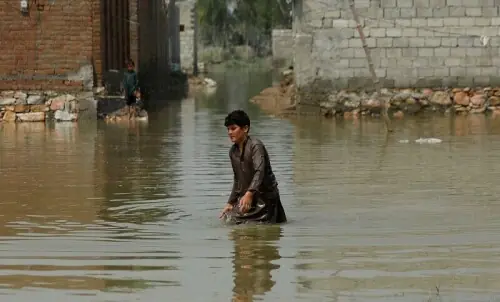
Unpriced risk: Macroeconomic stability cannot survive risk that no one has priced. Pakistan already has a climate budget. It is not the one captured by the recently introduced climate budget tagging. It is the one written after each disaster. Major floods now produce post-disaster needs assessments, reconstruction budgets, and emergency appeals. That is our real climate expenditure: unplanned and largely borrowed — a permanent drag on fiscal space. The fix is not more tagging of development spending. It is pricing climate risk before it arrives.
Pakistan already has a climate budget — the one written after each disaster.
In practice, this means treating climate losses as a contingent liability of each province, the way we already treat circular debt and SOE guarantees. The Fiscal Risk Statement mentions disasters but puts no number on them. Each province can estimate its average annual loss from floods, heat, and drought, and appropriate a share of it every year as an expected cost. Budget theorists call this ‘expected-value budgeting’. A loss that is budgeted becomes a decision. A loss that is not budgeted becomes a bailout, often paid through the Benazir Income Support Programme’s emergency transfers.
Maintenance first: Economic productivity depends on assets that work. That makes resilience a maintenance problem before it is a development problem. Embankments, drains, canals, and roads do not fail because nobody built them. They fail because their recurrent budgets are starved. Yet our economic conversation stays inside the development budget. The federal PSDP alone carries a throw-forward of about Rs11 trillion, and new schemes keep joining the queue, while existing assets go unmaintained. The ADP builds the embankment. The operations and maintenance line decides whether it holds. Protecting maintenance allocations for water assets would preserve existing capital and buy more resilience per rupee than most new projects.
One can see where local money is actually spent. The most local spending stream is not an SDG-linked programme. It is the parliamentarians’ development schemes: tube-wells, link roads, drains, and culverts. They are quick, uncoordinated, and climate-blind. Nobody screens them. A single check asking whether the asset will survive the next monsoon would protect more local capital than every formal climate project combined. Green growth at the local level will not come from specialised projects. It will come when ordinary public spending stops creating new fiscal liabilities.
District arithmetic: Growth targets fail when they stay abstract. The NDC is written in tonnes of carbon and gigawatts. A district plans in culverts, acres, and tube-wells. Nobody has done the translation. A union council cannot own or deliver a national target expressed in metrics it does not know.
The first mechanism is a translation layer. Each district needs a short climate investment and growth plan that converts national targets into local units: acres under laser levelling and drip irrigation, tube-wells solarised, kilometres of drains cleared. Once a target is counted in local units, a local official can be held accountable for it.
The second mechanism is money that rewards performance instead of rescuing failure. Versions of this model already work elsewhere. A district that sets up its own climate fund and meets basic public financial management standards qualifies for performance-based grants spent on investments its communities choose. Money follows institutions, not proposals. Pakistan could pilot this in 10 of its most flood-exposed districts through provincial finance commission transfers, with the grant rising as each district meets its conditions. That is local ownership with a test attached.
The third mechanism is creditworthiness. Local growth stays dependent on donor projects because no district or municipal body can borrow or issue a municipal bond. None has a balance sheet, an asset inventory, audited accounts, or a credit rating. A provincial pooled financing facility could bundle bankable projects, such as solar for water supply, municipal waste, and cold storage, and raise capital against the pool. The precondition is unglamorous: audited accounts and own-source revenue at local level. Investors do not lend to plans. They lend to entities with a record.
The fourth point is simpler. For most local investment, the bottleneck is not finance. It is permission. A solar mini-grid needs a Disco connection and a Nepra licence. A restoration project needs a land lease. A water scheme needs water rights. Locally owned investment needs a single district window for permissions before it needs another fund.
In all: price the loss before the flood. Fund maintenance before new projects. Count targets in district units. Make municipalities bankable. Citizens have already shown, panel by panel, even when they are below the poverty line, that they will finance their own resilience. The state cannot lead them, but can stop taxing their initiative and carry the risks they cannot.
The writer is a climate expert.
Published in Dawn, October 22nd, 2026