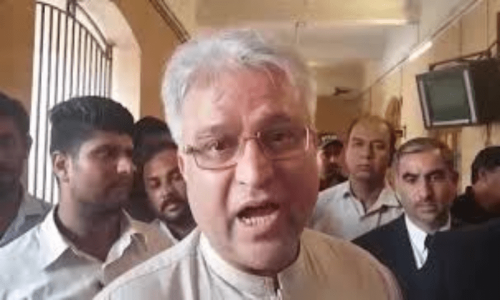
KARACHI: An anti-terrorism court (ATC) on Tuesday sentenced a man to death on two counts in a case pertaining to the kidnapping and murder of a lawyer after his ransom demand was not fulfilled.
Deceased advocate Syed Farhat Ali Askari, 70, was abducted by some criminals in 2020. Later, his wife received a ransom call demanding Rs40 million, otherwise the kidnappers threatened to kill her husband and as she failed to fulfil their demands, the kidnappers killed him by strangling him.
On a lead provided by the accused, the body of the slain advocate was recovered from a suitcase that had been thrown into a nullah in Surjani Town near Taiser Town.
The police had arrested four accused — Awais Ali Hashmi, Muhammad Faizan, Muhammad Saeed and Iftikhar Ahmed Khatri — and they were tried by an ATC, where all four accused were convicted in 2023.
ATC exonerates three co-accused from charges of abducting septuagenarian advocate for Rs40m ransom in 2020
However, the verdict was challenged before the Sindh High Court, which remanded back the case to the trial court with directions to record the statements of the convicts afresh.
After recording the statements and examining the evidence, the ATC-1 Judge, found Awais guilty on two counts and sentenced him to hang till death and imposed a fine of total Rs500,000.
“I would like to observe that the act of the accused, whereby he kidnapped Syed Farhat Ali Askari, demanded ransom amount Rs 4 Crore from his wife for releasing her husband, and due to non-fulfillment of demand committed murder of Syed Farhat Ali Askari, who was practicing advocate, and threw his dead body in a dirty/polluted Nala (drain), in such a brutal manner, squarely falls within the definition of “terrorism” as defined under Section 6 of the Anti-Terrorism Act, 1997, as such act definitely created panic and fear in the minds of the general public as well as the locality and the legal fraternity. Therefore, the accused is convicted and sentenced under the provisions of the Anti-Terrorism Act, 1997,” the judge observed.
However, the ATC acquitted remaining accused —Faizan, Iftikhar and Saeed — as prosecution failed to prove its case against them.
They were implicated in the case on the basis of confessional statement of Awais to the police; however, the court noted “the confessional statement of co-accused can only be used against other accused, if there is other evidence, direct or circumstantial connecting the accused with such crime. It is well-settled that if confession made by one accused can be taken into consideration against another accused, not as a substantive piece of evidence but as a corroboratory piece of evidence which requires independent corroboration”.
A case was registered at the Shahrah-i-Noor Jahan police station under Sections 302 (murder) 365-A (kidnapping) 34 (common intention) of the Pakistan Penal Code, read with Section 7 of the Anti-Terrorism Act, 1997.
Published in Dawn, September 30th, 2026