The Middle East’s Nato?



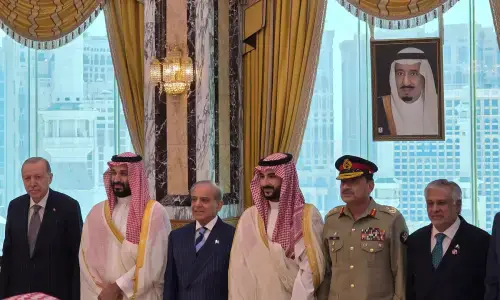
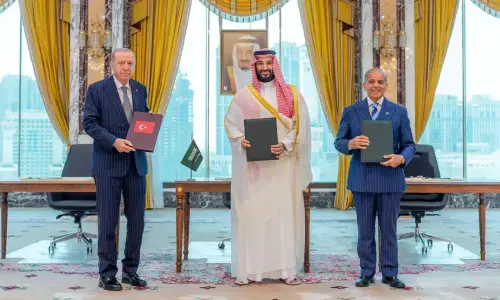
ON Aug 7, 2026, Saudi Arabia, Pakistan and Turkiye signed the historic Makkah Joint Defence Agreement (MJDA) to strengthen collective deterrence against external armed aggression. The agreement provides that an armed attack on one state would be regarded as an attack on all parties to the agreement. Historically, Pakistan has maintained long-standing defence ties with both countries. For example, Turkiye has supplied corvettes to Pakistan, while Pakistan has supplied training aircraft to Turkiye; Saudi Arabia, too, has purchased Turkish drones. Pakistan has also provided training and technical assistance to Saudi forces. Previously, Pakistan has entered into defence and military cooperation agreements with Saudi Arabia as well as other GCC countries.
MJDA is grounded in international law. Article 51 of the United Nations Charter recognises the inherent right to individual or collective self-defence when an armed attack occurs against a member state. Article 51, located in Chapter VII of the UN Charter, is the principal exception to the general prohibition on the threat or use of force in international relations established under Article 2(4) of the Charter, which protects the territorial integrity and political independence of states. Crucially, self-defence is triggered only by an “armed attack” establishing a high threshold for the lawful use of force.
In practice, states have used force in self-defence both after an armed attack and, more controversially, on a pre-emptive or anticipatory basis. Such force has been used unilaterally as well as collectively with allies. A prominent example of collective self-defence followed the Sept 11, 2001, attacks, when Nato invoked Article 5 of the North Atlantic Treaty for the first time. Article 5 provides that an armed attack against one or more Nato members is considered an attack against all, requiring each member to assist the state attacked, including through armed force where deemed necessary.
Controversial claims of collective self-defence have also arisen where a state has used force against another state purportedly in defence of a third state, in the absence of a mutual defence arrangement. One such case arose when the US used force against Nicaragua, claiming collective self-defence of El Salvador, alleging that Nicaragua was arming and assisting Salvadoran rebels fighting its government. The dispute ultimately came before the International Court of Justice in Military and Paramilitary Activities in and against Nicaragua.
The right to collective self-defence has, in practice, been invoked not only against other UN member states, but also against internal threats, or what has been interpreted as armed attacks attributed to terrorist groups and other non-state actors. Examples where states have requested foreign assistance as collective self-defence or, at a minimum, intervention by consent against internal threats, include the Syrian request for Russian assistance, and the Saudi-backed Yemeni government’s request from Saudi Arabia and its allies against the Houthis, the latter expressly invoking Article 51 of the UN Charter.
The Iraqi government also requested armed assistance against IS, providing the basis for states to invoke collective self-defence of Iraq against an international terrorist group. Iraq maintained that IS posed a serious threat to its people and territorial sovereignty. Moreover, the UN Security Council recognised IS as a threat to international peace and security.
The new trilateral security agreement raises questions about its costs for Pakistan.
Regarding global terrorism, the UN Security Council had earlier, somewhat controversially, recognised this position. Resolution 1368 (2001), adopted the day after 9/11, affirmed the inherent right of individual and collective self-defence in the context of those attacks. Resolution 1373 (2001) reaffirmed this right while strengthening global counterterrorism obligations. The US subsequently used force in Afghanistan under Article 51, while Nato separately invoked Article 5 of its collective defence pact.
Geopolitically, notwithstanding the potential benefits — including greater economic assistance from Saudi Arabia and other GCC states, and likely US support — the agreement raises questions about its costs for Pakistan and, more importantly, what Pakistan can realistically provide. Pakistan has consistently maintained that such arrangements would not extend its nuclear umbrella.
Practically, questions arise over how Pakistan could protect Turkish security interests, whether against Israel or internal threats from Kurdish separatist groups operating from Syria and Iraq. Regarding Saudi Arabia, reciprocal security guarantees may exist in theory, but their practical operation remains unclear. It is uncertain what meaningful military assistance Saudi Arabia could provide Pakistan in a conflict with India, with which it maintains close ties. More broadly, it is unclear what security benefits Pakistan would receive in return. The agreement could also draw Pakistan into a more direct confrontation with Israel, which has long maintained close defence ties with India and could further strengthen them in response.
The agreement also risks placing Pakistan at odds with Iran, with which it shares a long border and has at times cooperated against cross-border security threats. Involvement in a conflict with Iran over Middle Eastern security could further destabilise Pakistan’s western frontier while relations with Afghanistan and India remain tense and conflict-ridden. Pakistan has accused both states of facilitating terrorism and undermining its security. Moreover, Pakistan has the world’s second-largest Shia population after Iran. Any conflict with Iran could potentially strain internal cohesion and intensify sectarian tensions that Pakistan already struggles to contain.
Finally, if Pakistan is willing to enter mutual-defence pacts, why not prioritise one with China, which has major economic interests in Pakistan through CPEC and a strong stake in safeguarding this country’s external security? Such an arrangement could be mutually beneficial and deter further Indian adventurism, particularly given the effectiveness of the Pakistan-China defence cooperation and China-origin military systems during the four-day May 2025 Pakistan-India clash.
Historically, Western states have acquiesced in Pakistan’s possession and maintenance of nuclear weapons, largely in the context of its rivalry with India and stated self-defence needs. However, deeper integration into Middle Eastern and broader global security frameworks could generate greater Western pressure, including through international institutions, to constrain Pakistan’s nuclear weapons, missile technology and ballistic programmes. Such pressure could directly threaten Pakistan’s sovereignty and security. Lastly, the agreement could draw Pakistan’s armed forces into conflicts in which the country has historically maintained neutrality. Such commitments could stretch military resources, create fatigue, and increase vulnerability to Indian or Afghan opportunism and adventurism.
The writer is a professor of law at Lums.
Published in Dawn, August 15th, 2026