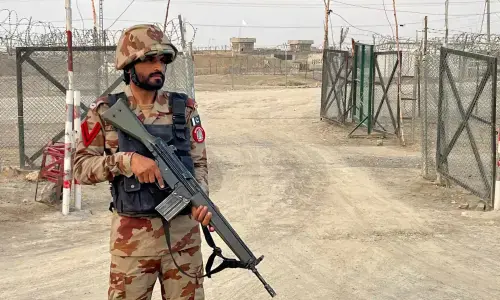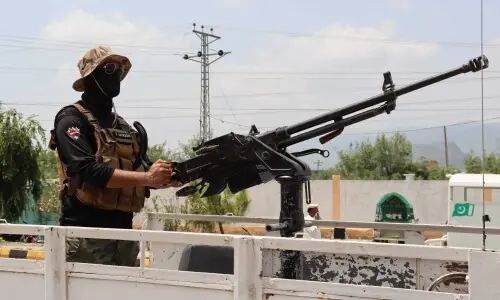


PAKISTAN’S security forces are fighting terrorism with commitment and high intensity. From sanitisation campaigns and intelligence-based operations to targeted raids and large-scale engagements, the tempo of action is rising. Yet terrorist violence is not receding.
July recorded the year’s highest number of attacks, underscoring the grim reality that the security situation is deteriorating, particularly in KP and Balochistan, despite mounting operational pressure on terrorist groups.
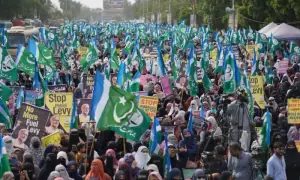
The return of violence to areas once declared cleared of terrorism is especially troubling. Last week, Swat suffered a devastating suicide bombing outside the Kabal police station. The attacker struck as participants were leaving the Swat People’s Peace Uprising, organised by residents and civil society groups alarmed by renewed terrorist activity in the valley. Seventeen people, including police personnel and civilians, were killed, while more than a dozen were wounded. Though there is confusion about whether the TTP had targeted the peace rally or the police station, whatever the group’s intentions, the attack raises a significant question about how and why the terrorists are increasing their operational base.
Balochistan, meanwhile, experienced one of its worst months of violence in recent years. July saw coordinated, high-impact attacks across Mastung, Lasbela, Ziarat, Kech and Khuzdar. These incidents demonstrated both the geographic reach of armed terrorist groups and their ability to challenge the state simultaneously in dispersed locations.
The security response was substantial. According to data maintained by the Pak Institute for Peace Studies, 26 anti-militant operations were recorded across Pakistan in July, compared with 24 in June. Conducted mainly by the army, Frontier Corps and police counterterrorism departments, these operations killed 205 terrorists. Eighteen operations took place in Balochistan and eight in KP. In Quetta and the adjoining Shaban and Hanna Urak areas alone, six operations reportedly killed 68 militants.
The country lacks a coordinated strategy that converts operational success into durable peace.
These figures reveal both capability and imbalance. Only five suspected terrorists were arrested during the month, all in Karachi. They were allegedly affiliated with the banned Balochistan Liberation Army, Jamaatul Ahrar and Lashkar-i-Jhangvi. The overwhelming ratio of deaths to arrests suggests an increasing reliance on lethal force and a weakness in the investigative, prosecutorial and intelligence-gathering dimensions of counterterrorism.
Arrests can expose facilitators, financiers, recruiters and communication networks; dead militants rarely do. Meanwhile, human rights groups continue to express concern over enforced disappearances, deepening mistrust in already alienated communities.
In KP, the threat remains centred on the banned TTP and allied factions, including the Hafiz Gul Bahadur group. Since violence resurged in 2021, attacks have been concentrated largely in the southern districts and former tribal areas.
Since early 2026, however, the operational map has widened. Militants are increasingly testing settled districts and extending networks towards Balochistan and potentially southern Punjab. Their continued mobility and logistical reach, despite sustained operations, show that they retain recruitment, facilitation and support structures.
Their tactics are also evolving. Suicide bombings, targeted killings and assaults on police and military installations remain central, but militants are increasingly experimenting with quadcopters and drones for explosive attacks. Government officials, civilians and public infrastructure are also being targeted. The objective is broader than producing casualties: it is to erode state authority, frighten communities and disrupt everyday governance.
Public anger over counterterrorism methods adds another layer of risk. The residents of Hassankhel recently protested outside the Peshawar Press Club against alleged drone strikes in their area. They claimed that civilians, including women and children, had been killed and that schools, mosques and roads had been damaged. Whether or not each allegation is established, such protests must be investigated transparently. Civilian harm, or even the perception that it is being ignored, provides militants with propaganda and weakens cooperation between communities and the state.
The regional dimension further complicates the challenge. Islamabad’s attempts to pursue Kabul on the TTP sanctuaries inside Afghanistan have not yielded results, and cross-border networks remain a major internal security concern. Still, escalating hostility with Afghanistan cannot substitute for a coherent domestic strategy. Border pressure may constrain the terrorists; it cannot repair governance deficits, police weaknesses or local alienation.
Recent counterterrorism operations in Bannu, Quetta and elsewhere confirm considerable operational capacity; however, whether these are translating into long-term success is not clear. The harder question is whether or not tactical successes are producing strategic stability. The evidence suggests they are not. Sanitising an area is not the same as securing it; killing militants is not the same as dismantling the ecosystem that sustains militancy.
In a similar context, Balochistan presents an even more complex landscape. Violent Baloch organisations operate alongside religiously inspired terrorist groups such as the TTP and IS-K. The province’s vast territory, difficult terrain and thin administrative presence allow militants to disrupt roads, movement and economic activity before security forces can respond. But geography explains only part of the problem. Political exclusion, socioeconomic deprivation, weak public services and a distrust of state institutions create openings that terrorists exploit, particularly among frustrated youth. Saner voices among politicians and intellectuals have long advised that a political solution must be given a full chance and should not be abandoned along the way.
Civilian governance must occupy the space recovered by security forces. Functional local administrations, reliable services, political engagement and employment opportunities can deny terrorists the grievances they weaponise. Communities should be treated as partners, not merely as populations to be controlled; their knowledge can strengthen early warning and prevent infiltration.
Pakistan’s problem, therefore, is not a shortage of operations. It is the absence of a coordinated strategy that converts operational successes into durable peace. Without accountable governance, political inclusion, capable policing, regional diplomacy and community trust, the state will keep clearing the same ground, and terrorists will keep returning to it. The stakes are now dangerously high nationwide.
The writer is a security analyst.
Published in Dawn, August 9th, 2026