

JI claims govt collected Rs1.9 trillion through petroleum levy last year
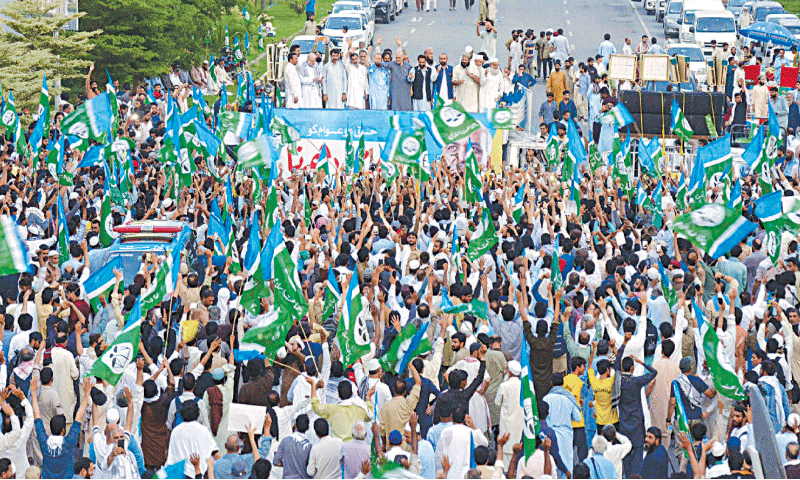

PESHAWAR: Jamaat-i-Islami has announced a nationwide protest on August 7 (Friday) against the rising oil prices and the fuel levy, with the party’s Khyber Pakhtunkhwa chapter planning to block major highways, including motorway interchanges, the Indus Highway and the Bab-i-Khyber crossing.
Addressing a news conference at Peshawar Press Club on Monday, JI Khyber Pakhtunkhwa Central chief Abdul Wasay alleged that the government had collected Rs1.9 trillion through the petroleum levy over the past year, including Rs1.2 trillion from people who were not regular taxpayers.
He was accompanied by provincial deputy chief Mian Sohaibuddin Kakakhel, former MNA Maulana Abdul Akbar Chitrali and Noorul Wahid Jadoon.
Mr Wasay claimed that oil prices had been increasing continuously since the Iran-Israel conflict, initially every week and now almost daily, and the government had imposed an additional financial burden on the public through the petroleum levy.
Plans countrywide protests on 7th
He said that according to a conservative estimate, around 30 million motorcycle riders across the country consumed at least a litre of petrol daily and paid Rs124 per litre in petroleum levy.
Criticising the government’s fuel pricing mechanism, Mr Wasay said the decision to revise petroleum prices daily had left consumers at the mercy of pump owners and a “petrol mafia”.
He alleged that while the government was quick to raise prices when international oil markets recorded slight increases, it did not pass on the benefit to consumers when global prices declined.
He also accused the government of obtaining loans from the International Monetary Fund, the World Bank and other international financial institutions under stringent conditions, alleging that the borrowed funds were lost to corruption while the burden of repayment was shifted onto the public through higher fuel prices and petroleum levies.
He further claimed that the ruling elite and bureaucracy were unwilling to reduce their own privileges and expenditures.
Mr Wasay said JI chief Hafiz Naeemur Rehman had called for nationwide protests on Aug 7 against the increase in petroleum prices and petroleum levy.
As part of the protest campaign, the party’s women wing will hold a demonstration on GT Road here on Aug 6.
He announced that on Aug 7, JI workers would block all interchanges on the Peshawar-Islamabad Motorway, the Indus Highway in Kohat and the Pak-Afghan Highway at Bab-i-Khyber in Jamrud. He said only ambulances would be allowed to pass during the protests.
Mr Wasay warned that if the government failed to reduce petroleum prices and abolish the petroleum levy, the party could launch the next phase of its campaign by announcing a march on Islamabad.
Published in Dawn, August 4th, 2026


























