DISCOURSE: THE STAMP OF A MASTER


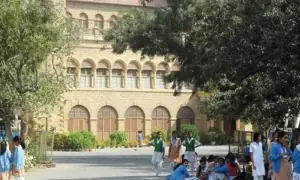
The first time I stood beneath the ceiling of the Sadequain Gallery at Frere Hall, I could not look away.
Arz-o-Samawat [The Earth and the Heavens] was Sadequain’s most ambitious mural and possibly his largest. His demise in 1986 left the mural permanently unfinished, and the empty blue space that remains gives the work a strange, mystic appeal, holding in itself the same intrigue that one might feel for the promised idea of heaven. Sadequain is said to have called it his own Sistine Chapel.
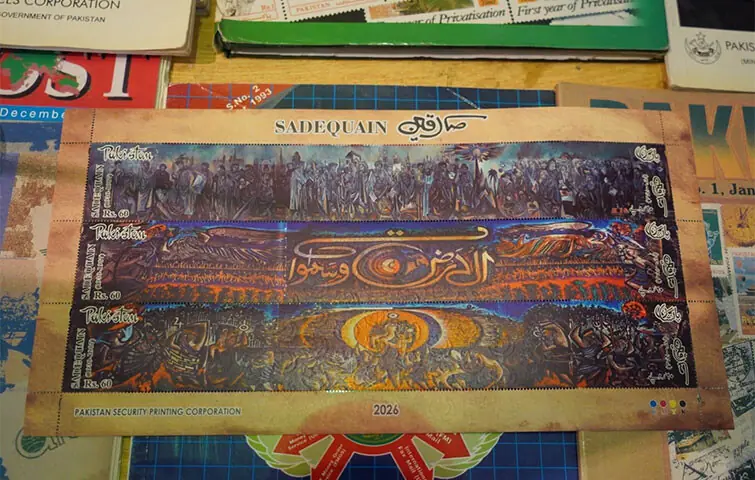
I came across the same mural again recently, in miniature, on a postage stamp. On June 30, 2026, Sadequain’s 96th birthday, Pakistan Post unveiled three record-length stamps in the artist’s honour at the Pakistan National Council of the Arts (PNCA), Islamabad.
Each stamp measures 280mm by 40mm, and a set of three stamps — billed as the longest in the world — are available on one perforated sheet. The stamp sheet itself features two panels from the Frere hall ceiling, alongside the entire length of another Sadequain mural, Treasures of Time.
Sadequain’s gift for scale and precision showed early. As a boy, he could reproduce entire schoolbooks by hand and taught himself to draw the world map from memory. He would fill the neighbourhood walls with charcoal birds and animals, much to his neighbours’ bewilderment and annoyance.
A reflection of that instinct for line and geography can still be traced in the details of the Frere Hall ceiling.
These early creative habits, alongside the history of his 1961 State Bank mural, Treasures of Time, were documented by his cousin Saiyid Ali Naqvi in his book Sadequain: Artist and Poet.
Four decades after his death, Sadequain’s monumental murals have found a new public canvas on Pakistan Post’s record-length stamps
The Treasures of Time mural is 62 feet long and eight feet wide, tracing the history of human thought from the fourth century BC to the 20th century CE across six panels: the Greeks, the mediaeval Italians, the Islamic world, the post-Renaissance Enlightenment, South Asia and, finally, Einstein, painted alone.
Forty-six figures appear along its length, among them Socrates, Leonardo da Vinci, Al-Biruni, Rumi and Rabindranath Tagore, each rendered as an impressionistic portrait identified by the tools or symbols of their calling.
Walking its length feels like walking through centuries. Sadequain placed himself in the mural too, a frail, sickly self-portrait, taking his own pulse before the ninth-century physician Al-Razi, reflecting his own appreciation and deep interest in the history of ideas he was painting.
Across his career, Sadequain is said to have produced more than 15,000 works. He gave many away freely, to friends, family and strangers alike, and chose to paint many of his murals inside public institutions rather than private galleries.
That instinct for accessibility shaped his legacy, even as, after his death, rising collector interest pulled much of his work into private hands and into the reach of forgers.
Sadequain was not just Pakistan’s foremost painter but a pioneer of modern South Asian art, and it is fitting that, even shrunk to a few centimetres on a postage stamp, the scale of his murals still comes through — although it does demand a record-length to hold them.
Stamps are made for public dissemination. Issuing one carries forward Sadequain’s belief in accessible art a step further, letting anyone possess a piece of his work that is otherwise locked inside a gallery or private collection.
At a moment when national narratives are so often shaped from above, the choice of what represents a country’s visual identity matters.
The recent digitisation of Sadequain’s artworks at the Lahore Museum is another attempt at increasing the broad appeal of his work. In choosing Sadequain, the state has honoured a national icon and set a quiet example for what Pakistani art can still claim as its own.
The writer is a university student with an interest in art, culture and urban history. He can be contacted at pakistaniumer04@gmail.com
Published in Dawn, EOS, July 26th, 2026