Five injured in building collapse incidents during rain in Jhelum district
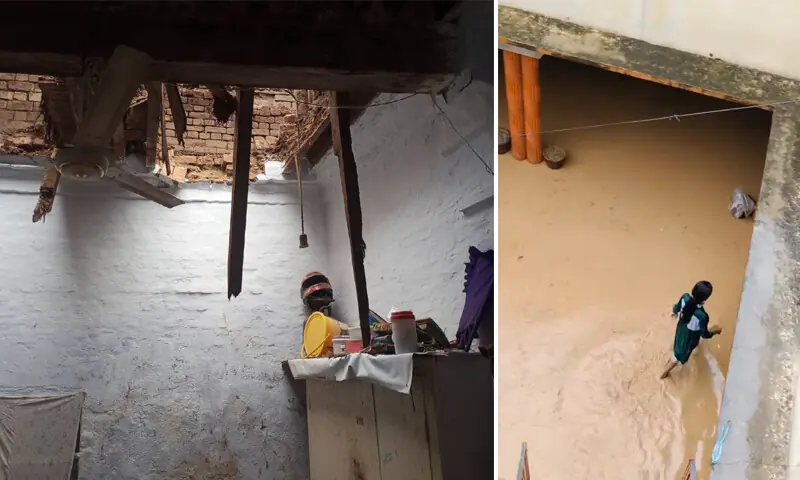

JHELUM/RAWALPINDI: At least five people, including a woman, were injured when a timber workshop and a house collapsed during rainfall in Pind Dadan Khan town of Jhelum district on Saturday.
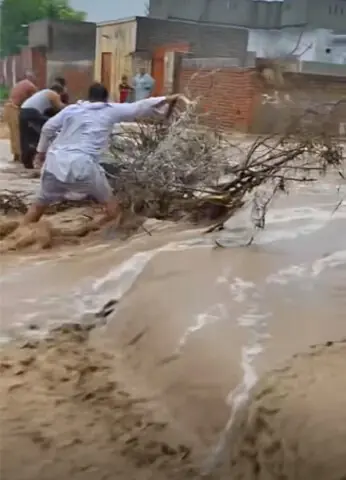
Moreover, floodwaters from hills entered houses in Dilawar, Chitti Rajgan and Dhoke Araiyan villages of Pind Dadan Khan tehsil.
According to residents, the timber workshop collapse left four people buried under the debris. In another incident, a woman was injured when a house collapsed in the Alam Shah town of Pind Dadan Khan. Assistant Commissioner Ayesha Shafqat said the injured were shifted to the Civil Hospital for treatment.
Meanwhile, villages along the Lillah Jhelum dual carriageway and the newly-constructed Jalapur canal in Pind Dadan Khan were hit by flash floods from the mountains of Salt Range.
According to residents of Dilawar village, faulty construction of drains caused the floodwater to run into their houses, leaving them on the verge of homelessness. The residents of Chitti Rajgan had already staged a protest rally on the dual carriageway, seeking the help of the Punjab government to protect their homes, as due to the rising level of the carriageway rainwater was entering their homes and spoiling agricultural lands. On the other hand, the collapse of homes in Khewra, Kaliwal and other areas of Pind Dadan Khan tehsil was also reported.
In the Dumgi area of Daultala, closure of the culvert for the rain drain led to water entering houses.
Floodwater from hills enters houses in Dilawar, Chitti Rajgan and Dhoke Araiyan villages of Pind Dadan Khan
Rawalpindi
Meanwhile, light to heavy rainfall lashed the twin cities of Rawalpindi and Islamabad on Saturday morning.
The rain started at 8am and continued till the afternoon with occasional gaps. The weather cleared in the evening.
As a result of the rain, the temperature dropped to 27 degrees Celsius while more rains have been predicted in the next 24 hours.
The Met Office recorded 13mm rain at Chaklala, 10mm at Shamsabad, 9mm at Kutchery, 7mm at Gawalmandi, New Kattarian and 6mm at Pirwadhai while in Islamabad 12mm rain was recorded at Saidpur, 11mm at Zero Point, 5mm at Bokra, 3mm at Golra and 1mm at the airport and 12mm in Murree.
The Met Office said a low-pressure area was located over southwest Rajasthan and adjoining areas. Due to this, monsoon currents are continuously penetrating in southern and central parts of the country.
Partly cloudy weather with rain-wind/thundershowers is expected at isolated places in southeastern Sindh, upper and central Punjab, upper Khyber Pakhtunkhwa, Kashmir and northeastern/southern Balochistan.
Heavy rainfall is likely at isolated places in southeastern Sindh, Kashmir and northeastern/central Punjab.
The Met Office warned that on Sunday heavy rainfall may cause flash flooding in streams/nullahs of Kashmir and hill torrents of Dera Ghazi Khan and northeastern Balochistan.
It said heavy rainfall may trigger urban flooding in low-lying areas of Sindh, Gujranwala, Lahore, Sialkot, Gujrat, Sahiwal, Sargodha, Jhangand Faisalabad. Heavy rainfall, strong winds and lightning may damage vulnerable structures, including solar panels, electric poles, billboards and other weak installations.
Meanwhile, residents of several localities in Rawalpindi Cantonment are facing severe hardship due to frequent power tripping, voltage fluctuations due to the alleged negligence of the authorities in addressing consumer complaints.
The affected residents called for an immediate and permanent solution to the issue.
Commissioner Salman Ghani visited Gawalmandi bridge at Leh Nullah to review water flow, drainage and monsoon arrangements. Officials from Wasa, Rawalpindi Waste Management Company, Civil Defence, Rescue 1122, Rawalpindi Municipal Corporation and other departments were present.
He directed departments concerned to remain on high alert throughout the monsoon season and ensure complete preparedness to handle any emergency situation.
The commissioner directed Wasa to continuously monitor Leh Nullah at Gawalmandi and other locations and keep a close watch on the water flow. All disposal stations, heavy machinery, dewatering sets and other essential equipment must remain operational and available in the field at all times.
Published in Dawn, July 26th, 2026