Plea for release of prime suspect in Karachi's Rs8.5bn Yellow Line scam rejected


 0
0


KARACHI: A provincial anti-corruption court on Wednesday dismissed an application of Bus Rapid Transit (BRT) Yellow Line project director Zameer Abbasi seeking discharge from the Rs8.5 billion corruption case.
The court also extended his physical remand for three more days.
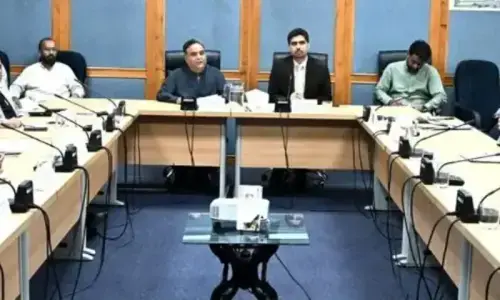
On Wednesday, the investigating officer, Inspector Sher Zaman, produced Abbasi, a grade-19 officer, before Special Anti-Corruption Court Judge Muhammad Aminullah Siddiqui and sought extension in his custody.
The IO also submitted the interim charge sheet in court.
At the outset of the hearing, the court expressed dissatisfaction with the performance of the IO and summoned the director general of the Anti-Corruption Establishment (ACE).
Court extends physical remand of suspect Abbasi for three more days
After a short adjournment, the DG appeared before the court and informed it that the relevant documents required for the investigation had been obtained, while the evidence and contracts were being reviewed.
He also informed the court that a combined investigation team had been constituted by the ACE to probe the case.
At that point, suspect Abbasi intervened and submitted that during the nine-day remand period, the IO had asked him 14 questions, all of which he had answered.
The court heard arguments from the defence counsel and state prosecutor Talib Ali Memon on the application filed under Section 63 of the criminal procedure code, seeking discharge of suspect Abbasi from the case.
The prosecutor opposed the application and maintained that the suspect had been specifically nominated in the FIR, with clear and direct allegations regarding his active involvement in the commission of the offences.
He argued that the application was misconceived, premature and not maintainable at this stage, adding that granting such a relief could hamper the ongoing investigation and may result in the disappearance of crucial evidence or influence witnesses.
On the other hand, the defence counsel opposed the extension of the suspect’s physical custody and argued that his client should be discharged from the case.
The counsel contended that the FIR deserved to be discarded at the threshold as it did not contain any foundational facts constituting the alleged offences and was based entirely on inferences, assumptions and conclusions drawn by an inquiry committee.
He further argued that the allegation that public funds approximately Rs8.5bn were misappropriated, embezzled or lost to the national exchequer was demonstrably false and contrary to the record.
He added that the project accounts, banking records, payment instruments, monthly progress reports and other contemporaneous documents established that all disbursements made to contractors were duly recorded, accounted for and reconciled.
After hearing both sides, the court dismissed the application and extended the physical custody of the suspect for three days and directed the IO to produce him at the next hearing along with a progress report.
In its detailed order, the court noted that the investigation was still in progress and further evidence was yet to be collected.
The order states: “The allegations in the present matter pertain to corruption, abuse of official authority and misuse of public office, which strike at the very foundation of good governance and public confidence in state institutions.
“Corruption is not merely an offence against an individual; it is an offence against society at large and the public exchequer. The courts are, therefore, under a constitutional and legal obligation to ensure that allegations of corruption are investigated carefully and brought to their logical conclusion.
“If, despite the existence of prima facie incriminating material and the pendency of investigation, the accused is discharged at this stage, it would amount to frustrating the lawful process of investigation and servants to evade accountability merely by seeking premature discharge before the investigating agency completes its task.
“Such an approach would not only defeat the ends of justice but would also erode public confidence in the system of accountability. The court cannot permit the statutory process to be short-circuited in this manner,” the court order concluded.
Published in Dawn, July 2nd, 2026