0
0

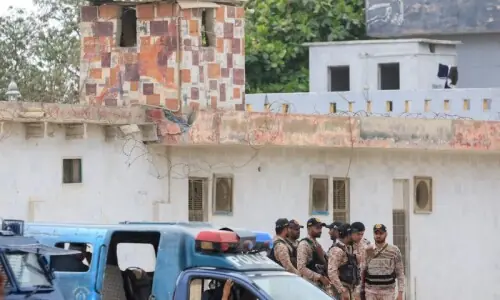
BAGHDAD: Iraq’s government has given pro-Iran armed groups in the country until September 30 to disarm, coinciding with the end of the US-led coalition’s mission, its spokesman said on Monday.
The announcement comes ahead of a visit to the United States by new Prime Minister Ali al-Zaidi, with Washington exerting pressure on Baghdad to ensure the factions turn in their weapons.
“All the armed groups have been informed of a specific date that marks the end of this issue (of disarmament)... which is September 30, which also marks the end of the international coalition’s presence,” government spokesman Haidar al-Aboudi said in a weekly press conference. “After this date, all weapons outside the state framework will be subject to legal redress,” he added. Iraq is home to several powerful Iran-backed armed factions, which have seen their political and financial clout increase over the years.
Many emerged in the wake of the 2003 US-led invasion of Iraq and gained further power and prominence during the fight against the militant Islamic State group from 2014 onwards.
They have long called for the withdrawal of American troops deployed within the anti-jihadist coalition, and they have frequently hit bases hosting US troops.
During the Middle East war, they have intervened in support of Tehran, targeting US facilities in Iraq more than 600 times. They also hit targets in Gulf countries.
Washington in turn launched its own attacks on the factions, before withholding cash payments for Iraqi oil revenues, which are largely at the Federal Reserve Bank in New York under an agreement reached following the invasion.
In early May, Washington pledged to resume financial transfers to Iraq and security assistance once “concrete steps” had been taken against the groups.
During a meeting with European ambassadors Monday, Zaidi “stressed that confining arms to the hands of the state is not merely a slogan, but a policy already being implemented,” according to his media office.
“The government remains committed to this course, particularly as Coalition forces are scheduled to complete their withdrawal by September 30,” said Zaidi, who recently took office with the blessing of the United States. Powerful Iraqi politicians have also called for a state monopoly on weapons.
While some armed groups announced they will cooperate to hand over weapons to the state, others remain adamant that the issue should not be discussed under US pressure.
Iraq has long been a proxy battleground for Iran and the United States, with Baghdad trying to walk a fine line between its two key allies but mutual enemies.
FM’s visit to Syria
Iraqi Foreign Minister Fuad Hussein on Monday discussed cooperation including on energy on his first trip to Syria since the December 2024 ouster of longtime ruler Bashar al-Assad.
Relations between the two countries have faced upheaval since the fall of Assad, who was a close ally of previous governments in Baghdad. During the visit, Hussein met with his Syrian counterpart Asaad al-Shaibani and Syrian President Ahmed al-Sharaa, according to Syrian state media. A joint statement issued by both sides said Hussein and Shaibani discussed “ways to strengthen bilateral relations between the two countries and develop joint cooperation in various fields”. The two sides also agreed to establish a joint committee overseeing energy, agriculture, water, transport and border crossings.
They also discussed “mechanisms for the transit of energy supplies and a project to rehabilitate the oil pipeline linking Iraq and Syria”, according to the statement.
Iraq at first approached new ruler Ahmed al-Sharaa cautiously but is now seeking to bolster trade and security cooperation with Syria, which is emerging from years of civil war. An Iraqi diplomatic source earlier said that Hussein would meet Sharaa and Shaibani, as well as Energy Minister Mohammad al-Bashir.
A statement from Hussein’s office meanwhile said the visit seeks to “deepen joint cooperation in various political, security, economic and trade fields” and address regional and international developments.
With its oil exports disrupted due to the Middle East war, Iraq in recent months has begun exporting limited amounts of oil through Syria. Hussein is the first senior Iraqi political figure to visit Damascus since the new authorities took power, though other Iraqi officials have done so.
Published in Dawn, June 30th, 2026