Diplomats scramble as doubts persist over Lebanon truce

• US, Qatari officials engage Lebanese president, discuss creation of ‘deconfliction cell’
• Ceasefire largely holds; isolated Israeli fire, drone activity, warning shots reported
BEIRUT: A ceasefire largely held in Lebanon on Monday, marking the longest lull in three months of war between Hezbollah and Israel, even as persisting fears of a collapse kept displaced residents from returning, while Lebanese president discussed the truce with US and Qatari officials.
While adherence to the ceasefire was “almost total” since Saturday evening, a senior Lebanese security official said an Israeli tank fired shells toward a village near Tyre. Israeli forces also fired sound grenades in two other locations on Monday, and an Israeli drone buzzed over Beirut.
Hassan Wazni, director of a hospital in the heavily bombarded southern city of Nabatieh, said calm had prevailed since Saturday.
“I’m monitoring the situation day by day, and most of the time I’m sleeping in the hospital. This is the longest a ceasefire has held,” Wazni said.
However, people remained hesitant to return, he noted, as a prior ceasefire declared on Friday quickly collapsed, leaving 20 people dead in Israeli attacks Saturday, according to Lebanon’s civil defence.
“People are still uneasy,” Wazni said. The municipal council of Zawtar El Charqiyeh warned residents on social media against returning until it is safe to do so.
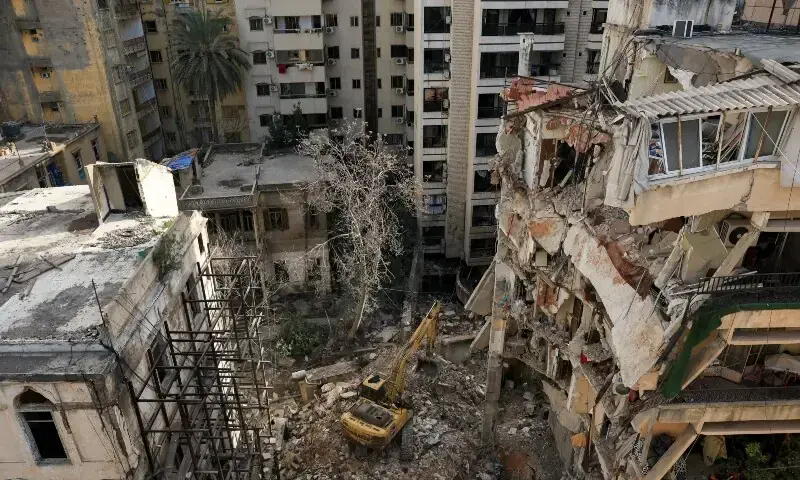
Israeli forces remain deployed deep inside southern Lebanon, occupying a self-declared security zone where they have been razing villages.
Israeli Prime Minister Benjamin Netanyahu said troops retain full freedom of action to thwart any Hezbollah threats and will remain in Lebanon for “as long as is necessary”, while Hezbollah chief Naim Qassem rejected any Israeli “security zone” inside Lebanon.
Israeli strikes and clashes with Hezbollah late last week threatened to derail the deal after Iran said it had closed the strategic Strait of Hormuz again in response to Israel’s attacks.
However, Israel lifted safety restrictions in eight border communities early on Monday.
Diplomacy
Meanwhile, Lebanese President Joseph Aoun discussed efforts to consolidate the ceasefire and halt Israeli military escalation during a phone call with US Vice President JD Vance, senior adviser Jared Kushner and Qatari Prime Minister Sheikh Mohammed bin Abdulrahman Al Thani.
They discussed “the issue of consolidating the ceasefire in Lebanon, stopping the Israeli military escalation and steps that should be taken in this regard, including the possibility of forming a cell for this purpose,” the statement from the Lebanese presidency said.
After a first round of US-Iran talks in Switzerland aimed at ending the broader Middle East war, mediators Pakistan and Qatar announced that Tehran and Washington had agreed to set up the cell while Iran’s Foreign Minister Abbas Araghchi wrote on X: “1st real test: Lebanon deconfliction cell.”
Vance told reporters in Switzerland that the mechanism aims to ensure “that when things happen, they don’t spiral into a broader escalation.”
“We do believe … that we can get to a place where Lebanon’s territorial integrity and sovereignty is protected, Israel’s security is protected,” Vance said. “That’s going to require some coordination with the Lebanese armed forces, and also it’s going to require the Iranians to rein in Hezbollah.”
Under US pressure, Lebanese officials began direct talks with Israel in April, with a fifth round scheduled for today.
Lebanese authorities are seeking the withdrawal of Israeli troops and to separate their negotiations from the US-Iran deal.
“We negotiate for ourselves, and we do not accept any other party doing so for us,” Aoun said. “We welcome any assistance … but there is a big difference between trying to help us and interfering in our internal affairs,” he added.
Published in Dawn, June 23rd, 2026