The Khyber Pakhtunkhwa government, in its Rs2.12 trillion budget for the next fiscal year, has set an ambitious target of collecting Rs182 billion in own tax and non-tax revenues. Total expenditures are projected at Rs2.17tr, leaving a deficit of Rs48bn.
For a resource-poor province like KP, which depends on federal transfers for around 90 per cent of its revenue, the aggressive push to expand own-source revenue is the only silver lining in an otherwise expenditure-heavy budget.
Budget documents show that provincial own receipts have been projected at Rs182.4bn for FY27, comprising Rs115.9bn in tax revenue and Rs66.5bn in non-tax revenue. Compared to the FY26 budget estimate of Rs129bn, this reflects a projected increase of 41.3pc, indicating efforts to strengthen domestic resource mobilisation and improve revenue administration, according to the finance department’s white paper.
Tax revenues have been budgeted at Rs115.9bn, up 38.8pc from last year’s estimate of Rs83.5bn and 32.6pc higher than revised estimates of Rs87.4bn. Within this, indirect taxes continue to dominate the structure, accounting for 91pc of total tax receipts, while direct taxes contribute just 9pc. Sales tax on services alone makes up nearly 47.8pc of total tax revenue, underlining its central role in provincial collections.
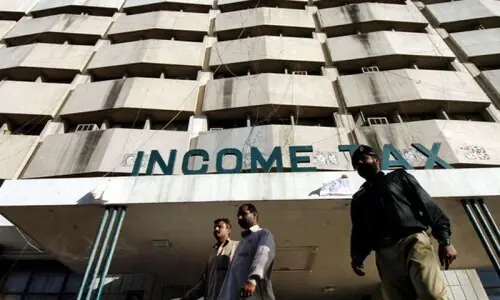
The KP budget’s provincial own receipts have been projected to increase by 41.3pc, indicating efforts to strengthen domestic resource mobilisation
Non-tax revenues are projected at Rs66.5bn, a rise of 46.1pc over last year’s budget estimate of Rs45.5bn and 26.9pc over revised estimates of Rs52.4bn.
The budget also outlines a reform agenda for the KP Revenue Authority, anchored on broadening the tax base, strengthening enforcement, advancing digital integration, and improving taxpayer facilitation. A flagship initiative for the year is the proposed Public Participation and Whistleblower Incentive Framework, under which citizens will be financially incentivised to report tax evasion, fake invoicing, point-of-sale manipulation, and other fraudulent practices — significantly enhancing market intelligence and deterrence.
At the same time, Chief Minister Afridi announced that no new taxes will be imposed in the next fiscal year. He also proposed reducing the infrastructure development cess from 2pc to 0.75pc, arguing that it would lower the cost of doing business, attract investment, and stimulate economic activity. The cess, which was projected to generate Rs10bn in the current fiscal year, was revised down to Rs7bn due to prolonged border closures and disruptions in cross-border trade with Afghanistan.
The budget also offers a series of relief measures. Properties up to five marlas have been exempted from property tax, a move expected to benefit nearly 200,000 households. Hotel bed tax has been reduced from 7pc to 5pc. Tax exemptions for the merged districts and Malakand division have also been maintained, with no new taxes imposed on these regions.
Chief Minister Afridi also raised concerns over the delay in finalising the 11th National Finance Commission (NFC) Award, saying it was contributing to a sense of deprivation in the merged areas. He noted that Prime Minister Shehbaz Sharif had, during a recent National Economic Council meeting, indicated that the NFC Award could be finalised within six months, and warned that if delayed further, the merged areas’ share could be adjusted within KP’s existing 7th NFC allocation. “We demand the finalisation of the 11th NFC Award within the same timeframe promised by the prime minister,” Mr Afridi said.
Adviser to the Chief Minister on Finance, Muzzammil Aslam, told Dawn that KP’s own-source revenue had risen from Rs97 billion to Rs129 billion in the current fiscal year, and is expected to increase by another Rs52 billion in the next fiscal year.
He said the jump was driven by improved revenue mobilisation across departments, including gains from the debt management fund, which is expected to generate Rs30 billion in savings. He added that funds previously retained by the forest department and Pakhtunkhwa Energy Development Organisation (Pedo) are now being routed through the provincial treasury.
The Excise and Taxation Department, he said, also exceeded its target, generating Rs10bn against a Rs7bn target, while digitalisation measures have further strengthened collections.
On the relief side, Mr Aslam said the budget aims to expand public welfare programmes, with the Sehat Card Plus allocation increased from Rs40 billion to Rs50 billion. The government also plans to introduce free WiFi in the provincial capital to promote digital access, along with student loan schemes and financing programmes for overseas Pakistanis.
Published in Dawn, The Business and Finance Weekly, June 22nd, 2026