PCB unveils new framework for awarding central contracts from next fiscal year

LAHORE: The Pakistan Cricket Board (PCB) on Monday unveiled a new framework for awarding central contracts to players from the next fiscal year beginning July 1, 2026, while making no changes to either the national selection committee or the coaching staff.
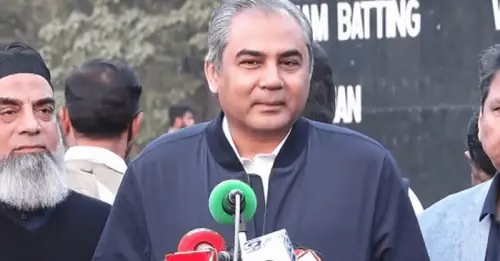
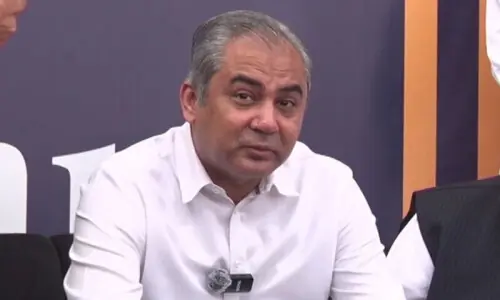
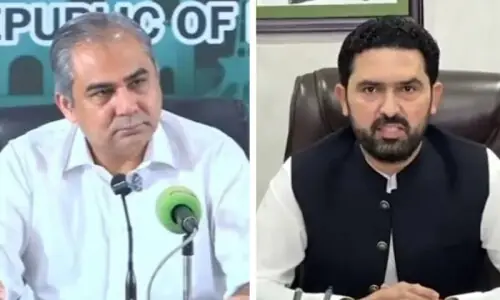
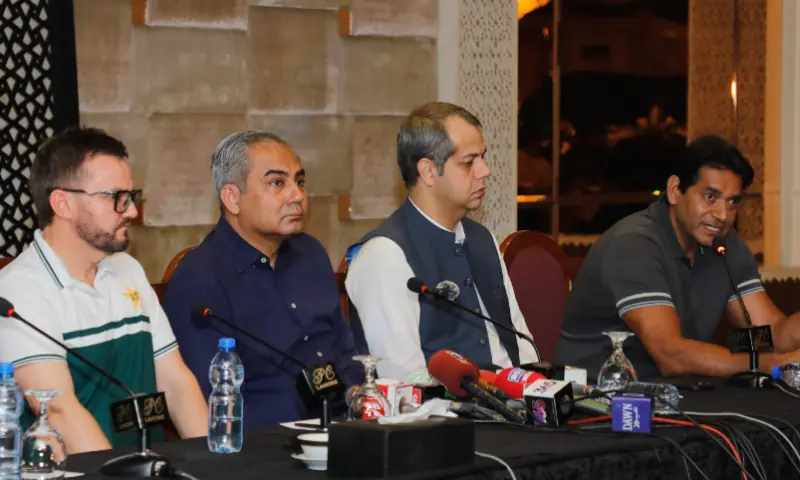
PCB Chairman Mohsin Naqvi, at a press conference held at a local hotel, made the announcements. He was accompanied by the High Performance Centre Director Aaqib Javed, white-ball head coach Mike Hesson, PCB Chief Medical Officer Dr Javed Mughal and other officials.
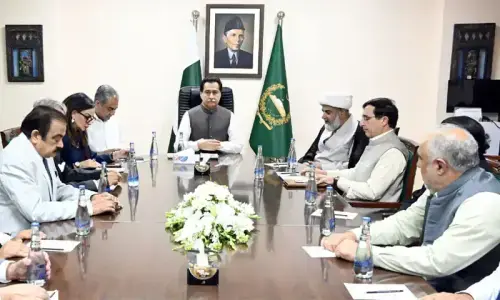
Earlier, the PCB chairman also met all 49 players of Pakistan’s red- and white-ball squads, who are currently attending training camps in Lahore, and briefed them on the new central contract system.
Interestingly, Naqvi had hinted during a media briefing on Saturday that several changes could be made within the PCB set-up. However, Monday’s announcement focused primarily on reforms to the central contracts system.
Under the new structure, players will be placed in five categories instead of the previous four. The categories are Track AB, Track A, Track BC, Track C and Track D.
In a press release, the PCB said that Track AB is a dual-format category covering Test and One-day International (ODI) cricket.
“Pakistan’s premier multi-format cricketers — the players who carry both the Test and ODI sides. This is the board’s highest commitment tier. The board does not regard an AB cricketer as a short-format player. That call is only made when selection options require it, never as a default,” the PCB stated.
Track A is reserved for red-ball specialists.
“The dedicated Test cricketers. This track exists to recognise and protect players who devote themselves to the longest format, and it carries permissions designed to keep them playing red-ball cricket at the highest level,” the PCB explained.
Track BC is designated for white-ball specialists who play ODI and T20 International cricket.
“The core white-ball track for players whose value to Pakistan lies across the limited-overs formats. This is where most white-ball cricketers will sit, and it absorbs what used to be a separate ODI category,” the PCB said.
Track C has been created for T20 franchise specialists.
“The dedicated short-format players, with the greatest freedom to pursue franchise cricket around their national commitments — a formal and respected recognition of T20 specialisation.”
Meanwhile, Track D will serve as a development category.
“A development track for the next generation, investing in young players through the National Cricket Academy and the wider high-performance system.”
The PCB also outlined two key principles underpinning the new framework. First, players will only be assessed against others within the same track, and not against players committed to different formats. Secondly, each senior track will have two internal tiers, allowing a player’s standing to rise or fall based solely on performance, without requiring a change in playing format.
The Development Track will remain a single tier.
“The board will not disclose how contracts are distributed within each track. The number and distribution of contracts is a selection matter, reviewed each cycle and not a fixed public figure,” the PCB said.
Giving particular emphasis to Test cricket, the cricket board highlighted a major policy shift under which dedicated Test specialists will be allowed to participate in overseas first-class competitions.
“For the first time, Pakistan’s dedicated Test specialists are being granted permission to play overseas first-class cricket in the premier red-ball competitions of the world’s leading nations,” the PCB maintained.
The board stressed that the move was aimed at strengthening, rather than undermining, Test cricket.
“This is the opposite of sending players away to the shorter game. It is a deliberate investment in red-ball quality. A Test cricketer who spends time in the most demanding first-class environments returns sharper, tougher and better prepared for Pakistan. The permission is for red-ball cricket only — franchise T20 leagues remain closed to this group. Pakistan is not just protecting Test cricket on paper; it is actively creating the conditions for its Test players to become the best in the world at what they do,” the PCB added.
Meanwhile, Naqvi said player selection would be largely data-driven, with analytics carrying an 85 per cent weightage in selection decisions and selectors accounting for the remaining 15pc.
He said fitness and medical assessments, mandatory participation in domestic cricket, and on-field performances would form the basis of selection for national teams.
Naqvi maintained that the new system was built around accountability.
“Assessment is structured rather than impressionistic. The process is documented and no single individual’s preference determines an outcome. Players are recognised for the commitment they make and the cricket they play, and the board can stand behind every decision it takes,” he said.
The PCB chairman added that the board was providing all possible facilities to players.
He acknowledged that while Pakistan had produced encouraging results in bilateral series, performances in major tournaments, including International Cricket Council and Asian Cricket Council events, had fallen short of expectations.
“Work is underway to improve results in those tournaments as well,” he said.
Former Pakistan fast bowler and current selector Aaqib Javed said the reforms would make Test cricket more attractive for players through improved financial incentives, including enhanced match fees.
However, he cautioned against expecting immediate results.
“No one can guarantee that the team will start winning within a specific timeframe or that it will not lose matches in the future,” Aaqib said.
Hesson expressed confidence that the reforms would help Pakistan achieve the desired results in the long term.
Responding to a question, Dr Mughal said it was not possible to conduct players’ physical fitness tests in front of the media, a practice that the PCB had followed in the past.