KARACHI’S HALL OF MEMORY
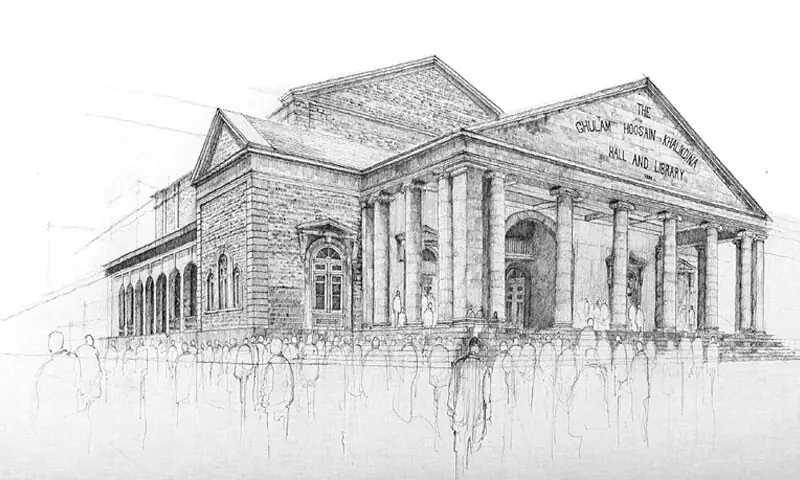


This year marks the 120th anniversary of the opening to the public of Karachi’s Ghulam Hoosain Khalikdina Hall and Library. It is a historical landmark, an architectural singularity. But it was an existence I was unaware of for most of my 30 years of living in Karachi.
That is, until six years ago, when the Earth and its humans were forced to still themselves, to enter into the realm of interiority during the coronavirus pandemic. When we collectively thought how very brittle and ephemeral our lives are. This is the story of how I became acquainted with this famed building.
CITY OF EARLY MEMORIES
Back during the stillness of the pandemic, I was called upon by the universe to become a repository of ancestral memories that no longer seemed middle class, monotonous and worthless. It meant an examination. Of newsroom and reporting life. The environment had pulverised me. I overcame the fear of the unknown and walked away.
Post-resignation, my early years of reporting excitement and nervousness returned. I set about interviewing my maternal relatives, scattered here in Pakistan and in North America. We went back in time to the mid-1950s. Ammi and her eldest brother narrated their first impressions of Karachi.
With their parents and four younger siblings, they had boarded a train from Lucknow, India. They had bid goodbye to their ancestral abodes and birthplaces, and disembarked in the newly formed country, Pakistan, at Karachi’s Cantt Station.
As Karachi’s 120-year-old Ghulam Hoosain Khalikdina Hall and Library finds a new lease of life and becomes a public space again, forgotten histories reveal how the city’s past continues to inhabit its present. From Partition-era recollections and Maulana Mohammad Ali Jauhar’s trial to art festivals and restoration projects, the story of Khalikdina Hall mirrors the many lives of Karachi itself
This Lukhnavi family, whose children had nicknames such as Jummu (Ammi’s eldest brother) and Jummi (my mother), had moved in temporarily with their relatives in a double-storeyed pre-Partition building on Bunder Road. The Pakistani government had perhaps allotted it to the relatives in exchange for their house in Allahabad in India. There they ran a stationery shop and were exclusive sellers of Parker and Sheaffer fountain pens. Jawaharlal Nehru and his daughter Indira Gandhi were their clients in the 1930s.
The Allahabadi relatives’ eldest daughters, nicknamed Chunni and Munni, told their new housemates that their current abode was once the residence of a Hindu family that had fled to India. Perhaps the family was forcibly evicted when anti-Hindu riots broke out in Karachi in early 1948. We don’t know. Nobody remembers. The minds of Chunni, Munni, Jummu and Jummi now swirl with mottled memories.
Before it became inevitable that India and Pakistan were to suffer the trauma of Partition, Karachi was a Hindu-majority city and the capital of Sindh in 1937, after the province was separated from Bombay. Within a few months of the 1947 estrangement, there was the beginning of an exodus of Muslims from India into Pakistan. By 1955, Karachi was substantially Muslim and eight years had gone by since it was anointed as the official capital of the new country.
Chunni and Munni showed off a large traditional jhoola [swing] in their new home. They confessed that it did not belong to them but was abandoned by the former residents who left with bare belongings. On such a swing, siblings and cousins likely played card games, completed homework, soothed crying infants, read books and newspapers. Perhaps younger children rocked it vigorously as adults rested at noon.
Through the apartment’s latticed balcony, the children viewed the shaggy-headed banyan trees. With their broad, thick parrot-green leaves, the trees stood tall on the wide Bunder Road that was constructed to connect directly to the Keamari Port. At the time of Partition, millions of tons of cargo were transiting annually through its port, opening into the immense Arabian Sea. ‘Bunder’, they were told, meant a naval harbour and not ‘monkey’, as they thought when they first heard its name.
They observed men going into a hotel, uniformed waiters expertly holding salvers of curries and rice high on the palm of their hands. Looking up, the children saw a majestic building, the Khalikdina Hall and Library. “This is where Mohammad Ali Jauhar’s treason trial took place,” piped one of them.
Tak-takakat-tak-takakat! From below the balcony. “What is this sound?” asked 12-year-old Jummu. Men were hammering away. They were beating silver foils into chandi ke varq — the gleaming silvery bits that decorated barfi and home-made kheer.
The children were called for dinner. On the dastarkhwan, placed on the floor, were bowls of rich mutton qorma, a platter of warming chicken biryani and stacks of aromatic sheermal. They were told the sumptuous food was from the Delhi Muslim Kali Hotel, whose waiters they had just seen.
After dinner, when they visited the toilet to wash-up, they heard booming sounds of men and women talking, emanating from the walls. Petrified, they rushed out. They were duly informed:
“These are dialogues that you are hearing.”
“Dialogues?”
“Yes, from the picture they are showing at the Ritz Cinema next door. We share the same wall.”
The next evening, the hosts took the visitors to stroll around Bunder Road and the Arambagh quarters. The older women put on their burqas and joined in. They crossed the wide road and stepped inside the Ghulam Hoosain Khalikdina Hall and Library. Inside the hall with high ceilings were huge pictures of the brothers Maulana Mohammad Ali Jauhar and Maulana Shaukat Ali, leaders of the Khilafat Movement, and their mother Bi Amma, their source of inspiration.
In his reminiscence of the eminent journalist and poet Maulana Mohammad Ali Jauhar, scholar Maulana Abdul Majid Daryabadi claims there was a time when every household in India was echoing with this song: “Boli amma Mohammad Ali ki/ Jaan beta khilafat pe de do [Said the mother of Mohammad Ali/ My son, lay down your life for the khilafat].”
In 1911, Mohammad Ali had started the English newspaper Comrade, with himself as its editor, stating, “The affairs of my [Muslim] community just at that juncture made it the only avenue through which I could prove of any appreciable use. I felt I should assist my community in taking its proper share in the political life of the country.”
By 1921, the British colonial authorities were livid with Mohammad Ali, with Jauhar as his nom de plume. According to them, Muhammad Ali had delivered a seditious speech against them at a Khilafat Conference in Lyari, declaring it haraam [forbidden] for Muslim soldiers in the British Army to wage war against Muslim nations. He was arrested for incitement to mutiny and brought to Karachi for trial at the Khalikdina Hall, along with six others. He was sentenced to two years of solitary imprisonment with hard labour.
As the strollers stepped out of the hall, Karachi’s gentle sea-breeze embraced them. The veils of the burqa-clad women fluttered. It was the visitors’ first experience of the famous ocean-breeze. Rows of shacks filled with old and new books, some well-known booksellers — such as Ferozsons publishers, the Taj Company and Oxford Press — lined alongside the Khalikdina Hall. A mosque, a cinema that showed only English films, Burnes Garden and a shop that sold burqas were some of the evening sightings. Karachi was alluring. A city that promised endless discoveries.
A few months later, the Lukhnavi family found permanent accommodation in Malir Halt’s Telephone and Telegraph Colony and moved out.
THE PAST IS ALWAYS PRESENT
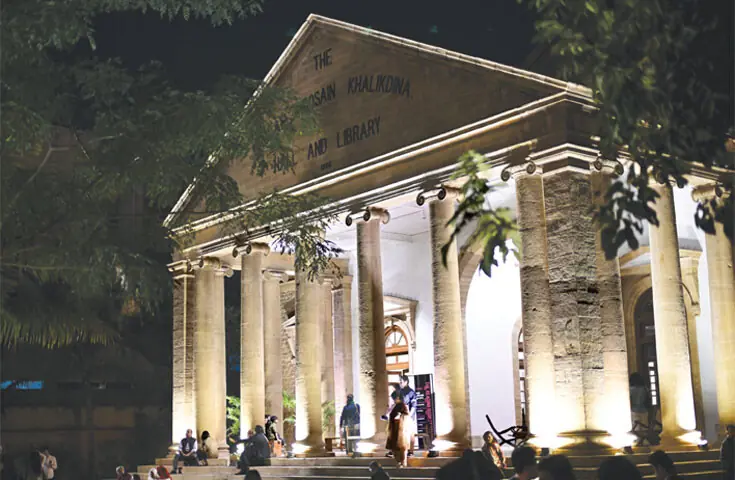
Outside the tall fence metal gate, last November, the air pressed cold against my naked 50-something arms. Upon entering the walkway, my gaze fell on tanned colonnades crowned with a Greek-style pediment. The words plated over it came into view: The Ghulam Hoosain Khalikdina Hall and Library 1906. My proofreading instinct urged undoing of the British colonial spellings: Hoosain to Hussain and Khalikdina to Khaliqdina.
Its Palladian architecture evoked memories of the Pantheon in Rome, which I visited in 2011 with a sister whose relentless pompous commentary provoked me to nearly throttle her. The Roman Pantheon is said to be one of the most imitated buildings in history. In Karachi, we see its reflections in the DJ Science College and the Sindh High Court. This architectural style, with its design of a portico and free-standing columns, conjured power. Standing beneath the colonnades, it evoked one’s brittleness in the larger scheme of things.
I was here because of an invitation to meet the recently renovated Ghulam Hoosain Khalikdina Hall. Also, ostensibly, to attend the Reading Room Festival at the premises. It was organised by the Karachi Metropolitan Corporation (KMC) and Numaish Karachi, a collective dedicated to opening heritage spaces to the public, and its joint custodian until 2027.
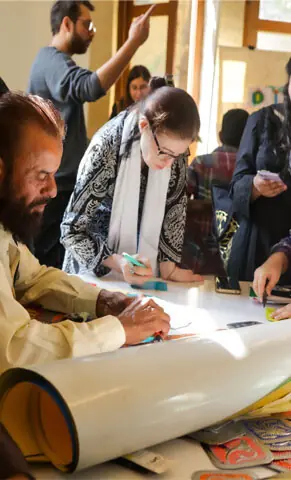
Upon ascending the long horizontal steps, I saw pre-teen girls and boys in school uniforms gathered around musicians, seated on a takht, singing “Dil, dil Pakistan”, laughing and clapping. On the left was the library, spruced up with new bookshelves. Today, it was a space of hands-on workshops on several tables. Curious participants explored truck art, block-printing, pencil-shaving, basket-weaving and cross-stitching, taught by master craftsmen and upcoming crafters.
The descendant in me wanted to escape. To cross the road now known as Mohammad Ali Jinnah Road (or M.A. Jinnah Road), and search for the Lukhnavi family’s discarded routes. But the past was abandoned for the present, as I reconnected with journalist colleagues who arrived to attend the festival. Pleasant was the experience, but it reaffirmed my decision to leave journalism. For me, journalism was an afterthought. A final attempt in choosing a long-term profession after earlier trials in administrative, teaching and human resources jobs.
“Reporters are dwindling. Only interns are hired. I have to cover most events like this festival when I really want to attend a friend’s wedding reception happening now,” whined my ex-colleague.
I was not envious. Even though I missed my reporting mode: rushing from the site and fast-typing a story in under an hour while colleagues narrated hilarious anecdotes and supplied snacks. But, here today I savoured the time to explore the immersive crafts. Seated in a corner, I cross-stitched on a plastic square canvas. Nearby, I watched a girl hammer silver foil. A father and son shaved pencils.
The Muslim philanthropist who funded the space would probably approve its creative revitalisation, which prior to Numaish Karachi’s care was functioning as a mass vaccination centre during the Covid pandemic, a time of social distancing, lockdowns and masks. However, Seth Ghulam Hoosain Khalikdina needs to be seen within the context of the rise of a city.
During Sir Bartle Frere’s tenure as Karachi Commissioner from 1851 to 1859, he transformed the small harbour into a metropolis. After 1857, the British thought of developing Karachi as an alternative to Calcutta. The economic rise of the city went through a first spurt with the American Civil War (1861-1865), which resulted in a strong demand for the export of cotton.
This rise in demand coincided with the building of the railways system in the Subcontinent. Karachi was linked to Hyderabad in 1861 and to Lahore in 1865. The growth of Karachi was reinforced by the opening of the Suez Canal in 1869. In about 15 years, imports and exports had multiplied 15 times. Such rapid development attracted new trader castes, both Hindu and Muslim, from neighbouring provinces such as Gujarat, the Rajputana (now Rajasthan) and Punjab.
The growth, and thus the influence, of the mercantile communities can be evaluated through their buildings. The Khalikdina Hall and Library provide a good example of how institutions created during Frere’s tenure came under the control of local merchants. The Native General Library was founded in 1856. Motiram Advani, secretary of the library association, and Tahilram Khemchand, the president, decided to erect a new building to replace the old one because of the increasing number of members, books and furniture.
In 1902, the trustees of the charitable funds of the late Seth Khalikdina, a wealthy Khoja merchant, offered Rs15,000 for the new building, on the condition that the Seth’s name be associated with it. The KMC offered a matching financial contribution. Thus, the Ghulam Hoosain Khalikdina Hall and Library was opened in 1906 on Bunder Road.
RESTORING A BATTERED BUILDING AND CITY
Karachi’s heatwaves, especially in April, are suffocating and scorching. But during the earlier part of that month this year, the weather was unusual: overcast clouds and isolated rain in parts of the city.
With a faint nip that continues from November, on a late afternoon in early April, I meet up with Saima Zaidi. She is one of the six wheels behind the Numaish Collective, the joint custodian of the Ghulam Hoosain Khalikdina Hall and Library, until July 2027. The other custodian is the KMC.
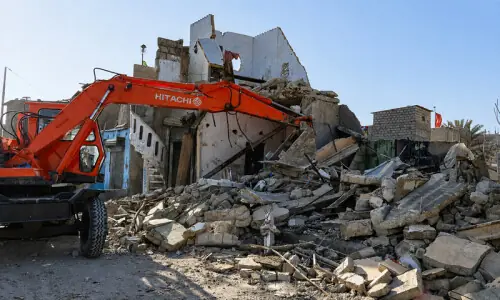
As we drive towards our destination, Saima remarks, “Oh! This also has been dug up,” as we snake our way on a once-upon-a-time wide M. A. Jinnah Road, now littered with heaps of rubble and reduced to a battered lane. But with an air of resignation and attitude of ‘what can be done?’, we carry on talking. And then she shows me the crumpled and blackened Gul Plaza but then asks me to quickly look away. “I always avoid looking at it,” she says. Karachi is broken. A city that ensures endless unlikelihoods.
As we chat after arriving at Khalikdina Hall while gulping hot milky tea from paper cups, the ceiling fans stop whirring. “At this time, the electricity goes away,” she says. She flips the pages of a register with a worn-out blue pink cover. Columns display names of people, time, purpose of visit, all penned in blue ballpoint. Some Hindu names amongst several Muslim names.
A stubbly boy in jeans and full-sleeved shirt sees us, hesitates. He is motioned to sit down while we lower our voices and talk. Another boy walks in and sits down on one of the chairs created for the library thanks to a grant awarded to the collective. He places his books on the gleaming wooden table, retrieved from the KMC’s storage.
There is no librarian. The boys don’t get books ‘issued’. They are here for a space that lets them study and prepare for their tests and exams. It reminded me of the time in the late 1990s when I frequented the Liaquat Memorial Library on National Stadium Road. I went there to prepare for the Central Superior Services (CSS) exams. I was grateful for a space that allowed me to be away from my large family and non-studious classmates and to study in peace. There was a librarian at Liaquat Memorial Library but then, too, hardly anyone got books issued.
In 2015, Saima was teaching communication and design to her “overprotected” and “cocooned” students at Karachi’s Habib University when she realised her students had no idea how to navigate the city. She compared her experience to growing up in the 1990s, at the height of the terror perpetuated by a political party and its frequent calls for shutdowns. Yet, she still ventured out, knowing how to navigate the urban space.
The experience with her students led her, visual artists and art educators Durriya Kazi and Zoya Currimbhoy, and architects Nabiha Ahmed and Sabeen Nazeer to create the Numaish Collective, an interdisciplinary group that “aims to open public spaces of the city for cultural production — an open-air gallery, a laboratory and playground.” Their first initiative targeted the Gothic-style 19th century Frere Hall built by the British colonialists, as a venue for open-air events of creative installations.
Eight years later, they sought a library to be transformed into a free community space. Durriya Kazi thought of the Ghulam Hoosein Khalikdina Hall, the venue of the trial of her great grandfather, Muhammad Ali Jauhar. Under KMC management, their initial visits to the site were an amalgam of horror and possibility. In the library space, books donated to the community in 1906 were dumped on the ground, several stacked against broken windows.
As we leave the library, Saima relives the Numaish Collective’s first sights. Her words stumble out like hesitant bullets out of a pistol. We stand in the passageway outside the library and the hall. Walking on, her hands gesticulate, pointing to the once paan [betel] spit-stained corners, strewn wires, cracked walls, a bridge built within in the 1990s and the kabaarr [junk] present everywhere. It is easy to imagine this. Karachi’s urban spaces, new and old, are rich with this kind of neglect and apathy.
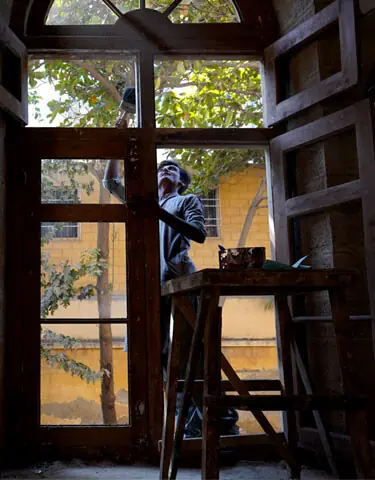
The immense hall, where pre-Partition badminton tournaments were organised, had been converted by the Sindh government into a Covid vaccination centre in 2021. Air conditioner wires were drilled into rare Burma teakwood arched doors, topped with five layers of paint, ranging from grey to parrot green over the years. By 2023, the coronavirus infections declined, as well as the public demand for vaccinations. The huge hall continued to hold space for three tables, four chairs and a paramedical staff. Just in case.
Saima takes me to the Student Welfare Organisation office beside the hall. A plain short woman, head and torso sheathed in black chador, talks to two other women. Behind her are stairs, leading to an unlit storage room, filled with redundant iron drawers half-opened and stuffed with papers, shelves of books, cartons and files lying on the floor haphazardly like an abandoned child at a fair whose parents have stopped looking for. “Imagine this but much worse, when we took over,” says Saima.
Back at the hall, I am led towards the main door, with its immense brass bolts eyed by drug addicts to steal, sell and fund their drug use. Saima pauses, looks around the restored doors, locks, lights and the flooring underneath. She shakes her head and says, “I find this all so surreal.” I nod, my attention caught by stray dogs barking, an uncontrolled menace in the city.
The KMC was willing to entrust the building to the women-led collective for restoration but sans financial resources. The collective entered a British Council grant competition supported by the Cultural Protection Fund, in partnership with the UK Government’s Department for Culture Media and Sport. According to Saima, “It’s very competitive.” Still, they won the grant that allowed them four months of uninterrupted renovation in 2024.
Saima is at pains to not be critical of the KMC. “They did not interfere,” she emphasises as she looks into my eyes. She fears the criticism will not be well-received. I understand. As a reporter, I have experienced backlash from critiquing sacred cows.
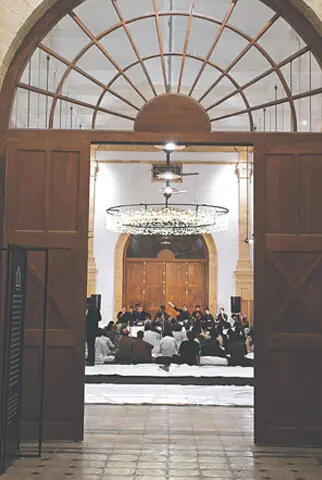
“The Numaish Collective has always believed in working with the government,” continues Saima. They found a heritage lover in KMC civil engineer Shakiluzzaman Khan. He thought about the lights, had them retrieved from KMC storage, cleaned up and installed in the hall space. The former administrator of Karachi, Fahimuzzaman Siddiqui, remembered during his tenure spotting the Muhammad Ali Jauhar trial stand in the storage. That was also found, cleaned and installed in the hall space. A hanging art installation titled Khayal was commissioned from the artist Muzummil Ruheel, who created an eye-catching arabesque wreath.
For the library’s books, they collaborated with architect consultants Sadiq and Polack, who helped decide which books to keep and to let go those that had become fragile over the years. Each salvageable book was cleaned and rebound. The librarians of the Anjuman Taraqqi-i-Urdu were brought in to catalogue the books.
Once the Numaish Collective figured out which book no longer had copyright issues, they had them digitally scanned and made them available online (https://readingroomkarachi.org/). A sign of the times. The future book world without the physical pleasure of holding a book or hearing the crackle of a page or inhaling the odour of a leathered binding. For now, the physical books are encased inside the newly built wood and glass cupboards.
A NEW LEASE OF LIFE
Evidently, the Numaish Collective has given the Ghulam Hoosein Khalikdina Hall and Library a new lease of life. But what about its longevity? “We are here till July 2027 but can be thrown out anytime. After us, who is going to carry on? Karachi’s architecture is beautiful, even though it is [only] a couple of hundred years old. It needs qadar-daans [connoisseurs]. It is these qadar-daans who have turned around the Flagstaff House, have created the TDF Ghar and the Magnifiscience Centre from forgotten, pre-Partition buildings,” says Saima, sounding like a feeble click of a vintage pistol.
In the absence of KMC funding, money is a persistent concern for the collective. Help has come in the form of the British Council’s Cultural Protection Fund and by organising fashion shows and concerts at the venue.
But regular visitors are going to expect more than exhibitions, festivals, fashion shows and concerts at the historical landmark. Though the Numaish Collective claims its future goal is to hire a librarian, let’s be upfront here: the reading culture in Pakistan has taken a nose dive. At the end of the day, students living in cramped spaces who can’t dream of a room of their own just want a space where they can stretch their legs and arms and study peacefully. The least the KMC can do is to ensure a regular supply of electricity.
It’s been decades since Jummu and Jummi, and their cousins Chunni and Munni visited their first abode in the newly formed country. I have told them about my visits to the area, triggering a torrent of memories. They ignore my laments over its current state. They live in the past, where the Ghulam Hoosein Khalikdina Hall echoes with Allama Rasheed Turabi’s Muharram majlis and reminds them of Lucknow’s imambaras.
In a past where Bunder Road, the Delhi Muslim Kali Hotel and the Ritz Cinema exist and continue to live on in their imagination.
The writer is a long-time journalist and is currently working on a culinary memoir
Published in Dawn, EOS, June 14th, 2026