Germany and Pakistan strongly oppose proxy warfare: ambassador
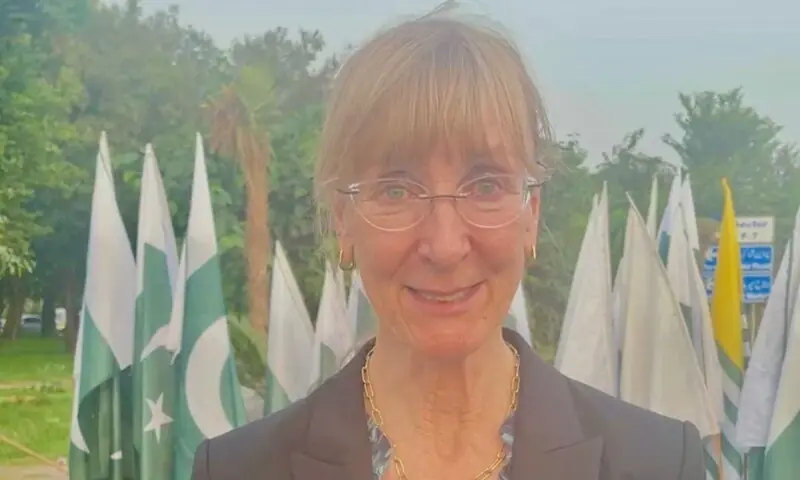

ISLAMABAD: Germany and Pakistan are on the same page regarding global peace and both countries strongly oppose proxy warfare, said German Ambassador Ina Lepel.
“All land and sea corridors including Strait of Hormuz must be peacefully open to avoid meltdown in global economy on micro, macro, and, mega levels,” the ambassador said while speaking at a function organised by the Islamabad Policy Research Institute (IPRI) in Islamabad.
Ms Lepel said Germany and Pakistan together can end the global tensions through effective hybrid diplomatic policies ensuring sovereign autonomy to real peace for all.
The ambassador appreciated Pakistan’s mediation role for regional peace and for averting resumption of war between Iran and the United States, and said Germany’s concerns on Iran are well-founded.
Appreciates Pakistan’s mediation role in averting resumption of war between Iran and US
She said Germany is not in favour of a “nuclear Iran” and Tehran must abandon its policy of supporting proxies in the region. On multilateral corridor of the global economy, she said Germany is looking forward to share ideas for progressive development and prosperity of the people of Pakistan.
She said more than 10,000 students from Pakistan are studying in Germany, and underscored the need for “learning German language if Pakistanis plan to become valued workforce in our country.” She observed that German business in Pakistan are more of value-added chains, and regretted that local companies and investors do not have an interest in promoting vocational training, which makes the ecosystem unresponsive.
The ambassador said that European integration, trans-Atlantic relationship, investment on defence and multilateralism are the pillars of German foreign policy. She told the forum about the possibility of boosting defence ties with Pakistan, and remarked that there are, however, hurdles vis-a-vis intellectual property rights and where the “provided technology would end up”.
She recalled that a decade ago Germany “procured uniforms from Pakistan, so there might be some engagement in the future”. The ambassador spoke in detail on the changing global order, especially in the backdrop of US-Israel-Iran war, and how upheavals are reshaping a new world order.
She said multilateralism is a preferred path for Europe, and a majority of member states are synergising themselves for a collective role in defence, foreign policy, economy and climatic concerns. She observed that climate change challenges needed to be resolved seriously, in terms of segregation of disruptive and non-disruptive outcomes.
It was also stated that integrated value chain systems are the priority of Germany, and Pakistan has already led the biggest industry, i.e., aviation, in the Gulf Aviation Consortiums through input of huge Airbus fleets.
She added that the ICT Fabric of Germany is one of the biggest canvases globally, and Germany intends to provide outsourced ICT entrepreneurship and self-employment opportunities to the youth of Pakistan.
She said the new government in Germany had its focus on security, freedom and prosperity of Europe. She said the invasion of Ukraine by Russia had altered the fulcrum of realpolitik as it carried severe consequences for collective security of Europe.
Talking about Nato, she said Russia’s expansionist policy had altered the paradigm and it was literally at war with Europe. She noted that Germany was bearing 2pc of defence budget burden of Nato.
To a question on gas supplies from Russia, she said the degree of dependence had lessened as alternative avenues were being tapped, and underscored the need for moving away from fossils.
She pointed out that Germany plans to cut human personnel by 8pc so that AI takes on for better efficiency, adding that European states are conscious of working together to cut back on bureaucratic red-tapism.
To another question, she said Germany and Europe view China as a competitor, and there are vistas of greater multilateral cooperation.
“We are open to partnerships in technology wherever possible with emerging economies.”
Published in Dawn, June 3rd, 2026