![Pakistan tried cowboy-style action in 1961’s Bara Bajay [12 O’Clock] -Photos courtesy: Sarfraz Fareed Nihash](https://i.dawn.com/large/2026/05/2910442253b81f2.webp)
Today, May 31, marks the 96th birthday of the legendary Man With No Name — the one and only cowboy icon we all admire, Clint Eastwood. An award-winning actor, director and producer, he remains one of Hollywood’s most enduring legends. And honestly, if you don’t know who Eastwood is, there’s probably little reason to read any further.
Still active, he continues to rank among cinema’s most timeless screen icons. With his piercing screen presence, minimal dialogue and sudden bursts of aggression, he redefined the image of the cowboy hero. He made ponchos, cowboy hats and high boots everlasting symbols of ‘being cool’ long after the Western era had faded. From Hollywood to Asian cinema, filmmakers generously borrowed from his attitude, visual language and anti-hero persona.
From inspiring Marty’s iconic alias in Back To The Future III (1990) to being referenced in the recent pan-Indian film Jigarthanda DoubleX (2023), Eastwood continues to leave a lasting imprint on filmmakers across generations.
The homage became even more notable when Jigarthanda DoubleX reportedly caught the attention of individuals associated with Eastwood’s team, who acknowledged and appreciated references to him — creating a rare and memorable East-meets-West cinematic moment.
Clint Eastwood, who turns 96 today, has inadvertently continued to leave a lasting imprint on South Asian filmmakers across generations
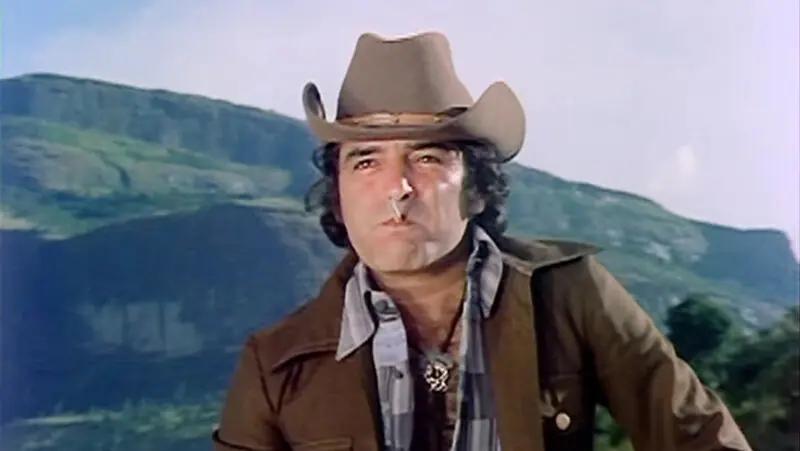
However, in the past, many attempts to imitate Eastwood came across more as caricatures than genuine tributes. Throughout the 1970s and 1980s, Bollywood enthusiastically experimented with the Spaghetti Western genre. Among its most influential figures was actor, director and producer Feroz Khan — often called the “Eastwood of the East” — for importing suave, Westernised glamour to India.
With his cowboy swagger, unbuttoned shirts, tight trousers, leather boots, trademark cigar, tall hat and sometimes poncho, he introduced a brand of machismo rarely seen in Hindi films at the time. Pundits dismissed it as limited acting masked by swagger and an awkward style.
However, that larger-than-life image gradually became the subject of parody. One of the most memorable spoofs came from Jaaved Jaaferi in Salaam Namaste (2005), where his iconic “Eggjactly! [Exactly!]” catchphrase humorously mimicked Feroz Khan’s Eastwood-inspired persona.
Unconventional-looking stars such as Shatrughan Sinha and Mithun Chakraborty may have appeared macho in cowboy hats back then, but today the image often feels unintentionally comical. The only thing Eastwood and “Shotgun” Sinha truly seemed to share was silence — Eastwood mastered it through restraint, while Shatrughan turned it into a catchphrase with his iconic “Khamosh! [Be quiet!].”
Similarly, Mithun Chakraborty, famous for his flamboyant energy and booming dialogue delivery, was never a natural fit for the quiet, stoic Man With No Name archetype that made Eastwood legendary.
Pakistan tried cowboy-style action in 1961’s Bara Bajay [12 O’Clock], directed by Baqar Rizvi and starring Alauddin and Talish. Alauddin’s gun-slinging stood out, while Neelo’s dances impressed audiences.
The music was composed by the acclaimed duo of Lal Mohammad and Buland Iqbal, while Nishi Kumari (known as ‘Nazli’) became one of the film’s major talking points, despite singing only two songs. Interestingly, she was actually an Indian Muslim student who was studying at the University of Karachi. Spotted at a private gathering, she changed her name and sang for the composers.
After completing her studies, she returned to India, leaving ‘Haar Gayi Haar Gayi’ [I Give Up, I Give Up] and ‘Balma Jiya Aahen Veeraan’ [Darling, My Heart Is Lonely] as the only film songs of her brief career.
Bara Bajay featured striking visuals, an original score and lively dances, capturing the cowboy spirit. Sadly, Lollywood’s standards in the genre declined later.
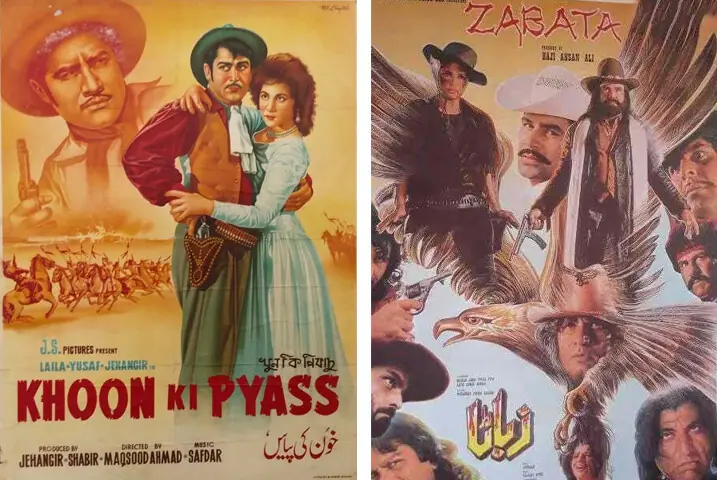
The first and perhaps the last major films of the genre in Pakistan were Khoon Ki Pyaas [Thirst For Blood, 1963] and Zabata (1993), directed by Jehangir Shaikh and Jahangir Mughal, respectively.
Interestingly, both directors were actually fight instructors, and their fascination with the “cowboy look” led them to make these films. Khoon Ki Pyaas, starring Laila and Yusuf Khan, introduced comedian Khalifa Nazir to cinema, while Zabata became one of the last films of the glamorous Babra Sharif.
A fascinating double-version film, Zabata is the only Western to be dubbed in Urdu and Punjabi. The movie is known for an extravagant mix of hats, from cowboy hats and oversized Mexican amigo sombreros to decorative women’s hats worn by male characters. Rather than realism, the film embraced excess and visual glamour, turning cowboy imagery into something uniquely South Asian.
Similarly, Iqbal Kashmiri and Iqbal Yusuf — both accomplished directors — long dreamt of bringing the Western genre to South Asian cinema. Inspired by Hollywood cowboy films and Spaghetti Westerns, they attempted to recreate the rugged atmosphere of the Wild West through local settings, stylised action, and larger-than-life heroes.
Iqbal Kashmiri directed Shaheen [Falcon, 1977] and Black Warant (1982) — yes, Warant, spelt without a double “r”. Both films featured nearly every actor who should not have been associated with cowboy-style cinema at the time. However, Shaheen’s story of prisoners, redemption and dangerous missions was later echoed in Karma (1986) by Subhash Ghai, while Black Warant was a strange combination of Hera Pheri [Foul Play, 1976] and Sholay [Flames, 1975].
Watching Sultan Rahi ride a motorcycle while Shahid stood behind him playing a harmonica was surreal. Rani looked badly miscast as Shano, the boat girl, an obvious imitation of Basanti from Sholay and that is where I lost patience.
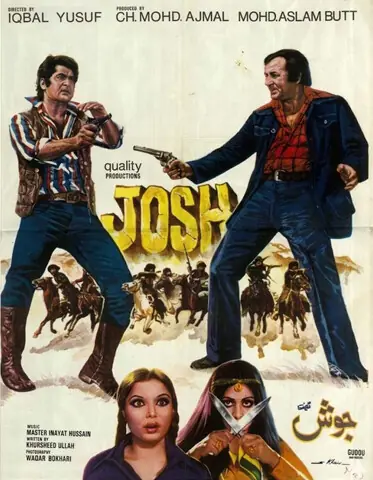
Coming to another Iqbal, Iqbal Yusuf’s pre-Eastwood Josh [Vigour, 1966] and post-Eastwood Josh (1979) (yes, they both had the same names) represented two desperate attempts to emulate the West. In the earlier Josh, with actors such as Sudhir, Waheed Murad, Hanif, himself and Asad Jafry, Iqbal Yusuf attempted something resembling The Magnificent Seven (1960) meets Seven Brides for Seven Brothers (1954).
In the later Josh (1979), he cast Shahid, Rani, Babra Sharif and Mohammad Ali in a film that constantly swung between My Name Is Nobody (1973), For a Few Dollars More (1965) and sometimes even Zanjeer [Chain, 1973], starring Amitabh Bachchan.
However, in Pakistan, Ghulam Mohiuddin perhaps possessed the ideal physique and screen presence of a Western-style hero, and filmmaker S.A. Hafiz — son of veteran actor Kumar — repeatedly cast him in such roles. Hafiz selected Mohiuddin, aka “Gullu Bhai”, as his quintessential lone-ranger figure and, despite impressive cinematography, realistic sets, daring action scenes and memorable songs, his films suffered from recycled plots, lifted background scores and an excessive dependence on imitation rather than innovation.
In response to Eastwood’s famous Dollars trilogy, an iconic series of Italian Spaghetti Westerns directed by Sergio Leone, Hafiz created his own unofficial trilogy: Aansoo Aur Sholay [Tears and Flames, 1976], Aatish [Fire, 1980] and Aandhi Aur Toofan [Wind and Thunder, 1984]. While the supporting casts changed from film to film, Mustafa Qureshi and Ghulam Mohiuddin remained the enduring constants.
Soon, inexperienced directors cast popular actors like Asif Khan, Badar Munir and Sultan Rahi in exaggerated cowboy roles, created films that lost the spirit of the American West and became a “Wild East” circus. These imitations felt misguided rather than innovative.
The hats, guns, horses, dust and harmonicas were all there, but the soul, restraint, atmosphere, and cinematic discipline that made Eastwood iconic were missing. Thankfully, Clint Eastwood (hopefully) has no knowledge of such films being made here.
The writer is a vintage cinema enthusiast. He can be reached at suhaybalavi@gmail.com
Published in Dawn, ICON, May 31st, 2026