US-Israel war on Iran breaks international law: Xi, Putin

BEIJING: In a landmark summit held just days after President Donald Trump’s pomp-filled visit, Chinese President Xi Jinping joined his Russian counterpart, Vladimir Putin, in accusing the United States and Israel of violating international law by attacking Iran.
Their joint declaration expressed “resolute opposition to hegemonism and unilateralism” and called on countries to stop “unilaterally” interfering with international trade and supply chains — an apparent reference to the closure of the Strait of Hormuz.
According to the statement published by the Kremlin: “The parties note with concern that unilateral actions by individual states, interstate associations, and their allies that impede international shipping threaten the integrity of global supply chains and maritime trade in general.”
The statement does not explicitly name the key waterway, but goes on to call for “cooperation in maritime infrastructure, such as ports, should be based on market principles and commercial principles to avoid politicisation and excessive emphasis on security issues”.
It also condemned various forms of military adventurism around the world, and appeared to reference US actions in Iran and Venezuela over the past six months.
“The global agenda of peace and development is facing new risks and challenges, with the danger of fragmentation of the international community and a drift back towards the “law of the jungle”, the joint declaration said, according to the Kremlin.
Xi and Putin called out “treacherous military strikes against other countries, the hypocritical use of negotiations as cover for preparing such strikes, the assassination of leaders of sovereign states, the destabilisation of the domestic political situation in these states and the provocation of regime change, and the brazen kidnapping of national leaders for trial”.
Such actions, they said, “grossly violate the purposes and principles of the UN Charter, the norms of international law and international relations, and cause irreparable damage to the foundations of the world order formed following World War Two”.
The two leaders also criticised US missile defence shield plans and Washington’s “irresponsible” nuclear policy that allowed a key arms reduction treaty to lapse.
The New Strategic Arms Reduction Treaty (New START) lapsed in February after Trump did not respond to Moscow’s proposal to extend its missile and warhead limits by a year.
No breakthroughs
The two leaders, who have met more than 40 times, stressed the closeness of the Russia-China ties they sealed in 2022 with a strategic partnership treaty signed less than three weeks before Moscow’s full-scale invasion of Ukraine.
While the meeting yielded a slew of agreements on trade and media, an elusive energy deal on the proposed ‘Power of Siberia 2’ pipeline remained out of reach.
The 2,600-kilometre pipeline would carry 50 billion cubic meters of gas per year from Russia to China via Mongolia.
China has said very little publicly about the project. While Xi said on Wednesday that cooperation in energy and resource connectivity should be the “ballast stone” in China-Russia relations, he did not mention the pipeline.
Kremlin spokesman Dmitry Peskov said both sides had reached a “basic understanding” on the project, he added that there was no “clear timeline.” Key issues such as pricing remain unresolved, with analysts expecting negotiations could take years.
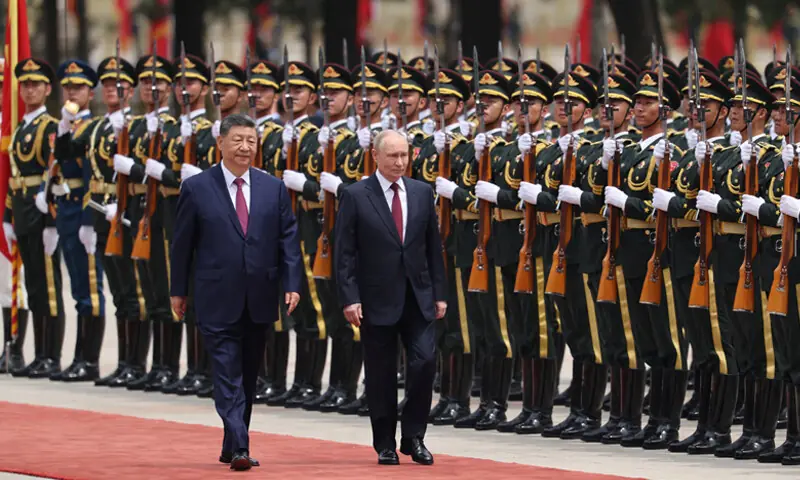
Earlier in the day, Xi welcomed Putin with an honour guard and a gun salute at the Great Hall of the People, as children waved Chinese and Russian flags. The Russian leader was received in much the same fashion as Trump a week prior, but the language was significantly warmer.
Xi told Putin that Beijing and Moscow have “continuously deepened our political mutual trust and strategic coordination with a resilience that remains unyielding,” according to Chinese state media.
Putin, quoting a Chinese phrase, told Xi that “a day apart feels like three autumns,” adding that relations had reached an “unprecedentedly high level”.
The two later dined on Peking duck before holding a 1.5-hour private talk over tea that the Kremlin had reserved for “the most important issues”.
Published in Dawn, May 21st, 2026