0
0

Q. My grafted mango plant — of an unknown variety and around three feet in height — is planted in well-prepared soil enriched with natural fertiliser. It has been affected by dieback disease. Brown spots have appeared on its leaves. Based on my past experiences, such spots spread rapidly and, ultimately, the plant dries up. In North Karachi, many mango plants grow and produce abundant fruit but some plants cannot survive due to dieback disease. Please advise remedial measures, including any spray that can be used. Please also let me know how frequently the plant should be watered.
A. Thank you for sharing information about your mango plant. It is evident that the plant is afflicted with dieback disease, a fungal disease, which you have already deduced. For already infected leaves and branches, pruning is the recommended course of action. Remove the infected branches and cover the newly opened spaces, from where the branches were attached to the stem, with a fungicidal paste. Follow it up with a fortnightly fungicidal spray, for at least two months, on the entire plant, especially on the leaves and stem. In this case, fungicidal products such as Mancozeb or Blue Copper spray can be used. Both are available at well-stocked gardening stores and nurseries. Simply mix a teaspoonful of any of the fungicides mentioned above in one litre of water to prepare the spray solution.
Regarding your query about watering frequency, every other day is enough during summers. During winters and rainy days, watering can be reduced in such a manner that the soil remains slightly moist throughout the day.
If you are able to control the fungal attack by following the above-mentioned remedies consistently, then there is a good chance that your mango tree will thrive again. Fingers crossed!
All your gardening queries answered here
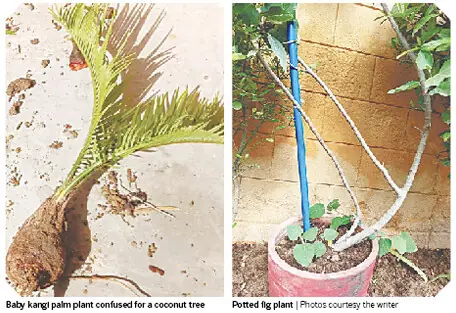
Q. We have a fig plant in a pot, of which I have attached photographs. Should we transplant it into the ground or keep it in the pot? It is currently placed outside in our lawn at our house in Karachi.
A. Ideally, the fig plant should be grown in the ground instead of a pot. Looking at the photographs, the potted fig plant seems old enough to be transplanted to its permanent location. For better size and growth of the tree and its fruiting, it is better to plant it in the ground as soon as possible. There is another major concern: the plant looks lanky and the stem can break while transplanting. It is critical to shift the plant very carefully. If the contents of the pot are not sliding out of the container with ease, the pot can be broken by gently striking the outside with a hammer. During this process, you may need to support the plant with one hand or require a second person to assist you. Please also ensure that the new place has exposure to direct sunlight throughout the day.

Q. I want to grow coconut trees at home. A few days ago, my son brought a small coconut tree, as shown in the photograph, which we planted in our garden. Later, I read in your column that the first leaf is a single, entire leaf, while leaflets appear later. It is not the case with the variety that we have.
A. Your observation about the leaf structure was astute — it is precisely this difference that indicates this is not a coconut palm. From the photograph, it seems that your son brought in a sucker, a term used for baby kangi palm plants. Kangi palm is not a coconut tree. It is a hardy decorative and ornamental plant. You need to visit any nursery to buy a coconut plant.
Q. I have lots of birds for whom I purchase mix feed from the market. Every few days, birds leave behind seed coverings and seed shells that they do not eat. I usually throw them away. I was wondering if I may spread them over the soil of my flower pots. I am not doing it currently as I was not sure what to do if any plants grow out of it and disturb my flower garden.
A. The leftover from bird feed can absolutely be used as a fertiliser to enrich the soil. Even if any of the seeds sprout, you can let them grow for a couple of days. Once they turn into seedlings, uproot them and feed to the birds, as fresh sprouts are highly nutritious for them.
Published in Dawn, EOS, March 29th, 2026