WASHINGTON: At the 70th session of the United Nations’ Commission on the Status of Women (CSW70) last week, two Pakistani voices — one from the country’s parliament, and the other from a Nobel laureate — placed access to justice for women at the centre of a polarised global debate.
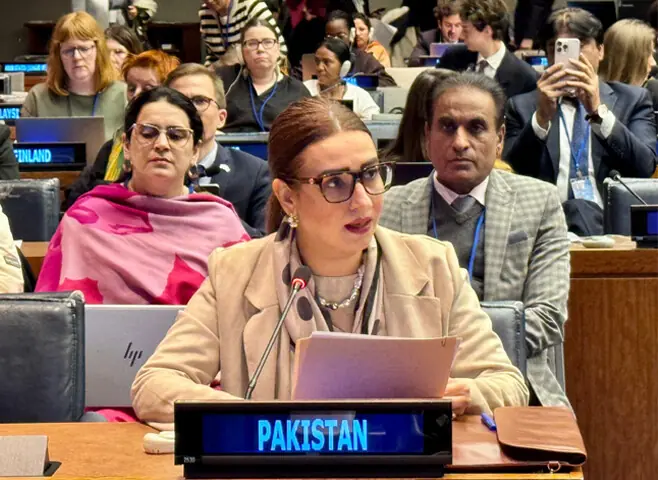
Speaking during the General Debate on behalf of Aseefa Bhutto-Zardari, Senator Bushra Anjum stressed that strengthening access to justice requires more than declarations — it demands institutional reform, representation within justice systems, and dismantling structural barriers.
Quoting Ms Bhutto-Zardari’s mother, the late former prime minister Benazir Bhutto, she reminded delegates that “the discrimination against women can only begin to erode when women are empowered to claim their rights”.
She highlighted Pakistan’s legal architecture: more than 480 specialised gender-based violence courts, legal aid mechanisms, family courts, ombudsperson institutions, and integrated protection services aimed at delivering remedies efficiently to women and girls.
Senator Bushra Anjum calls for institutional reforms; Malala slams ‘gender apartheid’ in Afghanistan
At another meeting, Senator Anjum also noted Pakistan’s constitutional framework for political participation, including 60 reserved seats for women in the National Assembly, 17 in the Senate, and 33 per cent representation at the local government level. Yet, despite these reforms, recent UN assessments underscore that women in Pakistan continue to face discrimination and structural barriers.
The Committee on the Elimination of Discrimination against Women (CEDAW) has highlighted persistent gaps between legal protections and their practical implementation, citing discriminatory laws, social norms restricting mobility and decision-making, and weak enforcement of protections against violence.
UN-supported national reports similarly document challenges across economic, political, health, and legal spheres, with many women hesitant to seek help due to societal pressures and inadequate institutional support.
These findings suggest that while Pakistan has taken steps toward reform, sustained implementation, resources, and social change remain crucial for realising women’s rights in practice.
Separately, addressing a high-level International Women’s Day event, Nobel Peace Prize laureate Malala Yousafzai warned against the selective application of justice.
“True justice does not defend the humanity of children in one place and ignore it in another,” she said, describing the treatment of women and girls in Afghanistan as “gender apartheid”.
“This is not culture. It is not religion. It is a system of segregation and domination — we must call the regime in Afghanistan by its true name,” she added, signalling a sharper, more urgent tone emerging at CSW70, where speakers repeatedly warned of pushback against gender equality.
“We must stand up, show up, and speak up, for rights, justice, action, so all women and girls can live safely, speak freely, and exist equally,” said Sima Bahous, Executive Director of UN Women, framing the moment as one requiring political courage rather than procedural consensus.
The urgency of these appeals was underscored by crises beyond the conference hall. As the UN Secretary-General arrived in Beirut in solidarity with the people of Lebanon, UN agencies highlighted the disproportionate impact of ongoing hostilities on women and girls.
According to the UNFPA, 11,600 pregnant women have been affected by the violence, with approximately 4,000 expected to give birth over the next three months.
“Many of these women have been forced from their homes, cut off from essential health services, and forced to give birth in dangerous conditions, some even by the side of the road,” said Anandita Philipose, UNFPA’s Lebanon representative.
Published in Dawn, March 16th, 2026