THE fresh electoral mandate has dealt a heavy blow to the country’s long-dominant political parties, signalling a sharp decline in public trust towards forces that have remained at the centre of national politics for decades.
Major parties including the Nepali Congress, the CPN-UML, the Nepali Communist Party (NCP) and several Madhesh-based parties appear to be shrinking significantly as a result of the election.
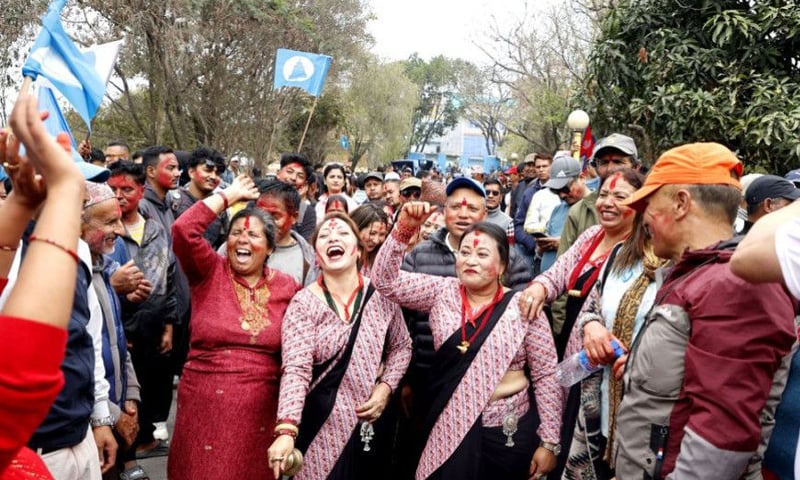
The outcome of the election has shaken the political establishment, raising profound questions about why voters appear to have turned away from the parties that have dominated national politics for years. Incoming results from both the first-past-the-post and proportional representation systems suggest that the Rastriya Swatantra Party (RSP) appears to be headed for a thumping majority.
According to political analysts, the election outcome reflects years of accumulated frustration with governance, corruption scandals and what many voters perceive as a culture of power-sharing among a small group of leaders.
This landslide support for the newish RSP comes amid an intense debate over the need to amend Nepal’s constitution, as critics have long said that the country’s mixed electoral system rarely delivers a single party a majority, thereby leading to political instability.
The RSP was registered only six months before the 2022 general election but has since transformed rapidly from an alternative force to the dominant party. Observers say the recent entry of former Kathmandu mayor Balendra Shah, popularly known as Balen, into the party and growing expectations among citizens from his leadership have drawn huge public support.
According to analysts, the growing disenchantment with traditional parties stems from years of political instability and governance concerns. Incessant power struggles among established leaders — often described as the “musical chairs” of government formation — along with corruption scandals, impunity, the politicisation of state institutions and mounting public frustration have collectively eroded trust in the older parties.
Leaders of the traditional parties, however, claim that the expansion of information technology and the influence of social media have also shaped public opinion. According to them, viral content on social media — often highly critical or abusive — has further damaged the image of established parties.
Former chief election commissioner Bhojraj Pokharel believes the election outcome represents an outburst of long-suppressed public frustration. “For 15 to 20 years, the leaders of three major parties played the ‘musical chairs’ of power. This period saw major corruption scandals, impunity flourished and state institutions were weakened through politicisation,” said Pokharel.
“Leaders jailed opponents while protecting their cronies. People had become fed up with this.” According to him, voters had long been searching for an alternative. “The opportunity was now,” Pokharel asserted.
Some political leaders have suggested that geopolitical factors may also have played a role in the rise of the RSP. Pokharel, however, dismissed such arguments, saying the election outcome reflects the independent choice of voters. “There is no need to interpret the results through the East-West geopolitical lens. Citizens are capable of making their own decisions,” he said.
Uddhav Pyakurel, an associate professor at Kathmandu University, said structural changes in society and the expansion of information access have contributed significantly to the growing distrust towards traditional parties.

“Sources of information have expanded and almost everyone now carries a mobile phone. Once people like a particular video, algorithms repeatedly show similar content. This has reduced patience for longer discussions and detailed analysis,” said Pyakurel, adding that the governing style of traditional parties has also failed to resonate with many citizens.
Some analysts also believe the election results were influenced by the political climate created by the Gen Z movement, which had raised strong demands for accountability and reform before the polls.
“For years the Congress, the UML and Maoists alternated in government. When they were in opposition, they criticised the government. Once in power, they became allies, only to turn against each other again later. This pattern damaged the credibility of all political parties,” said Pyakurel.
The Nepali Congress attempted to respond to the Gen Z uprising by introducing leadership and policy changes in the run up to the vote. In a significant move, then-president Sher Bahadur Deuba, who had remained at the centre of power since 1991, was replaced.
Despite resistance from the party establishment, a special general convention held in the second week of January elected a new central working committee under Gagan Kumar Thapa as president. The party had hoped that the changes would send across a new message ahead of the election.
However, Congress spokesperson Devraj Chalise said the party failed to effectively communicate these reforms to the voters. “Misinformation and disinformation influenced the decisions of many voters. We could not deliver the message of the party’s transformation to the public,” said Chalise. He added that the party would now focus on reform and reconnection with citizens.
“Elections are a test for any political party. This result teaches us that we must prepare better for the next test,” said Chalise. He also acknowledged organisational weaknesses within the party. “The election has revealed a situation where the number of leaders has increased while grassroots activists have declined,” he said.
According to Padam Giri, the UML candidate who lost in Parbat, said the party’s inability to understand public sentiment and geopolitical dynamics had been a key weakness. “We could not meet the expectations of young voters. Nor could we communicate our achievements effectively to the public. Political parties also failed to address the frustration and anger of citizens,” said Giri.
Nevertheless, Giri said his party would accept the people’s verdict. “The public has given us an opportunity to correct our mistakes. We will move forward with greater responsibility,” he said.
NCP leader Devendra Raj Paudel said the election results show that traditional party structures had weakened. “This election has shown a clear change in voters’ mindset. They are no longer loyal to a particular political party,” said Paudel. According to him, a party’s traditional strongholds no longer guarantee its electoral victory.
“Political organisations as we know them are collapsing. The lesson is clear: parties must win public trust through tangible results in people’s daily lives,” he added.
Despite the decline in their numerical strength, professor of political science Krishna Pokharel said, traditional parties will still play an important role in the country’s parliamentary exercise. At the same time, he emphasised that the party receiving the largest share of votes now faces its own critical test.
“The RSP will emerge as the largest party. It will form the government. But this is also the moment when its real test begins—governing the country responsibly while respecting the mandate of the people,” he said. —The Kathmandu Post/ANN
Published in Dawn, March 9th, 2026