
CHLOÉ Zhao’s Hamnet shows you what grief does to a body, to relationships, to the act of creation itself. The film is devastating not because it manipulates your emotions but because it sits with loss in a way that feels almost unbearable. Zhao films bereavement the way you experience it: as something that warps time, that makes the ordinary world feel impossible to navigate, that transforms everyone you love into strangers.
The film follows William Shakespeare and his wife Agnes after the death of their 11-year-old son Hamnet. But this isn’t a story about a famous writer finding inspiration in tragedy. It’s about two people trying to survive the unsurvivable. Agnes, a healer who couldn’t heal her own child, withdraws into a grief so large it threatens to swallow her. William, unable to process what he’s lost, buries himself in work, in performance, in the theatre that takes him away from the unbearable silence of home.
Hamnet was published in 2022 by Maggie O’Farrell to critical acclaim; it was my favourite read that year. She, along with Zhao, wrote the film. They understand that grief doesn’t just take something from you. It reshapes everything that remains. Love doesn’t disappear but it turns into resentment, blame, even the question: whose fault was this? The couple becomes a ghost of themselves. And creativity, that supposed refuge, becomes both betrayal and saviour. Agnes is shattered when she hears William has written Hamlet. He’s turned their grief into entertainment. He’s given strangers permission to watch what was theirs. But with that, he also asks: what do you do when the person you love processes pain in a way that deepens yours?
I kept thinking about this long after the film ended. Not just about William and Agnes, but about us. About Pakistan, about how we’ve been grieving for so long we’ve forgotten what it feels like not to grieve. We mourn leaders who promised us something better and were taken from us — Mohammad Ali Jinnah, gone too soon to see his vision through; Liaquat Ali Khan, assassinated before he could build a legacy; Zulfikar and Benazir Bhutto, murdered for daring. We even grieve the living — Imran Khan, being methodically disappeared from public life, in the hope that he’ll become a nobody on our watch.
Grief when denied doesn’t disappear. It shifts.
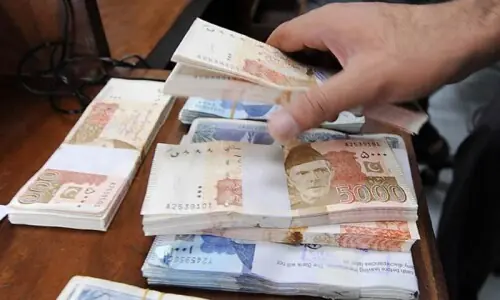
But we’re never actually allowed to grieve properly. The state takes our grief and repurposes it. Jinnah becomes a sanitised symbol on currency and textbooks, stripped of complexity. Benazir becomes a martyr whose death is invoked by some of the very forces that arguably contributed to the tragedy. And Imran — well, we’re not even allowed to speak his name, let alone question, forget mourn, what’s being done to him. Our grief is managed, channelled, made useful to someone else’s narrative.
We’ve become experts at performing grief without actually being allowed to feel it. We post condolences, we change our display pictures with ‘never forget’ hashtags, we say the right things. But the real work of mourning — the sitting with loss, the allowing yourself to break, the transformation that comes from truly reckoning with what’s been taken — we aren’t allowed to do that. There’s too much to do. Too much to survive. The clock resets and we rebuild, again and again, on foundations we know are rotten.
Hamnet reminded me that grief, when denied, doesn’t disappear. It shifts. It seeps into everything — into marriages, into art, into how we see ourselves and each other. Shakespeare channelled his unbearable loss into one of the greatest plays ever written, but the film doesn’t celebrate this. It shows the toll it took on the family. The way his wife feels erased by his art. The way his son’s death becomes everyone’s story but theirs.
We do this too. We turn our tragedies into content, our losses into news cycles, our grief into something consumable and then discarded. We perform resilience because we have no other choice. But resilience without permission to grieve is just another word for endurance. And endurance, after a while, hollows you out. The film ends with a kind of fragile reconciliation, a resolution that love and grief can coexist, that you can hold both and still move forward. I’m not sure we’ve learned how to do that.
We’re still stuck in performance, still pretending someone will save us, still rebuilding on scorched earth while pretending the burning was inevitable.
Zhao’s film refuses to rush past the hardest part. It sits in the wreckage and says: this matters. Your loss matters. The person you were before this happened matters. Maybe that’s what we need to hear. That grief isn’t weakness. That mourning isn’t inefficient. That before we rebuild, we’re allowed to break. If we’re honest, we’ve been broken for a while now. We’ve just gotten very good at not saying so.
The writer is a former journalism instructor.
Published in Dawn, February 15th, 2026