Solemn event marks fourth anniversary of Russia’s invasion of Ukraine
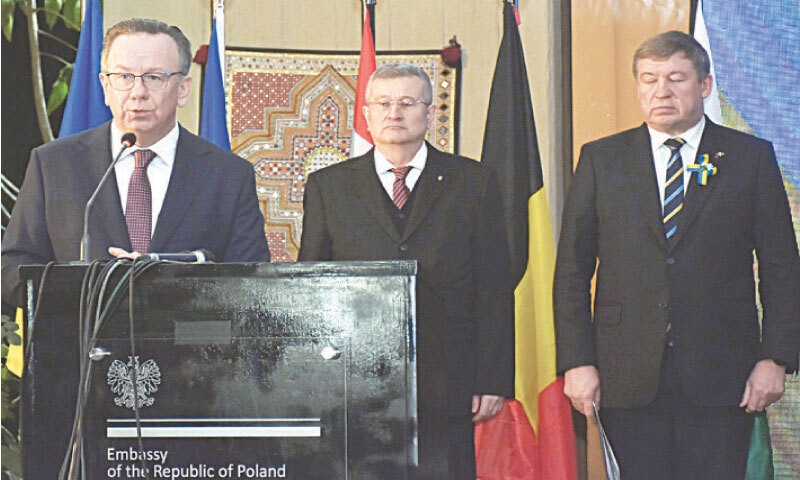

ISLAMABAD: The European Delegation, Team Europe, and the Embassy of Ukraine Wednesday night jointly held a solemn event to mark the fourth anniversary of Russia’s full-scale invasion of Ukraine.
Hosted at the Embassy of the Republic of Poland, the ceremony featured a documentary screening and photographic exhibition highlighting the devastating impact of the conflict on Ukrainian civilians.
The event was attended by diplomats, politicians, journalists, think-tank representatives, human rights activists, NGO members, and civil society leaders, who gathered to express solidarity with Ukraine and reaffirm support for its sovereignty and territorial integrity.
Before their speeches, Polish Ambassador Maciej Pisarski urged his guests to observe a moment’s silence for victims of the tragic suicide blast in Tarlai, five days ago.
In a joint statement, the EU Delegation, Team Europe, and the Ukrainian embassy strongly condemned Russia’s ongoing aggression, particularly its deliberate targeting of Ukraine’s energy infrastructure during the harsh winter, calling it unacceptable and a violation of international humanitarian law. The statement urged Russia to cease hostilities, withdraw its forces, and engage in meaningful peace negotiations, noting that the EU had committed an additional €90 billion in support for Ukraine and continued to enforce sanctions to hold Russia accountable.
Ukrainian Ambassador Markiian Chuchuk reflected on “Four Years of Ukraine’s Struggle for Freedom”, highlighting the immense human cost of the war, including over one million Russian casualties, tens of thousands of Ukrainian deaths, abductions of children, and the displacement of millions.
He condemned Russia’s imperial ambitions, emphasised Ukraine’s commitment to peace, and stressed that compromise and political will from both sides are essential.
Ambassador Chuchuk also thanked Pakistan for its principled support and urged Islamabad to play an active role in advancing a just peace through its position on the UN Security Council.
EU Ambassador Raimundas Karoblis, speaking on behalf of Team Europe, praised Ukraine’s resilience and reiterated the EU’s unwavering support.
He condemned Russia’s attacks on civilians, energy and transport infrastructure, leaving millions without electricity and heating during winter, and stressed that the EU would continue to pressure Russia economically, including through energy import reductions and bans on refined petroleum products. He highlighted Europe’s ongoing battles with hybrid threats, including cyber attacks and disinformation campaigns, and emphasised Pakistan’s important role in multilateral efforts to compel Russia into credible peace negotiations.
German Ambassador Ina Lepel reaffirmed Europe’s support, noting the EU’s €90 billion aid package for Ukraine, condemning Russia’s war crimes, and highlighting the humanitarian crises caused by attacks on energy infrastructure.
She reiterated that Ukraine is ready for serious negotiations while Russia persists with maximalist demands, stressing that pressure on Moscow would continue until meaningful dialogue occurs.
Polish Ambassador Maciej Pisarski condemned recent Russian strikes on residential areas and critical infrastructure as a deliberate strategy to inflict civilian suffering, particularly during the harsh winter. He reaffirmed Poland’s full solidarity with Ukraine and called on Russia to end the war immediately. A statement from the Embassy of Poland further noted that Russia’s aggression threatens global security, disrupts energy and food supplies, and destabilizes international peace, urging continued international support for Ukraine, both military and non-military.
The speakers collectively emphasized that ending Russia’s war of aggression required sustained diplomatic and practical support for Ukraine, accountability for Russian war crimes, and a coordinated global effort to prevent further destabilisation.
Published in Dawn, February 12th, 2026