Headline-making tweet

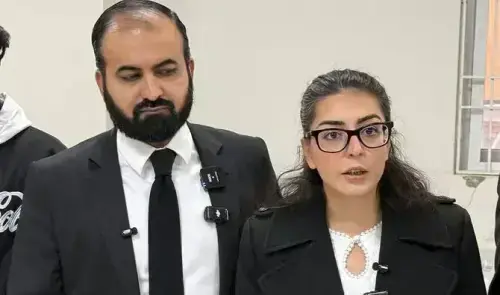
THE recent judgement of Additional District and Sessions Judge Majoka sentencing lawyers Imaan Mazari-Hazir and her spouse Hadi Chattha to a total of 17 years in prison on multiple charges in a case pertaining to social media posts, has made national and international headlines. If the court’s intention was to indicate condemnation for a post it perceived as inflammatory towards government institutions, the sentence has clearly had the opposite effect.
Condemnation of a biased and vindictive justice system has flowed thick and fast from opinion-makers, lawyers and others within Pakistan and abroad. The post and posters may not have generated such a following if ignored. Rather the sentence has laid bare a judicial system that has shown no hesitation in punishing anyone who dissents, even if through reposting a tweet.
Admittedly, our justice system is at a low point with the passage of the 26th and 27th Amendments, but even so, a sentence of 17 years’ imprisonment for social media posts makes a mockery of justice. Pakistan’s judiciary has seldom inspired confidence in ordinary litigants, but people have still approached courts in the hope that some rationality will follow. This judgement overturns any expectation of rationality, proportionality or reasonableness. While the current administration has engrossed itself in administrative matters and managing IMF loans, it has dug a deep grave for hard-fought democratic rights.
The PML-N government is known for passing punitive laws when in power. In the past, former prime minister Nawaz Sharif and other PML-N- leaders have expressed regret for passing such laws including the Prevention of Electronic Crimes Amendment Act (Peca), 2016, and the NAB Ordinance when those same laws were used to victimise its own leaders and workers. Sadly, no lessons were learnt and 2025 was possibly the deadliest year for eroding what little democratic rights remained.
In January 2025, Peca 2025 was passed introducing widely defined offences and regulatory bodies that expanded government control over online content. In June, the Anti-Terrorism (Balochistan Amendment) Act, 2025, was enacted which granted law-enforcement agencies in Balochistan the power to detain individuals for up to three months without being formally charged. In August, the Anti-Terrorism (Amendment) Bill, 2025, extended to all of Pakistan and granted security forces the power to use lethal force and to detain individuals without formal charges for up to three months.
Clamping down on Imaan Mazari sends a chilling message.
Meanwhile, as was predicted, the newly formed Constitutional Bench started back-tracking. In May 2025, the Constitutional Bench, via a five-two majority decision declared military trials of civilians constitutional, reversing the Supreme Court’s October 2023 decision. In a weak and poorly reasoned judgement, the court declared that while civilians can be tried in military courts, the government should legislate to provide a right of appeal to the high courts within 45 days. No such legislation has followed. However, all 105 civilians were tried in military courts for the May 9 riots, and all the accused convicted. As is common with military trials there were no judgements that were handed down but the results were made known through ISPR statements. In November, the 27th Amendment was passed which most lawyers felt dealt a final blow to the independence of the judiciary.
So far, this year has fared no better. The laws under Peca were used to silence several journalists who were working on stories related to corruption of public funds to others found to be either damaging the “ideology of Pakistan” or “containing aspersions against members of the armed forces, judiciary, parliament or provincial assembly”. However, the recent sentence of 17 years awarded to the couple wi-thout any regard to due process has only confirmed the public’s perception of the state of our judiciary.
Imaan Mazari-Hazir has been targeted by the state not just for her advocacy for missing persons and those accused of blasphemy but also for her anti-establishment views. The clamping down on her through dubious FIRs that resurfaced at convenient times sends a chilling message to bar associations, lawyers and human rights defenders. It is sad that post the lawyers movement of 2007, the hard-fought victories towards judicial independence have been so willingly bartered away by the current government. While one can hope that the sentence against Mazari and Chattha will be quashed on appeal, the damage to judicial independence will not only terrorise those who dissent now but will also return to haunt those who may be compelled to dissent in the future.
The writer is a board member, AGHS Legal Aid Cell, an advocate of the high courts, Pakistan, and a solicitor of the senior courts of England and Wales.
Published in Dawn, February 2nd, 2026