Kurds feel disappointed, abandoned by US after Damascus deal
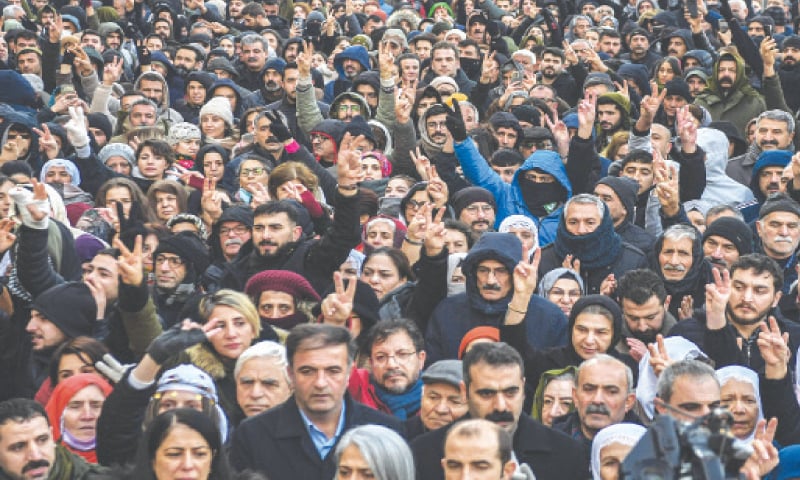

QAMISHLI/ISTANBUL: Residents of the Kurdish Syrian city of Qamishli voiced disillusionment on Monday after a deal with Damascus struck a fatal blow to their long-held aspirations of autonomy, with some accusing the United States of abandoning them.
Under pressure from a government advance through Kurdish-controlled areas, Syrian Democratic Forces (SDF) leader Mazloum Abdi said that he had agreed to a ceasefire deal formalising plans for Kurdish integration into the state in order to avoid “civil war”.
The deal stipulates that the Kurds’ de facto autonomous administration immediately hand over two predominantly Arab provinces it controlled, and outlines the integration of the body’s civil institutions in its stronghold of Hasakeh. On Sunday, US envoy Tom Barrack embraced the new deal as an “inflection point, where former adversaries embrace partnership”, but some in Qamishli saw it as a betrayal after the Kurds’ contributions in the war against the militant Islamic State (IS) group.
“I never felt like the Americans’ support was genuine,” said 40-year-old Kurdish activist Hevi Ahmed, who likened Washington’s “dealings with people to mere real estate brokerage”. “The agreement is a disappointment after years of hope that the Syrian constitution might contain a better future for the Kurds,” she added.
Erdogan hails Syria army for ‘careful’ offensive
Spread across Turkiye, Syria, Iraq and Iran, the Kurds say that their attempts to establish an independent state have been systematically repressed by regional and international powers throughout their history.
Washington has long allied itself with the SDF, which helped lead the fight against IS. But since the fall of Assad in 2024, the US position has been more complex, with President Donald Trump broadly supporting the new government’s efforts to unify the country while sending signals he is ready to move on from the SDF partnership.
Erdogan hails Syrian army
Turkish President Recep Tayyip Erdogan on Monday hailed the Syrian army for its “careful” offensive to take over Kurdish-held areas of the country’s northeast despite what he called “provocations”.
“The Syrian army’s careful management of this sensitive operation ... is commendable. Despite provocations, the Syrian army has passed a successful test, avoiding actions that would put them in the wrong when they are in the right,” he said.
Deadly clashes erupted about two weeks ago between Syrian government forces and the Kurdish-dominated SDF after the two sides failed to reach a year-end deadline to merge Kurdish fighters into the main Damascus military.
Days later, the army expelled the SDF from Aleppo then pushed rapidly eastwards sparking further clashes until Syrian President Ahmed al-Sharaa announced a ceasefire deal late Sunday that would see Kurdish fighters and Kurdish administrative bodies merged into the central state.
Turkiye has long been hostile to the US-backed SDF, seeing it as an extension of the Kurdish militant PKK and a major threat along the 900-kilometre (550-mile) border it shares with Syria.
“The principle of one state, one army is indispensable for stability,” said Erdogan, describing the ceasefire and the integration agreement as “a very important achievement for lasting peace and stability in Syria”.
He urged the deal to be implemented as soon as possible, saying there was “no excuse for stalling or playing for time. The era of terror in our region is over. No one should miscalculate.”
Aras Mohammed, a 34-year-old employee in the Kurdish administration, also expressed a “great sense of disappointment”. With the new deal, he said, Syrian President Ahmed al-Sharaa “imposes his vision of the state and constitution, based on the legitimacy he obtained by overthrowing al-Assad”.
That vision involves a centralised government, which Sharaa argues is necessary for stability after years of war, but which flies in the face of calls from minority groups in Syria for a more federalised system that safeguards their goal of self-determination.
Mohammed said he also had major concerns after past “agreements have been violated, bypassed or diluted”.
Published in Dawn, January 20th, 2026