Basant ‘safety plan’ submitted to Lahore High Court

• Provincial capital divided into red, yellow and green zones based on 10 years of kite-flying incident data
• Festival scheduled for Feb 6-8 with 24/7 monitoring via Safe City cameras and drones
LAHORE: A “Safe Basant Security Plan” submitted to the Lahore High Court reveals that the provincial metropolis has been divided into three zones — red (high risk), yellow (medium risk), and green (low risk) — based on an analysis of kite-flying-related incidents over the past 10 years.
A report filed on behalf of the Punjab Inspector General of Police (IGP) outlines stringent measures for the upcoming Basant festival, scheduled to be held from February 6 to 8 in the city.
Under the plan, kite-flying zones will remain under 24/7 surveillance through Safe City cameras and drone monitoring.
According to the report, 48 road safety camps will be established in red zone areas, including the Walled City, Mall Road, Lakshmi Chowk, Mughalpura, Harbanspura, Shimla Hill, Dharampura, Shadman, Nishtar Colony, Multan Chungi and Defence.
The yellow zone will have safety camps at 32 locations, including MAO College Chowk, Ichra, Qartaba Chowk, Dubai Chowk, Barkat Market, Bhatta Chowk, Saddar, Askari-10, and Allah
Hoo Chowk.
A total of 20 safety camps will be set up in green-zone areas, including Liberty Chowk, Wateen Chowk, Gajju Matta, Gulberg, and Bhobtian Chowk.
The report states that kite-flying hotspots have been identified using data collected over the past decade. These include the Walled City, Band Road, Canal Road, Ferozepur Road, DHA Society Road, Ring Road, Misri Shah, Shalimar Link Road, and Jail Road.
It adds that every kite and pinna (string ball) must carry a mandatory QR code or barcode for registration, enabling law enforcement agencies to trace illegal manufacturers and sellers.
Motorcyclists will be barred from entering red zones without helmets or unless their motorcycles are equipped with protective safety wires or antennas to prevent neck injuries from stray strings.
Police personnel will assist traffic police in installing neck-safety wires and ensuring helmet compliance.
Auto-rickshaws will be booked through ride-hailing applications, while the government will provide 5,000 rickshaws offering free rides across Lahore during the Basant days.
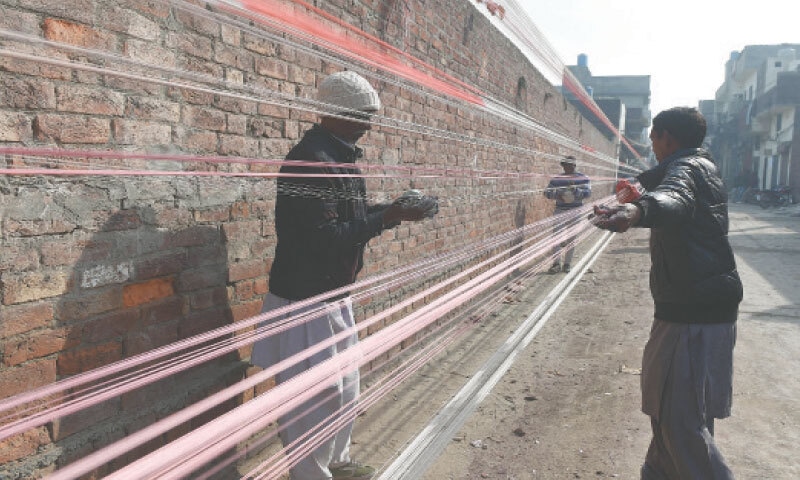
Only approved cotton-based pinna strings will be permitted. The use of nylon, metallic wire, or chemical-coated (manjha) strings will lead to immediate arrest and non-bailable charges, the report says.
The plan also bans aerial firing and the consumption of alcohol on rooftops during the festival.
Police teams will conduct flag marches, rooftop inspections, and deploy pickets throughout the three-day Basant festival.
The report further states that police will coordinate with the district administration and Rescue-1122 to provide first aid services, and with Lahore Electric Supply Company (Lesco) to ensure power-line safety and prevent electrocution incidents.
It also confirms that the manufacturing and sale of kites may begin only from February 1 for registered vendors, while the sale of charkhis (spools) will remain completely banned to prevent the use of chemical twine.
A similar report has been filed on behalf of the Capital City Police Officer.
These reports were submitted in response to a petition pending before the LHC regarding security and safety arrangements for the upcoming Basant event.
The Judicial Activism Panel filed the petition, questioning the alleged failure of the government and police to make adequate security arrangements.
Published in Dawn, January 18th, 2026