Pims employees warn to resist plan to make cardiac centre autonomous


 0
0
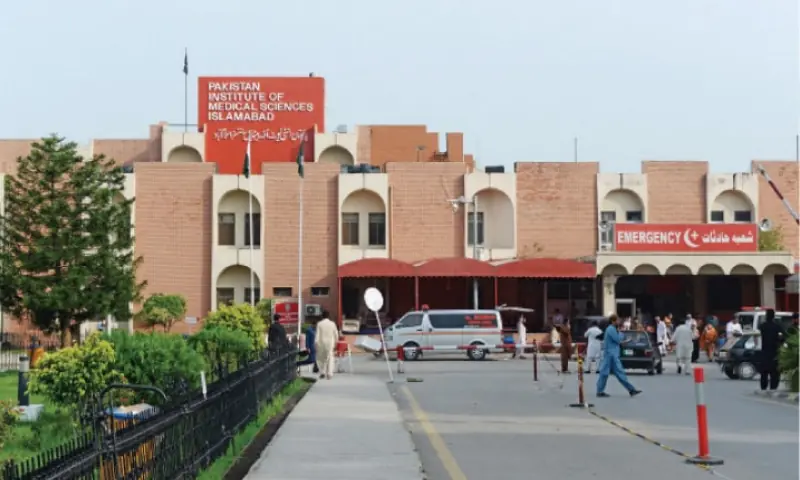

ISLAMABAD: A plan is being considered to make the cardiac centre at Pakistan Institute of Medical Sciences (Pims) an autonomous body, under which private persons will be made responsible for managing the funds of the exchequer.
However, the employees’ association has announced its decision to resist the move, claiming that similar attempts were made in the past but patients were the major losers as their free treatment was discontinued. A meeting of the committee set up for the establishment of an autonomous cardiac centre at Pims was held with retired Maj Gen Dr Azhar Mahmood Kayani and Special Secretary Ministry of Health Mohammad Aslam Ghauri in the chair.
According to the minutes (available with Dawn), the meeting was also attended by Pims Ed Dr Rana Imran Sikander, Head of Cardiology Department Prof Dr Fazal Aziz, retired Brig Prof Dr Azmat Hayat, DG Health Dr Abdul Wali Khan, Director (Programmes) Dr Soofia, HoD AFIC Brig Jehanzeb, retired Maj Gen Asif Ali Khan and Prof Dr Iqbal Saifullah [owner of a private hospital who also served in Pims).
“The Chair briefed the participants on the Committee’s mandate as per the notification, emphasising formulation of legally viable, administratively workable, and financially sustainable modalities for establishment of an autonomous cardiac center at Pims. He emphasised that setting an autonomous cardiac center without altering terms and conditions of existing employees is our agreed necessity.
Federal Health Alliance chairman claims move aims to privatise hospital in phases
“Dr. Rana Imran, ED Pims, informed the Committee that multiple past attempts to autotomize Pims resulted in employee unrest, strikes and disruption of hospital services. He stressed the need for careful planning to avoid recurrence of such outcomes,” stated the minutes of the meeting.
“The chair raised the option of granting autonomy only to the Cardiac Center, with separate governance/executive director and budgetary arrangements, while retaining existing HR and infrastructure as attached department of health ministry. It was agreed that such a model would require legal examination under the Rules of Business and applicable laws.”
Dr Rana Imran said the cardiac centre was operationally dependent on Pims for multiple support services, and partial autonomy may create administrative complexity. He stated that modification of the Pims Act 2023 may be required. Prof Dr Azmat Hayat endorsed this view, it added.
“The Chair emphasised that the proposed Cardiac Center must be financially sustainable, capable of generating revenue, while ensuring free or subsidised services for poor patients. It was reiterated that perks, privileges, and service conditions of employees must remain fully protected.”
The cardiology department head briefed the committee on existing facilities, including coronary and carotid angiography, cath labs, cardiac surgery, echocardiography and electrophysiology services. He explained the key gaps, including absence of paediatric cardiology and paediatric cardiac surgery, need for preventive cardiology and rehabilitation services, strengthening of research, upgrading of outdated equipment, and increased patient load resulting in prolonged waiting times.”
“The AFIC model was discussed as an example of autonomy with continued government support. Maj. Gen. (R) Asif Ali Khan opined that autonomy can be implemented successfully with clear governance and funding mechanisms. He supported the establishment of an autonomous Cardiac Center without disturbing the service structure of the existing employees.”
Prof Saifullah supported autonomy of the cardiac centre as attached department of the health ministry. In principle, he added that the cardiac centre would require government financial support.
The special secretary emphasised the need for a systematic analysis of earlier autonomy attempts to identify administrative, financial, legal and HR-related issues before finalising recommendations.
The committee agreed to seek formal legal opinion to determine whether autonomy can be implemented without major legislative amendments or whether modification of the Pims Act 2023 was required.
The committee will refer the matter to the Ministry of Law and Justice for guidance on legal point of view. The final recommendations shall be made based on the legal opinion, ensuring no adverse impact on employees’ service conditions. The committee will reconvene next week to finalise recommendations for submission to the Prime Minister Office.
A cardiologist of Pims, wishing not to be quoted, said recently a retired brigadier had been appointed in Pims on contractual basis. “As Rs7 billion have been allocated for the cardiac centre, efforts are being made to use the funds through the private sector. In the past, similar experiments were made in the liver transplant centre but in the end it failed,” he said.
Federal Health Alliance (FHA) Chairman Chaudhry Qamar Gujjar alleged that it was a move to privatise the hospital in phases due to which general public will suffer.
“Whenever a proposal is made to make the hospital or a department of it autonomous, in the end it is aimed to charge patients to make the department financially viable,” he said.
“FHA, which is representative body of the employees, will use all possible options including protests and courts to stop the move,” he said.
A senior doctor, wishing not to be quoted, said if the policy was so good it should be for all health institutions under the health ministry.
“If they make all hospitals autonomous, there will be no need to keep the health ministry as one officer sitting in the PM Office will be able to manage all institutions,” he added.
Published in Dawn, December 31st, 2025