ISLAMABAD: The Capital Development Authority (CDA) has digitised residential and commercial property documents and files — and if the plan is executed properly, details of all residential and commercial properties will soon be available with a single click.
The CDA, through the Punjab Land & Revenue Authority (PLRA), after scanning millions of pages, has prepared its data bank and is now mulling ending the manual transfer and allotment of property.
According to documents available with Dawn, 23,036 residential properties of 47 sectors and model towns, and all 5,657 commercial properties, including agro farms’ records from first transfer to last transfer, have been digitised.
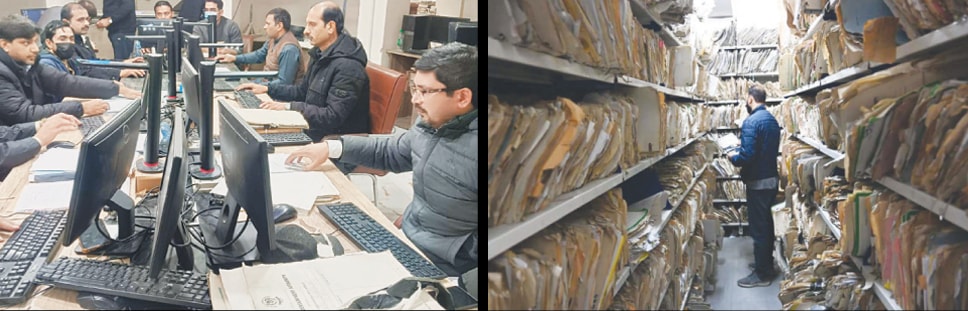
During a visit to record rooms, it was noticed that all files available in the record rooms had been scanned. “Now, we are planning to end manual transfer and allotment of properties, starting from Sector D-12, likely from next week,” said a CDA official.
Authority scans millions of pages, launches e-filing to improve transparency, curb fraud; pilot project begins in Sector D-12
He said that as a pilot project, Sector D-12 would be fully online, followed by others. “Now, all land and property records are secured. This process is aimed at facilitating the public in property transfers, inheritances and transactions,” the official said.
It is relevant to note here that due to poor record management or bad intentions, many original files in the past had “disappeared” from CDA records, putting bona fide purchasers in trouble.
There are three types of property being dealt with by the CDA: commercial properties and two types of residential properties. In the first category of residential plots are those which the CDA sold through auction or balloting, and in the second category, called estate affectees, the CDA allotted thousands of plots to estate-affected people (those whose land had been acquired by the CDA and who were entitled to plots as compensation).
In this category, a large number of fraudulent allotment cases took place.
Insiders say that in many cases, the first allotment in the past was made on the basis of bogus documents, and the first allottee sold plots in the open market. Later, when it transpired that the first allotment had been made based on forged documents, the first allottee and the CDA officials involved “removed the file from official records to hide their crime”, putting bona fide purchasers in trouble.
Whereas in many cases original files are available, the CDA, after transferring plots a number of times, suddenly stopped further transfers after declaring the allotment fake, at the cost of the last purchasers.
CDA officials added that these types of fraud took place because of the manual handling of files and records.
PLRA official Ijaz Ahmed, whose team is carrying out the digitisation work of the CDA, while speaking to Dawn, said that all available records of residential and commercial properties had been scanned and were now available on the dashboard.
He stated that under this project, the transfer of properties would be carried out through e-filing and digitisation.
“Automation always helps end corrupt practices and tampering of records. Now, all available files have been scanned, and at least from now onwards, the CDA has a complete databank,” he said.
Mr Ahmed added that under the new system, the movement of files would be tracked online with timelines, and all CDA officers would have access to the entire files. “With a single click, they can check the entire record from first transfer to the last one,” he said.
“Our CDA-related project is heading towards completion, as the major work of scanning all documents of files has been completed,” he emphasised.
When contacted, CDA Chairman Muhammad Ali Randhawa said that the purpose of this project was to facilitate citizens.
“The prime minister and interior minister had directed us for this project. We believe automation is the best solution to reduce the chances of corruption,” he said, adding that the system would have a digital trail and every action would be logged, including who approved files, when, how, and who was sitting on a file. “Digitisation will also help us significantly improve service delivery,” he declared.
Mr Randhawa further said that records of the revenue department of the Islamabad Capital Territory (ICT), which deals with rural land areas, were also being digitised through the PLRA, and many revenue estates (mouzas) had already been digitised.
Published in Dawn, December 18th, 2025