0
0

An anti-terrorism court accepted the plea of the Pakistan Broadcasting Corporation (PBC) and ordered a forensic examination of relevant videos as well as facial recognition of the accused through the National Database and Registration Authority (NADRA) in the ongoing trial into the ransacking and torching of the Radio Pakistan building in Peshawar in May 2023.
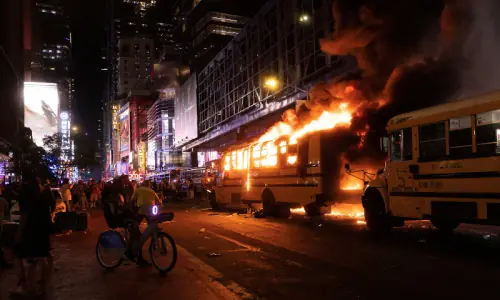
The Radio Pakistan office building was set afire during a protest against former prime minister Imran Khan’s arrest in Peshawar on May 11. The attack destroyed equipment, historical recordings and three vehicles. An employee of the radio was also hospitalised with burns.
Judge Wali Mohammad Khan ordered that the USB containing the video recordings be handed over to the investigation officer, with directions to ascertain its genuineness vis-à-vis the identification of offenders through NADRA records, and to submit a report at the earliest, before January 10, 2026, the next date fixed for hearing.
The court referred to various provisions of the Code of Criminal Procedure (CrPC) and judgments of the superior courts, and ordered the acceptance of the application filed by the private complainant, the Pakistan Broadcasting Corporation (PBC).
The PBC’s station director had submitted an application to the ATC, requesting the examination of the videos through the Punjab Forensic Science Agency (PFSA), Lahore, to verify their genuineness, determine the presence and participation of individuals, and conduct facial recognition through NADRA for the identification of the accused in the incident, which took place during protests triggered by the arrest of former prime minister and PTI founder Imran Khan.
The ATC is conducting the trial, in which 75 accused, including some current and former lawmakers, were indicted on June 3 on multiple counts. The accused have pleaded not guilty.
The accused facing trial included provincial minister Meena Khan Afridi, MNA Asif Khan, MPAs Fazal Ilahi Khan and Arbab Waseem, who left the PTI and joined the PTI-Parliamentarians, and former MPAs Arbab Jehandad, Fida Gul, and Wajid Khan.
The application was filed through senior counsel Shabbir Hussain Gigyani, who contended that certain viral videos of the incident were on record in which several known personalities were actively participating in the crime, while abettors, conspirators, and instigators were clearly visible along with numerous unidentified persons.
He further contended that various cameras recorded the scenes of the commission of the offences, and that Section 94 (summons to produce document or other thing) of the CrPC provides for the production of documents or other things for corroboration.
He stated that different videos relating to the offences had been secured on a USB, which would help identify the real culprits if subjected to forensic examination through the Punjab Forensic Science Agency (PFSA) and data from NADRA.
He argued that, to reach the right conclusion, it was necessary to conduct a forensic examination of the videos through PFSA and NADRA, including facial recognition to identify the actual culprits.
The defence counsel rebutted his arguments, stating that the investigation had already been concluded and that material evidence had been recorded during the trial.
He requested that the application be rejected as belated and not covered by law.
Meanwhile, the ATC also turned down an application filed by the defence, raising objections to the appointment of private counsel by the PBC.
The defence counsel contended that the state prosecutor, representing the complainant, was a government officer.
He further argued that the engagement of private counsel for a government department in the presence of the prosecutor was illegal.
Advocate Gigyani opposed the defence plea, arguing that the appointed prosecutor was a provincial employee representing the provincial government, whereas the complainant was the federal government.
He contended that all the accused were related to the PTI, the ruling party in Khyber Pakhtunkhwa, and some were members of the provincial cabinet, national and provincial assemblies.
He added that there were compelling reasons for engagement of private counsel, including public interests and the fragile position of the prosecutor who may be subjected to hardships if not acting as directed.
The court observed that the provincial government had appointed the prosecutor in the case, while Radio Pakistan was the complainant, which falls under the federal government.
“A fair trial is the mandate of law. Some of the accused in this case are either members of parliament or the cabinet, or members of the ruling party in the province of KP,” the judge stated in his order.
It is pertinent to mention that the FIR in the case was registered at the East Cantonment police station on May 10, 2023, on the complaint of the then Station House Officer (SHO), Arbab Naeem Haider, under various provisions of the Pakistan Penal Code and the Anti-Terrorism Act.
The complainant said that after breaking the main gate of the Radio Pakistan building, the protesters torched the building as well as the vehicles parked there, thereby spreading fear, terror, and insecurity in society.
He added that the police arrested 20 suspects from the mob, while the remaining 200–300 miscreants managed to escape. Several other suspects were arrested later.
Separately, the KP Assembly unanimously adopted a motion to form a special committee to investigate the attack on the Radio Pakistan Peshawar building during the May 9 riots.
The motion, moved by Minister for Law Aftab Alam Afridi during a KP Assembly sitting chaired by Muhammad Idrees, stated that the composition and functions of the committee would be determined by the Speaker of the KP Assembly, as provided in the rules.
On December 5, the KP cabinet approved the formation of a special committee to probe the attack on the Radio Pakistan Peshawar building.