• Safe Cities Authority approaches police, cybercrime agency after suspects clone its website
• Scammers got phone numbers, CNICs from black market to trick citizens, officials say
• Insist PSCA only uses 8070 short code
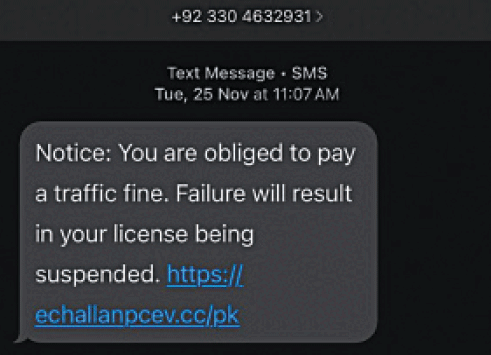
LAHORE: The Punjab Safe Cities Authority (PSCA) has asked the National Cyber Crime Investigation Agency (NCCIA) to trace and initiate legal action against suspects who allegedly cloned their official website and sent fraudulent alerts, urging citizens to deposit fines for e-challans they had not incurred.
The PSCA has also written to Punjab Police, requesting that they trace the mobile phone numbers used by the suspects to disseminate the fake website link.
Over the past several weeks, a rising number of citizens complained of receiving messages (over SMS and WhatsApp) notifying them of payable e-challans, when they had not committed any such violations.
In some cases, individuals residing in Karachi, including a woman who did not own a car or possess a driving licence, was also sent multiple messages from unknown numbers, asking them to pay the e-challan.
A web link given in the messages took people to a page that closely resembled the PCSA’s official website, but eagle-eyed individuals spotted that these links were not to the government portal’s official website.
The PSCA swung into action after discovering that a large number of citizens had received a fabricated link claiming they had pending e-challans. The link directed recipients to click and follow steps on a cloned website to deposit supposed fines.
The Authority declared that the website and its link were illegitimate and clearly part of a phishing scheme.
A public safety message has since been circulated across social media, advising citizens to exercise caution and verify any such alerts by checking with the official short code 8070, in order to avoid online fraud.
PSCA Managing Director Ahsan Younas told Dawn that fraudsters had increasingly been using the internet to deceive people for financial gain. He said scammers employ various tactics, and online fraud had become a widespread phenomenon.
Mr Younas explained that several weeks ago, they learned that unidentified suspects were sending fraudulent messages while using a cloned version of the PSCA website. Around the same time, a citizen recorded a voice note warning people that the website circulating online was fake. “We deputed a team of experts to dig out the facts, and it transpired that the alert message and voice note regarding the fake PSCA link were prepared and circulated by a citizen in Karachi,” he said.
After deliberation, the PSCA decided to counter the situation by launching a large-scale public awareness campaign.
Regarding the fake website and its self-generated link, he said the PSCA itself did not have the mandate to initiate legal proceedings against the scammer behind the cloned site. Therefore, he added, the PSCA first opted to alert the public that the message urging individuals to deposit unpaid traffic fines contained suspicious links to fraudulent websites.
“PSCA always sends e-challan alerts from the official number 8070,” the official said, adding that the authentic PSCA website never uses terms such as “urgent” for payments.
Similarly, the legitimate website uses the “.gov.pk” domain, while the fraudulent version used an entirely different domain.
Despite these differences, the scammers made significant efforts to replicate the original PSCA website to commit fraud on a large scale.
PSCA Chief Operating Officer Mustansar Feroze said one mobile number used to send the fake website link was traced, and it was found to be registered to a woman who had no connection to the scam. He said this indicated that suspects were acquiring mobile numbers, SIMs, and CNICs from the black market, which was an alarming situation for authorities.
Mr Feroze added the suspects were using multiple mobile phone numbers to send targeted messages to individuals in an attempt to extract money from them.
He advised the public not to open unknown links, as they often contain scripts and trackers designed to steal personal information.
According to him, the PSCA has submitted a formal request to the NCCIA to conduct a high-level investigation to uncover the network behind the cloned website and take action for harming the reputation of the authority, which is recognised globally as a game-changing initiative in public safety.
Published in Dawn, December 9th, 2025