A window into Saddam’s Iraq and Qadhafi’s Libya

DOHA: The Arab world in particular, and the Muslim world in general, has an ambivalent relationship with Moammar Qadhafi of Libya and Saddam Hussein of Iraq.
Many hated the dictators for their oppressive acts, but what happened to the region after their ouster changed the opinion of some.
The eras of both these dictators were the subject of discussions at the Doha Film Festival, courtesy two films — The President’s Cake and My Father and Qadhafi.
Hasan Hadi, a young director from Iraq, surprised the festival with the Middle Eastern premiere of his debut movie, The President’s Cake — potentially the best movie of the event so far.
A co-production of Iraq, Qatar and the US, it has already won the Audience Award and the Golden Camera Award at the Cannes Film Festival this year, and is also Iraq’s submission to the Academy Awards.
Hadi Hasan’s The President’s Cake and Jihan K’s My Father and Qadhafi are both personal stories set against the turbulent backdrop of US sanctions and civil wars
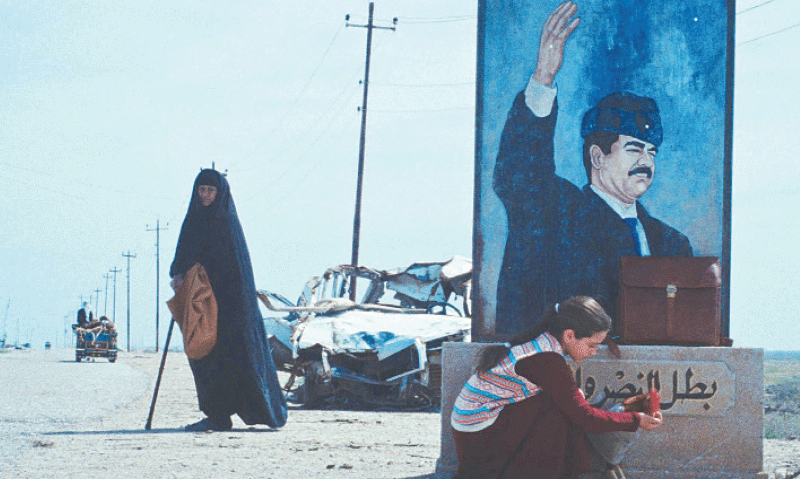
Set in 1990s Iraq, the film follows nine-year-old Lamia, who has lost her parents and lives with her old grandmother. The old woman tries to give her away for adoption, as she can’t take care of her anymore.
The film is set against the backdrop of Saddam’s Iraq, facing economic sanctions and shortages of every kind. Exploitation of the masses by the forces and authorities in the name of Saddam is the order of the day.
In such circumstances, Lamia (Baneen Ahmad Nayyef) is asked to bring a cake for the president’s birthday, which her teacher wants to eat. What follows is Lamia’s struggle to make a cake her granny can’t afford and get away from being adopted by another family.
It is a flawless performance from Baneen, the child star; full of maturity. The film’s story is well-knit, with no digressions or sub-plots to distract viewers.
The depiction of the hard times faced by the Iraqi people under Saddam’s rule is especially poignant, as they mirror the experiences of the director, Hadi, who also grew up under the shadow of the dictator.
During a press talk, Hadi said that blockade of Saddam’s regime during the 1990s was an important historical time for Iraq. “The siege led to the death of 500,000 children and when Madeleine Albright (then-US secretary of state) was asked about these deaths and whether it was worth it, she casually said, ‘yes’. Iraqi people were the victims of dictatorship, war and siege itself.”
Misery under Moammar
My Father and Qadhafi is a woman’s attempt at emotional closure, revisiting the memory of her father, who remained missing for 19 years under Qadhafi.
The debut documentary by Jihan K retraces the search for her father, Mansour Rashid Kikhia — once a minister and close aide of Moammar Qadhafi and ambassador to the US who became dissident and never went back to Libya.
He went missing in Cairo in 1993 while taking part in a human rights conference. From that day, his family kept searching for him, until his body was found in Libya in 2012 after the fall of the dictator: it had been kept in a freezer at a farmhouse for more than a decade, for reasons unknown.
The documentary traces the family’s frantic search for the missing Mansour, but is interspersed with the country’s colonial history, going back to the Great War, and Italian occupation.
It details the civil war, the rise of Qadhafi and discovery of oil that kept him in power for four decades.
But despite the labyrinthine political history of the country, the documentary remains focused on the family’s predicament through intimate accounts of a daughter who was just six when her father went missing.
The interesting part is that Qadhafi allowed Jihan’s family and mother to visit Libya in 1997 to search for Mansour themselves while the dissident was in his custody, footage from which is also included in the film.
Speaking about her father, the director said that people knew him as a political figure and activist. “I think of my film as a piece in a bigger puzzle. This is my contribution to the story. There are many ways to speak of my father and to share his story.”
Jihan made the film over nine years and interviewed more than 60 people. It was also screened at the Venice Film Festival in Italy, despite its scathing criticism of Italian occupation, and shows how Mussolini set up the first concentration camps in Libya, a method that was later used by Hitler against Jews.
Published in Dawn, November 26th, 2025