Pakistan needs to ‘do more’ on fulfilling GSP Plus conventions ahead of review, EU envoy says


 1
1
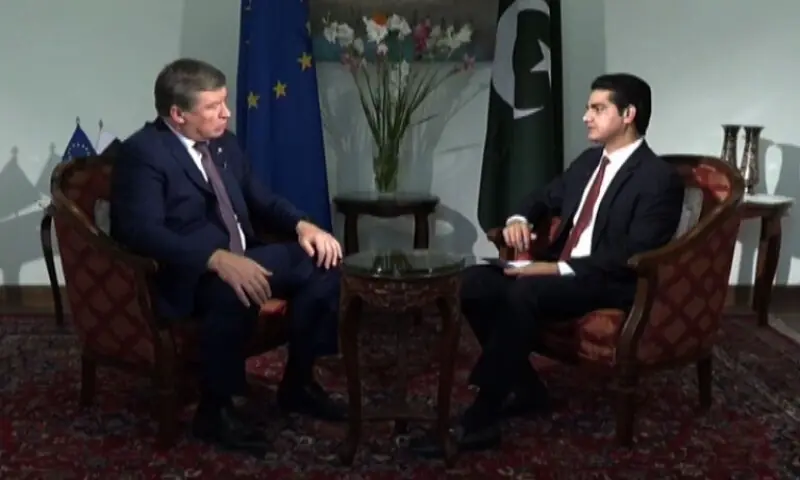

European Union (EU) Ambassador to Pakistan Raimundas Karoblis on Wednesday said that the country needed to “do more” in terms of fulfilling its commitments under the Generalised Scheme of Preferences Plus (GSP+) ahead of a review.
The status was granted by the EU in 2014, which led to a 108 per cent hike in Pakistani textile exports to the EU due to concessional tariffs. In October 2023, the European Parliament unanimously voted to extend the GSP+ status for another four years until 2027 for developing countries, including Pakistan, to enjoy duty-free or minimum duty on European exports.
The upcoming GSP+ monitoring mission was delayed from June because of the Iran-Israel conflict and will scrutinise Pakistan’s record on 27 international conventions tied to the trade scheme, which grants duty-free access to most Pakistani exports.
In an interview on DawnNewstv show ‘Doosra Rukh’ today, the EU ambassador was asked about whether Pakistan needed to do more to fulfil the requirements of the scheme, to which he said: “Yes, we are saying that. We are saying that it should be, well, needs to be, to do more.”
He said it would be a periodic monitoring mission that would assess the implementation of all necessary United Nations conventions for the scheme’s application.
“There are human rights, labour rights, environmental issues as well, and good governance. Quite a lot of meetings will be with state institutions, but also with civil society organisations, with human rights defenders, but also with the companies and actually with people who are working in the companies.”
He said a report would subsequently be issued with further recommendations based on the findings of United Nations bodies, since they were responsible for monitoring the conventions.
Karoblis stressed that implementation of the conventions was “really important”.
Outlining areas of concern, he pointed to human rights, the death penalty, blasphemy, forced disappearances, minority rights, women’s rights, child labour and forced labour.
“It will probably be the last monitoring mission of the present GSP+ scheme, because the new scheme will enter into force soon, probably from 2027, and Pakistan will need to reapply in order if it would like to continue with the GSP+ preferences. So it means that the report of the monitoring mission will be one of the most important sources assessing the progress and compliance with Pakistani commitments vis-à-vis the UN.”
The ambassador highlighted that the EU had already identified the main issues that it was asking Pakistan to address.
He said that the EU did see “certain progress”.
Karoblis said that the issue of forced disappearances in particular was one of the EU’s “priorities”, saying it was one of the issues on which “we have questions and we see the problems in the context of the GSP+”.
“Of course, we understand that some structures were established, such as the Commission of [Inquiry on Enforced] Disappearances. Of course, we will look into whether it is enough, whether it is sufficient, but of course, we will have a lot of questions on that for the institutions.”
Questioned about his thoughts on the recently enacted contentious 27th Constitutional Amendment, he said it was an “internal issue”.
However, he did say on the issue of the judiciary’s independence that “we have different views” and different opinions and thoughts were being solicited from the opposition, think tanks, civil society organisations, and international organisations working in Pakistan.
The envoy also said that there was a need to discuss the issue of recent military trials of civilians.
“Maybe during discussions we will have some justifications. So, well, of course, the security situation is problematic. There are a lot of challenges which we really see.”
Noting a deteriorating human rights climate, former EU ambassador Riina Kionka had called on Pakistan in August to show ‘credible’ and ‘visible progress’ on human rights and labour reforms, signalling that the EU’s next trade preference scheme will demand stronger compliance.
“Pakistan needs to show more visible progress, especially ahead of the upcoming GSP Plus monitoring mission in November,” she said.
“Governance is looking pretty good, (progress on) environment also positive. But labour rights need more work, and human rights remain the most challenging area.”
On human rights, she was blunt: “If you talk to many human rights defenders, civil society activists —and even just live here, like I have for three years — you often see … a clear degradation. Our monitors read the newspapers. They have networks, they know what’s going on. So, they’re in a position to judge whether things are moving in the right direction or not.”
European lawmakers and civil society, she added, were increasingly vocal about conditioning trade support on rights performance: “Why should we continue to offer this level of support if there’s no reciprocal progress on the values side?”
Similarly, in January, the EU had warned Pakistan not to take its GSP+ status for granted. Olof Skoog, the EU Special Representative for Human Rights, had urged the government not to use military courts to pursue cases against citizens, and opposed recent moves to restrict freedom of expression.
Talking to Dawn, he said he had conveyed these messages in separate meetings with top government functionaries, including the army chief, the chief justice and members of the federal cabinet.
The focus of his visit was to engage with the government on pressing human rights issues and learn about Pakistan’s plans to address them ahead of the GSP+ monitoring mission.