Reserved seats case: Justice Mandokhail says ROs rightly showed 41 candidates as independents
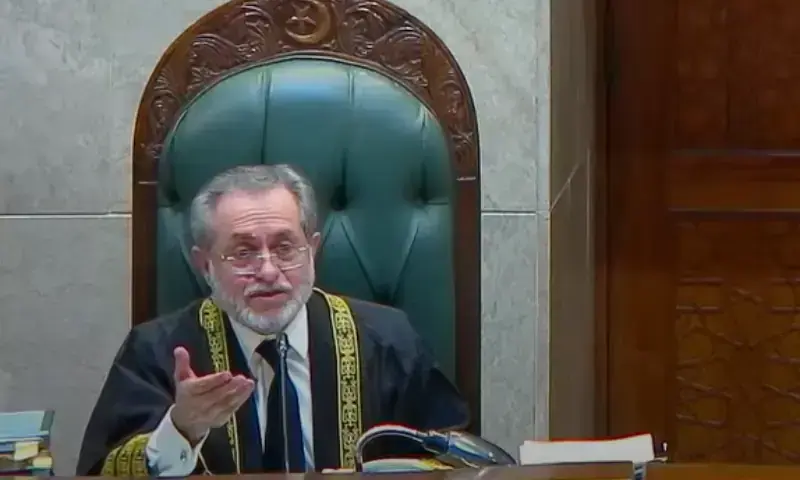


Supreme Court’s Justice Jamal Khan Mandokhail has observed that returning officers (ROs) correctly prepared lists of 41 independent candidates during the 2024 general elections, as it was PTI’s decision-makers who “compelled” them to contest in that manner.
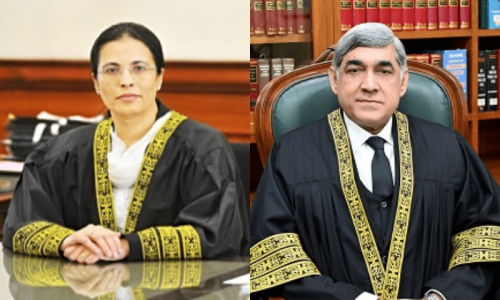
Justice Mandokhail, a member of the now-defunct Constitutional Bench (CB), made the observation in his additional note in the reserved seats review case. In its June 27 ruling, the CB, by a majority of seven judges, had overturned the earlier SC judgment of July 12, 2024 that had granted reserved seats to the PTI.
While seven judges had accepted all review petitions filed by the ruling coalition parties, three others — including Justice Mandokhail — had partially allowed them, and two had rejected the pleas outright on the first day of the hearing.
Justice Mandokhail had maintained his original July 2024 order of giving 39 seats to PTI, but reviewed the majority judgment to the extent of 41 seats. In his note uploaded on the SC website on Tuesday, the judge detailed the reasoning for his ruling and how the CB could not include all judges who were part of the original bench due to the post-26th Amendment scenario.
“Apparently, it was the PTI’s decision-makers’ decision, which compelled the 41 candidates and others to submit their nomination papers independently,” Justice Mandokhail wrote, adding that the majority of the original SC bench did not “consider this important aspect of the case”.
The judge noted that to the extent of those 41 candidates, the ROs “correctly prepared [a] list of contesting candidates while drawing Form-33, showing them as independents” and those 41 individuals then joined the Sunni Ittehad Council (SIC) by exercising their right provided under Article 51 (6d) of the Constitution.
Justice Mandokhail pointed out that the 41 candidates had declared themselves as independents in their nomination papers submitted by Dec 24, 2023, which was before the January 2024 SC verdict that revoked the PTI’s bat symbol — the same judgment that PTI argued led to “peculiar circumstances” and therefore the independent declarations.
PTI’s Salman Akram Raja said that the party “administration had decided that the candidates should submit their nomination papers independently to avoid any unwarranted situation”, the note recalled.
“They did not claim to be affiliated with PTI nor showed their intention to leave SIC and join any other party. Under such circumstances, how could it be presumed that their declaration as independent candidates was on account of that judgment?” Justice Mandokhail said.
He added that if Raja’s contention about peculiar circumstances was “believed to be correct, a question arises as to how those 39 returned candidates and the number of others who lost elections, submitted their nomination papers declaring themselves as PTI’s candidates?”
However, about the 39 PTI-backed people who had submitted their party nomination papers, Justice Mandokhail maintained that the ROs and the Election Commission of Pakistan (ECP) had “mis-exercised their jurisdiction by declaring the PTI’s 39 affiliated candidates as independents [and] by refusing to allot reserved seats to PTI on the strength of its affiliated returned candidates”.
Headed by Justice Aminuddin Khan then, the CB, through a short order on June 27, had overturned the July 12, 2024 majority judgment that declared the PTI eligible for reserved seats for women and non-Muslims in the national and provincial assemblies.
Majority of CB refused ‘best solution’ on way to include original bench judges
In his additional note, Justice Mandokhail also touched upon the matter of not being able to include judges from the SC bench that gave the original July 2024 verdict.
He noted that after the 26th Amendment, the CB was specifically authorised to hear constitutional matters and hence, a 13-member CB was formed out of the 15 judges nominated by the Judicial Commission of Pakistan (JCP). The bench excluded Justices Shakeel Ahmad and Ishtiaq Ibrahim as they were part of the Peshawar High Court bench whose order had been challenged.
While the judge stated it was “not practicable” to fix the petitions before the same bench that had delivered the judgment under review, he noted that the purpose of fixing the review pleas before the same judges was “to ensure judicial continuity and consistency”.
“There is no bar upon the JCP to nominate all judges of the Supreme Court,” Justice Mandokhail maintained.
“In order to make it practicable to fix these CRPs (civil review petitions) before the same bench, I proposed that the matter be referred to the JCP to nominate the rest of the members of the original bench,” he wrote, as that would allow the constitutional committee to reconstitute the CB and include the original bench’s judges.
“Had the matter been referred to the JCP, the [Supreme Court Rules] of 1980 could have been implemented within the parameters of the Constitution. It was the best solution to resolve the problem, which would have fostered public trust and confidence in the judiciary.
“However, the majority members of the CB did not agree and decided to proceed with the matter through the available members nominated by the JCP,” Justice Mandokhail revealed.
‘Presumption that 41 were PTI candidates not supported by any evidence’
In its detailed judgment released last month, the CB ruled that the original SC verdict was not justified in granting relief to PTI by invoking Article 187 of the Constitution — which empowers the court to do complete justice — when no issue regarding the grant of reserved seats to the party was pending before it.
In the detailed verdict, 10 judges of the 12-judge CB held that there was no justification in giving relief to the PTI under Article 187, especially when appeals were filed and pursued by the SIC under Article 185(3) (appeal against high court order) of the Constitution.
Now, in his additional note, Justice Mandokhail explained that the majority members of the original bench declared 41 MNAs as independents and gave them an option to join any political party within 15 days, “despite the fact that the matter of 41 candidates was never pending before the Supreme Court as well as before any of the fora below”.
“The decision of the majority members proves the fact that those 41 candidates were actually independents,” the judge observed.
“By now, it is well settled that a candidate who is elected with an affiliation of a particular political party or after being elected independently, joins any political party, cannot leave that particular party nor can join another,” Justice Mandokhail observed, adding if the candidate does so, he will face the consequences of losing his seat, as provided by Article 63A(1) of the Constitution.
“We have already held that no authority including the Supreme Court has the power to declare a candidate independent or change his status contrary to his declaration,” Justice Mandokhail emphasised.
He added that while there was no doubt on the SC’s jurisdiction under Article 187 to do complete justice in a matter pending before it, such power was not unlimited and hence, “cannot be expanded in any circumstance”.
Noting that pendency of a matter was a condition precedent under Article 187, the judge pointed out that “there was no matter pending before the Supreme Court with regard to declaring 41 candidates as independents nor did they claim such relief”.
Justice Mandokhail further said the majority members of July 2024 order “overlooked Article 51(6)(d) and consequences of Article 63A(1) of the Constitution” in declaring the 41 MNAs as independents.
“The presumption of majority members that those 41 candidates belonged to PTI has not been supported by any evidence or material available before them,” he wrote.
The labelling of those 41 lawmakers as independents and the option given to them to join a party in 15 days was “an error of the Constitution and law, as well as an error of facts floating on the surface of the record”, the judge declared.
Justice Mandokhail also acknowledged, “Judges are humans and humans are bound to make mistakes, which is a normal human psyche.
“The Supreme Court is the ultimate forum having inherent powers,” he added, noting that it had the power under Article 188 to review any judgment “only when serious injustice could be seen in its judgment or order on account of clear and evident mistake or an error apparent on the face of the record”.
“A mistake or an error in the judgment under review can only be corrected when circumstances of a substantial and compelling character, leading to a miscarriage of justice make it necessary to revisit the matter with a view to correction or improvement in the judgment, not to substitute its view,” Justice Mandokhail said.