Pakistan will not hold talks with any terrorist group: FO


 1
1
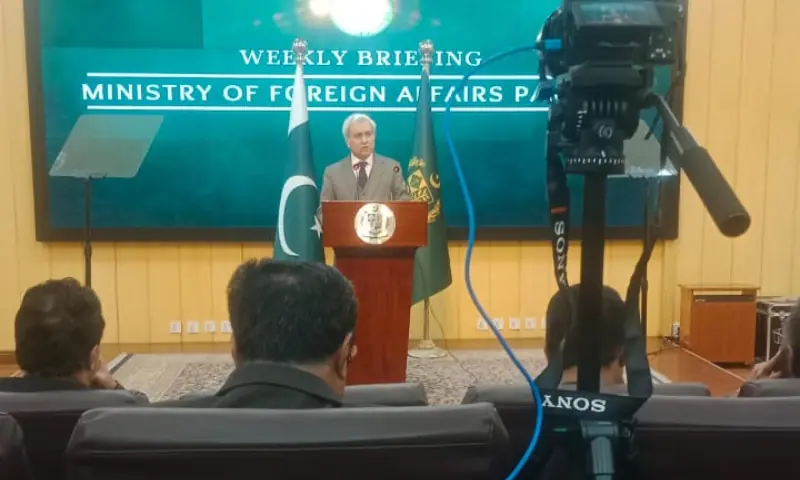

Foreign Office (FO) Spokesperson Tahir Hussain Andrabi asserted on Friday that Pakistan had never eschewed dialogue with any government in Kabul but would not hold talks with any terrorist groups.
The spokesperson’s speech came in the context of the third round of talks that concluded on November 7 in Istanbul between Pakistan and Afghanistan, aimed at ending cross-border terrorism and consolidating a fragile ceasefire that was initially agreed upon after border clashes last month.
Since the skirmishes, representatives of the two countries held two rounds of talks — first in Doha and then in Istanbul — but a final agreement could not be achieved. Defence Minister Khawaja Asif said that a ceasefire, however, was still in place “for the time being”.
“Pakistan has never eschewed dialogue with any government in Kabul. However, Pakistan will not hold dialogue with any terrorist groups, be it Tehreek-i-Taliban Pakistan (TTP) or Balochistan Liberation Army (BLA),” he said while addressing his weekly press briefing.
“The third round of talks with the Afghan Taliban regime concluded on November 7 in Istanbul,” he said, expressing appreciation for the “sincere efforts” of mediating countries Qatar and Turkiye.
“Since the Taliban regime came to power in Afghanistan, there has been a sharp surge in terrorist attacks emanating from Afghan soil on Pakistan. Throughout these years, Pakistan — despite suffering military and civilian casualties — exercised maximum restraint and did not escalate,” he said.
He added that Pakistan expected that with the passage of time, the Taliban regime would be able to control these attacks and take concrete actions against the banned TTP.
He said that during this time, Pakistan also tried to positively engage with the Afghan Taliban regime, offering bilateral trade concessions and humanitarian assistance.
“However, despite all these positive gestures by Pakistan, the response from the Taliban regimes has only been hollow promises and inaction,” he regretted.
He said that the TTP and the BLA were declared enemies of Pakistan.
“Anyone harbouring, abetting or financing them is not considered a friend and a well-wisher of Pakistan and its people,” he said.
“Pakistan is determined to take every possible action to safeguard its security and the security of its people. We regret that the Taliban regime is constantly trying to misrepresent the issue of terrorists hiding in Afghanistan as a humanitarian issue.
“Taliban regime is also trying to portray TTP and BLA as refugees in Afghanistan. This is not a humanitarian or a refugee crisis but a ploy to frame terrorists as refugees,” he said.
“Pakistan is ready to receive any Pakistani living in Afghanistan … provided they are handed over at the border crossing … and not hurled across the border fully equipped with sophisticated weapons and equipment,” he said.
The FO spokesperson also stated that some elements in the Afghan Taliban did not want confrontation with Pakistan, but there was a “strong lobby” with monetary support from foreign actors that had been tasked to “stoke tension”.
“These elements have been engaged in abuses and outrageous allegations against Pakistan, and in doing so, they are fast eroding whatever goodwill they had,” he said.
“Some elements in the Taliban regime are also trying to propagate that there is some disagreement within Pakistan over its Afghan policy. This is misleading. There is absolute clarity among the people of Pakistan that ordinary people are the biggest victims of terrorist activities by elements hiding in Afghanistan,” he said.
“The armed forces of Pakistan are making sacrifices to safeguard the lives and properties of the people of Pakistan. Therefore, the entire nation stands with its armed forces to safeguard the interests of Pakistan and the lives of the people,” he said.
Andrabi also said that some elements within the Afghan Taliban regime were “trying to instigate Pashtun nationalism in Pakistan.”
“It is a historical fact that Pashtuns in Pakistan are a vibrant part of society and state, holding leadership positions across the spectrum of public life and civil society. More Pashtuns live in Pakistan than in Afghanistan; therefore, instead of instigating Pashtunism in Pakistan, it would be wise for the Taliban regime to look into its own credentials,” he said.
The FO spokesperson added that with the “evidence-based and well-documented sharp rise in terrorism emanating from Afghanistan into Pakistan after August 2021, the Taliban regime can neither deny the reality nor absolve itself of its responsibility”.
“While the Afghan Taliban declare terrorism and Pakistan an internal issue, they fail to mention that there are people within Afghanistan who have issued fatwas, legitimising terrorist attacks against Pakistan. Moreover, terrorist groups operating inside Pakistan now comprise a large no. of Afghan nationals.
He said that Pakistan remained committed to the resolution of bilateral differences through dialogue; however, Pakistan’s core concerns, i.e. terrorism emanating from Afghanistan, needed to be addressed “first and foremost.”