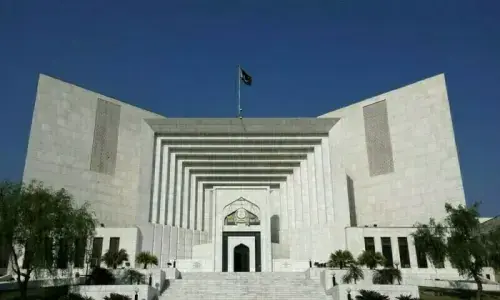
Khawaja Asif assails SC judges for stepping down, says ‘conscience awakened only after monopoly curtailed’
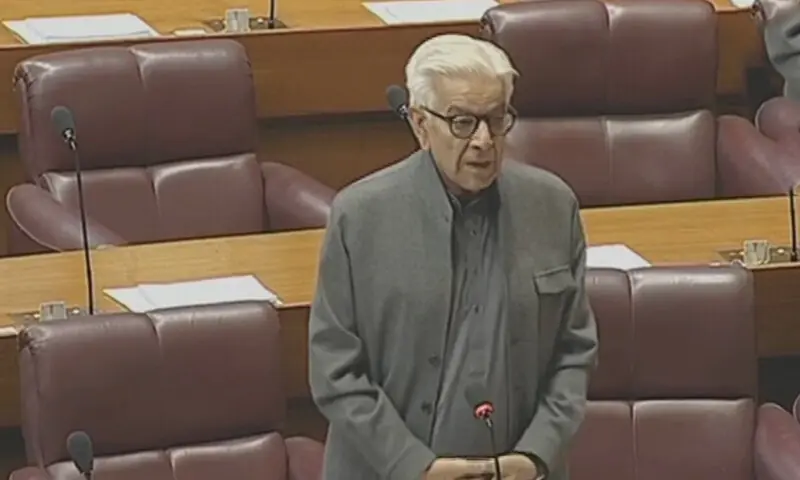

Defence Minister Khawaja Asif on Friday criticised two Supreme Court judges for tendering resignations following the passage of the 27th constitutional amendment a day earlier, saying their “consciences only awakened after their monopoly was curtailed.”
Justices Mansoor Ali Shah and Athar Minallah handed in their resignations, hours after the contentious 27th Constitutional Amendment was signed into law by President Asif Ali Zardari on Thursday.
Speaking on the floor of the National Assembly today, Asif accused the judges of having “selective amnesia”, saying that they had “forgotten their past” and were now becoming “guardians of democracy”.
“Four to five years ago — in fact, eight to 10 years ago — when the process to remove Nawaz Sharif from his post started, I want to tell you about the history of our SC judges at that time. The conspiracy created against Nawaz before that and the role our judiciary played in turning that conspiracy into reality,” Asif said, amid chants of ‘kon bachayega Pakistan; Imran Khan, Imran Khan’ [who will save Pakistan; Imran Khan, Imran Khan] by the opposition.
“The entire process started with the Panama case when Chief Justice Saqib Nisar formed two benches that deemed Nawaz ineligible to hold office,” Asif said, adding that the bench included Justices Asif Saeed Khan Khosa, Ejaz Afzal, Gulzar Ahmed, and Ijazul Ahsan.
“After Nawaz was declared ineligible, another bench was created to decide the duration of the ineligibility,” the defence minister said.
He highlighted that under the supervision of Justice Nisar, a bench comprising Justices Umar Ata Bandial, Ijazul Ahsan, and Sajjad Ali Shah, decided that ineligibility will be life-long.
“Then another bench was formed, also supervised by Justice Nisar, which declared that no ineligible person can become the leader of a political party,” Asif added. He said in almost every political lawsuit, the same few judges were witnessed thereafter.
“When these kangaroo courts were being formed, Nawaz was being victimised, and an agenda was being implemented that he would not remain a leader and would be expelled from politics forever; at that time, no one felt any shame,” the minister said, referring to the resignations of Justices Shah and Minallah following the passage of the 27th Amendment by the parliament.
“These judges from yesterday were serving in SC and high courts back then; now they’re writing poetry and issuing political statements,” referring to a poem Justice Shah added to his resignation letter.
According to Asif, the judges’ “conscience awakened because their monopoly in SC was curtailed.”
The minister added that the amendment in question sought to establish the superiority of the Constitution.
Referring to the opposition, he said that they chant ‘Khan nahi tou Pakistan nahi’ [if there is no Khan, there is no Pakistan], which was proof that they don’t stand with the Constitution of Pakistan but instead with a single person.
“These people have become protectors of terrorists; people who come from across the border and do murder and destruction here,” Asif said, assailing the opposition for not condemning the attacks in Wana and Islamabad.
Resignation letters
In his letter to the president yesterday, Justice Shah had assailed the 27th Amendment as “a grave assault on the Constitution of Pakistan”, which “dismantles the Supreme Court of Pakistan, subjugates the judiciary to executive control, and strikes at the very heart of our constitutional democracy”.
“By fracturing the unity of the nation’s apex court, it has crippled judicial independence and integrity, pushing the country back by decades,” he wrote.
“As history bears witness, such a disfigurement of the constitutional order is unsustainable and will, in time, be reversed — but not before leaving deep institutional scars.”
The judge had stated that he had a choice between serving as an SC justice, which he said “undermines the very foundation of the institution one has sworn to protect”, or hand in his resignation.
On the other hand, Justice Minallah had stated in his letter that when he took the oath of office 11 years ago, he swore to uphold not “a constitution” but “the Constitution”.
He wrote: “Prior to the passage of the 27th Amendment, I wrote to the Chief Justice of Pakistan, expressing concern over what its proposed features meant for our constitutional order.
“I need not reproduce the detailed contents of that letter, but suffice it to say that, against a canvas of selective silence and inaction, those fears have now come to be,” he added.
Justice Minallah regretted that the Constitution he swore to uphold was “no more”, adding that he “can think of no greater assault on its memory than to pretend that, as new foundations are now laid, they rest upon anything other than its grave”.
“What is left of it is a mere shadow; one that breathes neither its spirit, nor speaks the words of the people to whom it belongs,” the judge wrote.
Senate’s approval
The president’s assent to the legislation had come hours after the Senate approved the bill for the amendment after voting on it for a second time amid the opposition’s protest.
Announcing the result, Senate Chairman Yousuf Raza Gilani had said 64 votes were cast in favour of the bill and four against it. “So the motion is carried by the votes of not less than two-thirds of the total membership of the Senate, and consequently, the bill stands passed.”
The bill was initially presented in the Senate for voting on Monday and passed the same day. It was then referred to the NA, which approved it with some amendments. Therefore, the proposed legislation was again presented in the Senate yesterday to consider the latest changes.
The 27th Amendment promised, on paper, to “streamline” governance through new constitutional courts, revived executive magistrates and even a relook at how the armed forces are commanded.
At the heart of the amendment is the creation of the Federal Constitutional Court (FCC), which would have superior court judges from all provinces and hear constitutional matters, while regular courts would continue to hear all other matters