Lebanon to disarm Hezbollah near Israel border within three months
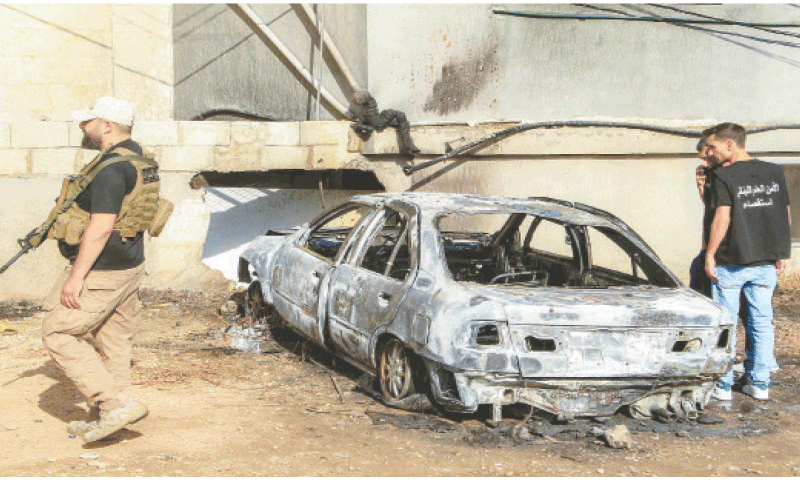

BEIRUT: Lebanon’s army will fully disarm Hezbollah near the border with Israel within three months, Foreign Minister Youssef Raggi said on Tuesday in an interview that provided details of a plan rejected by the group.
In August, the Lebanese government, under pressure from the United States and Israeli strikes, ordered the military to draw up disarmament plans which cabinet said last week the army would begin implementing, without disclosing details.
Raggi said army chief Rodolphe Haykal presented a five-stage plan that would ensure the Lebanese state has a monopoly over weapons in the country.
The first stage should take “three months... during which the removal of weapons will be completed south of the Litani River”, around 30 kilometres from Israel, Raggi said.
“There will be no warehouses, no weapons, no weapons transfers, no fighters, and no display of arms” in the area by the end of November, he said. During the first phase, the army will implement security measures across the country, he added.
The army will “tighten and increase the number of checkpoints, prevent the movement and carrying of weapons... but without conducting raids, arresting individuals, or confiscating weapons from warehouses”, Raggi said.
“At the very least, the movement of weapons from one area to another will be prohibited.” Raggi said the next four phases of the plan will see disarmament in other regions, including Beirut and the eastern Bekaa, “but without timelines”.
Hezbollah has been severely weakened by a year-long conflict with Israel, including two months of open war, that destroyed part of its arsenal and decimated its leadership.
It has along with its allies in the government opposed the disarmament push, which Lebanon says is part of a ceasefire deal that ended the war last November.
In June, Prime Minister Nawaf Salam said that the Lebanese army had dismantled more than 500 Hezbollah military positions and weapons depots in the south, where the group built a large number of tunnels and still holds sway.
Limited capabilities
Last week, Information Minister Paul Morcos told journalists that the army will implement its disarmament plan “in accordance with the available capabilities, which are limited in terms of logistics, material and human resources”.
Referring to the end-of-year deadline, Raggi said army chief Haykal has briefed the government that there are insufficient “human, material, or technical capabilities to be able to do everything within that period, and that he needs more time”.
In August, Lebanon approved a US proposal that laid out the timeline and mechanism for dismantling Hezbollah’s arsenal, and stipulated Israel’s total withdrawal from Lebanon.
Lebanon said last week that “the Israeli side has not yet shown any commitment” to the contents of the American proposal presented by envoy Tom Barrack.
It insisted any progress on implementation was conditional on other parties, primarily Israel.
Lebanon remains bound to disarm the Iran-backed group regardless, Raggi said, explaining that “arms monopoly is not linked to Barrack’s proposal” but a matter of
state policy.
Diplomatic pressure
Last year’s truce, based on a 2006 UN Security Council resolution that said all non-state groups should be disarmed, called for the withdrawal of Israeli troops from Lebanon and an end to strikes on the country. But Israel has repeatedly bombed its northern neighbour since and kept soldiers deployed in five border areas it deems strategic.
Raggi said Lebanon is exerting diplomatic pressure to push Israel to stop its attacks and withdraw its troops. Hezbollah has strongly rejected the disarmament bid, accusing the government of implementing US and Israeli directives.
Before the war and the
overthrow of its Syrian ally Bashar al-Assad shifted the balance of power in the region, Hezbollah was the most powerful political force in Lebanon, able to sway and disrupt governments.
It was the only group to keep its weapons after Lebanon’s 1975-1990 civil war, doing so in the name of resistance against Israel, which occupied the south until 2000.
Published in Dawn, September 10th, 2025