No signs of panic in riverine areas as flood approaches fast
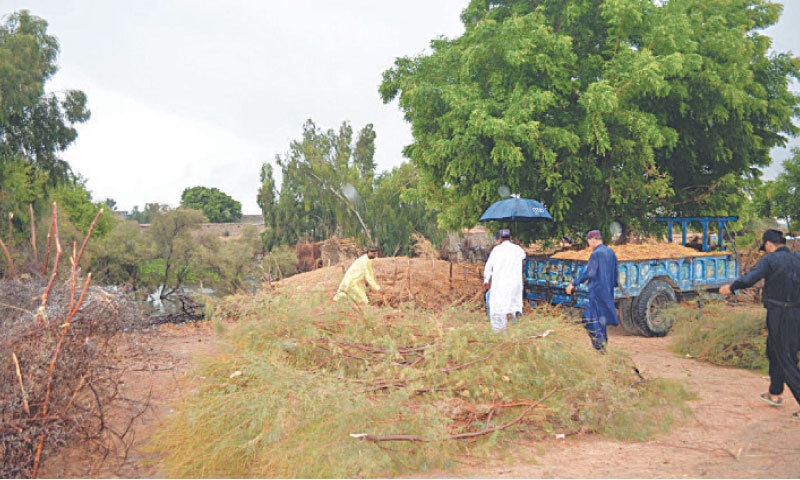

TORI BUND (Kandhkot): Sky was heavily overcast in this part of upper Sindh and it was raining intermittently with moderate intensity since morning on Monday. A physically challenged Mohammad Ayub Sabzoi appeared optimistic that this time he and his family might not have to migrate, even temporarily, from his village expecting the floods to pass safely through his area.
Ayub, a low-ranking policeman, is a resident of Dost Mohammad Sabzoi village — named after his father — which is the first village where most houses were inundated when a breach in the Tori dyke triggered heavy flooding on Aug 7, 2010. The dyke is located downstream Guddu Barrage and the deluge had hit it during super flood.
Life in this area looked normal. The village is located inside the riverine (katcha) area of Tori protected by the dyke which passes through the otherwise dacoits-infested area of Kandhkot-Kashmore district. The dyke’s location falls within the limits of the Durrani-Mahar police station that often remains in media limelight due to dacoits’ attacks on police and latter’s counterattacks. “We shouldn’t move further from this point,” came the quick advice from an area resident during the visit by this reporter on Monday evening.
Bitter memories of the Aug 7, 2010 breach, that had widened considerably soon after it developed, are still fresh in Ayub’s mind. “We left the village and ended up in Sukkur then,” he recalled. “This time, I feel, situation is relatively much better and I don’t feel any threat of a 2010-like disaster at this dyke,” he said. “Yes, we’re not in panic. The bund’s height has been increased by 6ft. God knows the rest,” Sabzoi noted.
People living in 2010 disaster-hit Tori dyke area unmoved by warnings, not ready to migrate
Dahar Khan Sabzoi, also a native of this village, pointed out that “it was raining then [in 2010 as well and floodwaters were aplenty. Resultantly, this dyke couldn’t sustain pressure and lost the strength”. Dahar’s family had left only before the breach had occurred. “Floodwaters had started overtopping the [Tori] dyke before it turned into a massive breach,” he said.
Ayub has grown paddy crop on a small piece of land inside the katcha area. “Let’s see I am able to salvage the crop or floodwaters sweep it away,” he said smilingly. He was referencing to a gradual increase in discharges at Guddu Barrage upstream where flows from eastern rivers are to reach.
Tori dyke breach had, in fact, spelt disaster for Indus right bank districts located downstream Sukkur and Guddu barrages in 2010, displacing millions and inundating large swathes of lands. These ‘internally displaced persons (IDPs)’ ended up in different improvised relief camps.
“Ghauspur was the city in this newly-created district first,” says Abdul Majid Chachar, an employee of Pakistan Postal Services and a resident of Jatoi Khan Chachar village located outside the Tori dyke. “Kandhkot city had remained by and large safe then. We returned after over two months only to find our house in pretty bad shape,” said Majid. He remembered that villagers had tried to block river flows from hitting the bund by dumping sacks but then finally gave in to the gushing flows from the Indus.
“River flows are considerably low till today (Sept 8) and have only touched the dyke’s bottom,” he pointed out. He felt that the Ghotki-Kandhkot bridge — under construction for several years — is perhaps causing a diversion in the river’s course, thus sparing Tori. Work on this bridge had to be suspended several a times during the period due to dacoits’ activities.
“In 2010 river flows had directly hit the Tori dyke and everything was lost then. The breach then widened to about 1km-stretch before authorities started plugging it,” he noted.
Like Ayub, Sindh irrigation authorities await peak of 609,664 cusecs to pass at Panjnad downstream at 7pm on Sept 7 to reach Guddu. This peak had floodwaters generated in eastern rivers —
Chenab, Ravi and Sutlej — in Punjab. It would cumulatively end up at Guddu sometime on Sept 9 although irrigation functionaries had earlier guessed it would start passing latest by Sept 3 or 4. Guddu Barrage remained in medium flood state till the filing of this report at 9pm Monday.
“The peak of floodwaters from Panjnad downstream along with the Indus River’s own flows are likely to reach us on Sept 9 evening. We are observing flows’ reading recorded at Chachran in Rahim Yar Khan district near Mithankot which was 9.7 at 6pm on Monday,” said Guddu Barrage executive engineer Javed Chachhar.
He said that “when Guddu had first received a peak of 547,441 cusecs — Indus River’s own flows — against downstream discharge of 510,798 cusecs on Aug 24, Chachra’s reading was 10.6”. “A rising trend at Chachra will help us have an idea of actual peak arriving at Guddu,” he explained.
With a designed discharge capacity of 1.2m cusecs, Guddu had withstood 1,148,200 cusecs flood on Aug 8, 2010 after receiving 1,148,738 cusecs. The barrage is set to receive flows from Indus and eastern rivers now.
Guddu Barrage undergoing modernisation as part of a project of Sindh Barrages Improvement Programme (SBIP). Its 65 gates, in all, are to be replaced under programme, funded by World Bank.
Published in Dawn, September 9th, 2025