Pakistan, China urge Kabul to rein in terror outfits



• Afghanistan promised economic cooperation, CPEC in trilateral dialogue
• Chinese FM arrives in Islamabad for ‘strategic dialogue’
ISLAMABAD: Pakistan and China on Wednesday pressed Afghanistan’s Taliban authorities to act against terrorist groups threatening their security while reiterating offers of economic cooperation and the extension of the China-Pakistan Economic Corridor (CPEC) to the landlocked country.
The calls were made during and on the sidelines of the 6th Pakistan-Afghanistan-China trilateral dialogue, held in Kabul for the first time since the Taliban’s return to power in 2021. Security dominated the agenda not only at the trilateral but also in bilateral talks the Pakistani and Chinese foreign ministers held with Afghan leaders.
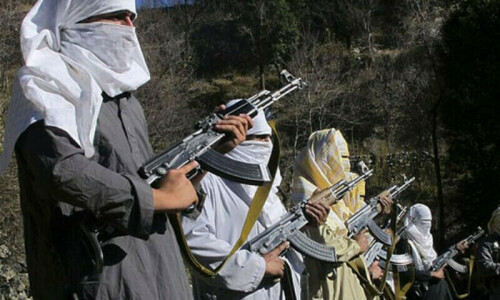
Pakistan and China view Afghanistan-based terrorist groups as critical threats to their stability. Since August 2021, Afghanistan has again become a hub for the Islamic State Khorasan (IS-K), Tehreek-i-Taliban Pakistan (TTP), East Turkestan Islamic Movement (ETIM), and Al Qaeda, according to the UN assessments.
At a China-mediated trilateral meeting in May, Pakistan had secured promises for closer coordination on security, while Beijing linked future economic projects, including the Mes Aynak copper mine, to action against ETIM militants active near Xinjiang.
Deputy Prime Minister and Foreign Minister Ishaq Dar, speaking with Afghan Acting Foreign Minister Amir Khan Muttaqi in Kabul, regretted that counter-terrorism commitments were not being honoured.
“Encouraging progress has been made in political and commercial ties, but progress in the security domain, especially in counterterrorism, continues to lag behind,” Mr Dar said, according to the Foreign Office.
He highlighted a “recent surge in terrorist attacks inside Pakistan perpetrated by groups operating from Afghan soil,” calling for “concrete and verifiable measures” against the TTP and the Balochistan Liberation Army.
The UN Security Council reported in July that the TTP commands around 6,000 fighters operating from Afghan territory with Taliban support. Bolstered by advanced weapons and ties with IS-K, Al Qaeda, and Baloch separatists, the group carried out more than 600 attacks in Pakistan in late 2024, killing nearly 1,000 people.
Despite a Chinese-brokered thaw between Kabul and Islamabad earlier this year, progress remains uneven. Pakistan restored ambassadorial-level diplomatic ties with Afghanistan, and in July Interior Minister Mohsin Naqvi met Taliban Interior Minister Sirajuddin Haqqani to revive the Joint Coordination Committee on counterterrorism.
The Taliban, meanwhile, relocated some TTP families to Ghazni and Zabul provinces and offered them financial aid. But the militants rejected relocation to northern Afghanistan, citing supply chain problems; the Taliban have resisted major crackdowns, fearing defections to IS-K.
Diplomatic optics in Kabul reflected the strains between Pakistan and Afghanistan. While Chinese Foreign Minister Wang Yi met Taliban Prime Minister Mullah Hassan Akhund, FM Dar only got a counterpart meeting. Official statements and the tone of reception also suggested a more lukewarm attitude toward Pakistan.
Afghan leaders also signalled displeasure over an upcoming conference of Afghan opposition activists in Islamabad, organised by a local group. Though not mentioned in formal communiques, Taliban officials have privately voiced strong objections.
‘Positive engagement’
In his meeting with Chinese Foreign Minister Wang Yi, Mr Akhund alluded to foreign interference, saying: “We also call upon other countries to pursue the path of friendship, sound relations, and positive engagement rather than interference.”
Mr Wang, meanwhile, emphasised Beijing’s concerns over ETIM, whose fighters are based in Afghanistan and pose a threat to China’s Xinjiang region. The group, which rebranded itself as the Turkistan Islamic Party in March, has called for “jihad in Xinjiang” and maintains ties with other extremist groups.
“We also hope that Afghanistan will take into account some of our concerns, particularly concerning security,” he said. “Effective security cooperation between the two countries will establish a foundation for Afghanistan’s development. We hope that you, as China’s friend, will attach special importance to this matter and further enhance your cooperation.”
“Please assure the Chinese leadership that we have demonstrated in practice that no insecurity or other problem will emanate from Afghan soil toward any party,” Mr Akhund told Wang Yi.
Pakistan’s Foreign Office said Muttaqi reaffirmed to Mr Dar that Afghanistan’s territory “will never be used against neighbouring countries.”
Although no joint communique was issued after the trilateral, Pakistan’s Foreign Office said that the three countries agreed to strengthen efforts against terrorism. They also reaffirmed commitments to deepen cooperation in trade, transit, regional development, health, education, culture, combating narcotics and expanding CPEC into Afghanistan.
Meanwhile, the Chinese foreign minister has landed in Islamabad to attend the Pakistan-China strategic dialogue, being held today (Thursday).
Published in Dawn, August 21st, 2025