Iran warns war with Israel could resume at any time
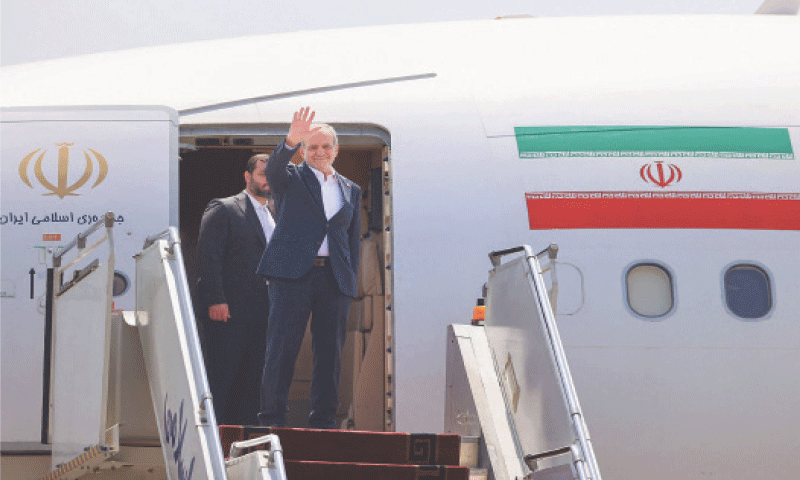

TEHRAN: A senior Iranian official warned on Monday that war with Israel could erupt at any moment, describing the current lull after June’s 12-day conflict as only a temporary halt.
“We must be prepared at every moment for confrontation; right now, we are not even in a ceasefire (agreement); we are in a cessation of hostilities,” said First Vice President Mohammad Reza Aref.
The fighting in June saw Israel bombard Iranian nuclear and military sites, as well as residential areas, killing more than 1,000 people, including senior commanders and nuclear scientists. Iran retaliated with missile and drone strikes that killed dozens in Israel.
The United States announced a halt in fighting on June 24, two days after it joined the war by bombing Iranian nuclear facilities. But there was no agreement formalising the ceasefire, only an undeclared pause in hostilities.
On Sunday, Yahya Rahim Safavi, a military adviser to Iran’s supreme leader Ayatollah Ali Khamenei, told Iranian media the country was “preparing plans for the worst-case scenario”.
“We are not in a ceasefire now, we are in a war phase, it could break down at any time, there is no protocol, no regulations, no agreement between us and the Israelis, between us and the Americans,” he said in remarks carried by the Shargh daily.
“A ceasefire means ceasing attacks; that could change at any time,” he added. Since then, Iranian officials have insisted the country is not seeking war but is ready for another confrontation.
Western powers accuse Iran of pursuing nuclear weapons through its atomic programme, a charge Tehran strongly denies. Following the war, Israel and the United States repeatedly threatened to attack Iran again should Tehran relaunch its nuclear sites and resume its nuclear enrichment programme.
The United Nations nuclear watchdog has warned that Iran is the only non-nuclear-armed country that enriches uranium to 60 per cent — far beyond the 3.67pc cap set by a landmark international accord reached in 2015.
The level is a short step from the 90-percent enrichment required for a nuclear weapon. Last week, Britain, France and Germany, all signatories to the 2015 deal, threatened to reimpose sanctions lifted under the agreement.
Iran has warned of serious consequence with some officials in the country hinting at withdrawal of Tehran from the nuclear non-proliferation treaty.
Talks with IAEA
Iran will continue talks with the UN nuclear watchdog and the two sides will probably have another round of negotiations in the coming days, Iranian Foreign Ministry spokesperson Esmaeil Baghaei told state media on Monday.
International Atomic Energy Agency inspectors have been unable to access Iran’s nuclear sites since Israel and the US bombed them during a 12-day war in June, despite IAEA chief Rafael Grossi stating that inspections remain his top priority.
“We had talks (with the IAEA) last week. These talks will continue and there will be another round of talks between Iran and the agency probably in the coming days,” Baghaei said.
Published in Dawn, August 19th, 2025