Footprints: Worth its weight in salt

JUST as I’m getting ready to jet off to Japan for the Expo 2025 Osaka, Noorjehan Bilgrami gives me a call and offers two primary instructions. I listen studiously.
Bilgrami is a woman of many talents and, after her curatorial success at the Expo 2020 in Dubai, which resulted in the much-lauded Pakistan Pavilion bagging the Silver Award, she is now at the helm of Pakistan’s latest endeavour at the newest iteration of the Expo. The question is: can she capture lightning in a bottle twice?
She tells me two things. One: try to experience the Pakistan Pavilion at a leisurely pace, before the swathes of visitors arrive. Two: appreciate the Japanese people and their way of life. This second instruction is easy enough to follow.
They say that if you ask a Japanese person for directions, they’ll walk you to your destination instead of simply pointing the way. I experience this first-hand shortly after hopping off the train at Yumeshima Island — the location of the Expo 2025 Osaka — as I’m diligently shepherded through the crowd by an excessively courteous volunteer.
I begin to make my way towards the Pakistan Pavilion. All facets of Pakistan’s participation at Expo 2025 Osaka are being managed by the Trade Development Authority of Pakistan (TDAP), which has been designated as the Responsible National Authority (RNA) by the prime minister of Pakistan.
Undeniably, the most awe-inspiring aspect of the expansive Expo is the Grand Ring — an enormous, continuous wooden structure that encircles the site’s seemingly endless expanse and is constructed using a fusion of modern timber engineering and traditional Japanese nuki joinery. It seems almost primordial and elemental — much like the Pakistan Pavilion at this year’s Expo.
Situated in a large warehouse-like space that is shared with several other countries — including Palestine — the Pakistan Pavilion this year is more modest in size than its previous counterpart in Dubai.
But its ambitions are just as lofty, if not more. In fact, it is less an ‘exhibition’ and more a meditation, serving as a journey into the timeless depths of a single, humble element — rock salt.
This is where Bilgrami’s first instruction proves to be unachievable for me. The Pakistan Pavilion is the only one in its enclosure that has a continuous line of people waiting to get in, be it morning, noon or night. So what are they all so eager to see?
Before even entering, the first thing one notices is the iridiscent façade — a litany of hand-hammered copper tiles, crafted by artisans from Peshawar, with the surface of each tile rippling under the light. The floor tiles in the interior are made of pink rock salt, mined from the Salt Range in Kallar Kahar.
The pavilion’s theme, ‘The Universe in a Grain of Salt’, distils the Expo 2025 Osaka’s central vision — ‘Designing Future Society for Our Lives’ — into a tangible metaphor that serves as a symbol of resilience, healing and universal human connection.
Paradoxically, the pavilion’s power lies in its restraint. By focusing on a single material, it achieves a clarity that is surprisingly missing from some of the bigger and ‘flashier’ offerings at Expo 2025 Osaka.
Emblazoned on a wall at the pavilion’s entrance is a poem by Zehra Nigah — with an accompanying English and Japanese translation — evoking salt as both sustenance and symbol. In the background, Faiza Kassim’s melodic rendition of Nigah’s verses, accompanied by the sound of a flute, helps create what Bilgrami calls “a sanctuary for reflection.”
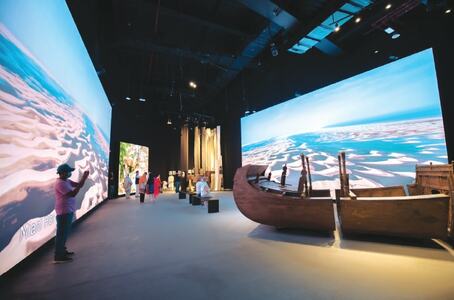
What follows is a chronological journey through millions of years painted by miniature artist Farooq Mustafa Maeda. It takes viewers from the transformation of ancient seas into rugged hills, to the value Mughal courts placed on salt, and miners today working in the Khewra Salt Mine. Similarly, Nisar Malik’s film at the pavilion also explores the majesty and magic of the Salt Range.
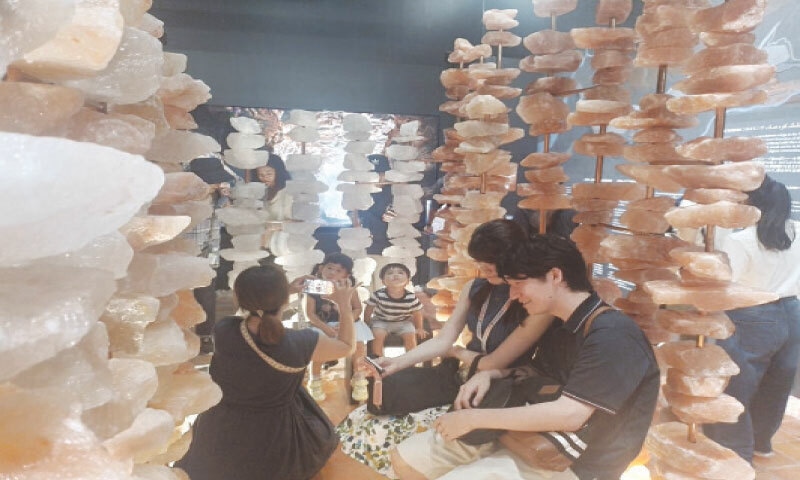
The pièce de résistance, its ‘Healing Garden’, is visually striking and deeply alluring, which explains why it is a popular picture spot for most visitors. Here, 29 columns comprising of pink, white and red rock salt slabs in their original raw states rise like glowing sentinels on slender steel rods — raw geology framed by expert human craftsmanship.
These works are meant to be touched, felt, smelt and engaged with — not just viewed in passing. With many pavilions competing for attention through LED walls, kinetic architecture and an unclear thematic throughline, Pakistan’s is refreshingly human. It trusts the strength of material, the depth of heritage, and our desire to be around creations that are luminous rather than loud.
Fittingly, this is a philosophy embraced by the Japanese. How they conduct their daily lives, coupled with the Pakistan Pavilion’s central motif, is a reminder that even the most seemingly ordinary thing or action can hold infinite meaning — if we take the time to notice.
Published in Dawn, August 16th, 2025