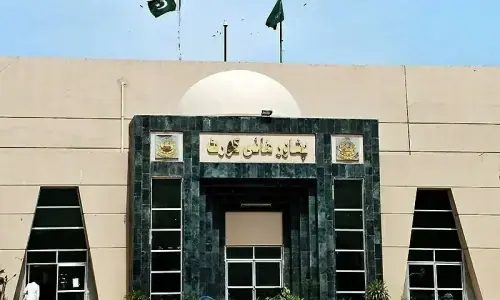
PESHAWAR: Khyber Pakhtunkhwa on Tuesday opened the country’s first Provincial Intelligence Fusion and Threat Assessment Centre (PIFTAC) to strengthen real-time intelligence fusion and enhance threat anticipation across the province.
The PIFTAC, according to details shared with Dawn, will function as intelligence fusion hub aimed at real-time and inter-agency collaboration to enhance counterterrorism efforts. It will be headed by the additional chief secretary home and tribal affairs department.
Chief Minister Ali Amin Gandapur inaugurated the fusion hub, which has been set up at the home and tribal affairs department at a cost of Rs210 million.
Chief secretary Shahab Ali Shah and additional chief secretary home Mohammad Abid Majeed were also present on this occasion.
The federal Apex Committee had in January this year decided to establish National Intelligence Fusion and Threat Assessment Centre (NIFTAC) and PIFTAC at the provincial level.
CM says PIFTAC to provide timely intelligence, facilitate its effective use for neutralising threats
PIFTAC will also facilitate seamless coordination between federal and provincial security agencies. It will also utilise smart IT-based systems to reduce response time in intelligence operations and law enforcement actions, support district police and administration in improving security measures through localised intelligence processing, and enable intelligence sharing in coordination with NIFTAC.
Besides, it will also carry out in-depth analysis of info provided, disseminate actionable intelligence, and maintain database of all extremist and terrorist groups.
Besides, PIFTAC has been integrated with the existing Provincial Security Secretariat (PSS) and KP Integrated Security Architecture (KPISA), and leverage existing infrastructure, workstations, and databases.
Mr Gandapur was briefed on the functions and scope of the newly-established facility.
The system connects the federal and all provincial governments, enabling a uniform mechanism for intelligence and data sharing on potential threats.
The chief minister was informed that PIFTAC integrates 14 relevant agencies — including FIA, Nadra, PTA and intelligence organisations — under a single platform. It is also directly linked with district coordination committees across the province.
Through this system, real-time intelligence sharing across the country will be possible, ensuring coordinated, timely and effective actions against terrorist activities. Officials said the centre would significantly enhance the operational capacity of intelligence agencies.
Speaking on the occasion, Mr Gandapur said the establishment of PIFTAC marked an important step towards effectively countering terrorism.
He stressed that the fight against terrorism was a national agenda that required the government, the public and all institutions to remain on the same page.
The chief minister underscored the need for a comprehensive system to tackle the menace, expressing hope that PIFTAC would play a vital role in providing timely intelligence and facilitating its effective use for neutralising threats.
Published in Dawn, August 13th, 2025