The US Supreme Court’s ruling tied to birthright citizenship prompted confusion and phone calls to lawyers as people who could be affected tried to process a convoluted legal decision with major humanitarian implications.
The court’s conservative majority on Friday granted President Donald Trump his request to curb federal judges’ power but did not decide the legality of his bid to restrict birthright citizenship.
That outcome has raised more questions than answers about a right long understood to be guaranteed under the US Constitution: that anyone born in the United States is considered a citizen at birth, regardless of their parents’ citizenship or legal status.
Lorena, a 24-year-old Colombian asylum seeker who lives in Houston and is due to give birth in September, pored over media reports on Friday morning. She was looking for details about how her baby might be affected, but said she was left confused and worried.
“There are not many specifics,” said Lorena, who like others interviewed by Reuters asked to be identified by her first name out of fear for her safety.
“I don’t understand it well.”
She is concerned that her baby could end up with no nationality.
“I dont know if I can give her mine,” she said.
“I also don’t know how it would work, if I can add her to my asylum case. I don’t want her to be adrift with no nationality.”
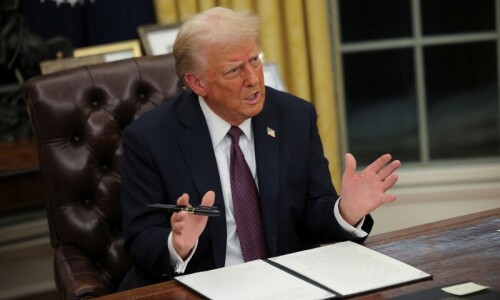
Trump, a Republican, issued an order after taking office in January that directed US agencies to refuse to recognise the citizenship of children born in the US who do not have at least one parent who is an American citizen or lawful permanent resident.
The order was blocked by three separate US district court judges, sending the case on a path to the Supreme Court. The resulting decision said Trump’s policy could go into effect in 30 days but appeared to leave open the possibility of further proceedings in the lower courts that could keep the policy blocked.
On Friday afternoon, plaintiffs filed an amended lawsuit in federal court in Maryland seeking to establish a nationwide class of people whose children could be denied citizenship.
If they are not blocked nationwide, the restrictions could be applied in the 28 states that did not contest them in court, creating “an extremely confusing patchwork” across the country, according to Kathleen Bush-Joseph, a policy analyst for the non-partisan Migration Policy Institute.
“Would individual doctors, individual hospitals be having to try to figure out how to determine the citizenship of babies and their parents?” she said.
The drive to restrict birthright citizenship is part of Trump’s broader immigration crackdown, and he has framed automatic citizenship as a magnet for people to come to give birth.
“Hundreds of thousands of people are pouring into our country under birthright citizenship, and it wasn’t meant for that reason,” he said during a White House press briefing on Friday.
Worried calls
Immigration advocates and lawyers in some Republican-led states said they received calls from a wide range of pregnant immigrants and their partners following the ruling.
They were grappling with how to explain it to clients who could be dramatically affected, given all the unknowns of how future litigation would play out or how the executive order would be implemented state by state.
Lynn Tramonte, director of the Ohio Immigrant Alliance, said she got a call on Friday from an East Asian temporary visa holder with a pregnant wife. He was anxious because Ohio is not one of the plaintiff states and wanted to know how he could protect his child’s rights.
“He kept stressing that he was very interested in the rights included in the Constitution,” she said.
Advocates underscored the gravity of Trump’s restrictions, which would block an estimated 150,000 children born in the US annually from receiving automatic citizenship.
“It really creates different classes of people in the country with different types of rights,” said Juliana Macedo do Nascimento, a spokesperson for the immigrant rights organisation United We Dream.
“That is really chaotic.”
Adding uncertainty, the Supreme Court ruled that members of two plaintiff groups in the litigation — CASA, an immigrant advocacy service in Maryland, and the Asylum Seeker Advocacy Project — would still be covered by lower court blocks on the policy.
Whether someone in a state where Trump’s policy could go into effect could join one of the organisations to avoid the restrictions, or how state or federal officials would check for membership, remained unclear.
Betsy, a US citizen who recently graduated from high school in Virginia and a CASA member, said both of her parents came to the US from El Salvador two decades ago and lacked legal status when she was born.
“I feel like it targets these innocent kids who haven’t even been born,” she said, declining to give her last name for concerns over her family’s safety.
Nivida, a Honduran asylum seeker in Louisiana, is a member of the Asylum Seeker Advocacy Project and recently gave birth. She heard on Friday from a friend without legal status who is pregnant and wonders about the situation under Louisiana’s Republican governor, since the state is not one of those fighting Trump’s order.
“She called me very worried and asked what’s going to happen,” she said.
“If her child is born in Louisiana is the baby going to be a citizen?”