787 Dreamliner: Boeing’s flagship long-distance plane
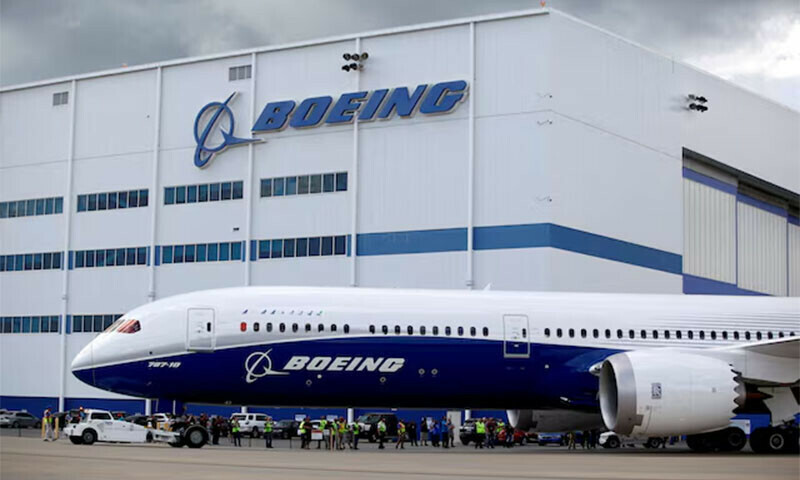

The Boeing 787 Dreamliner that crashed in India on Thursday is the pride of the US company’s catalogue for long-distance planes: a fuel-efficient, wide-body aircraft able to transport up to 330 people.
Lightweight
After first entering service in October 2011, with Japan’s All Nippon Airways, 2,598 of the planes have been ordered by more than 80 airlines around the world, with 889 still awaiting delivery.
Its appeal is its lightweight structure, half of which is made from composite materials, allowing it to burn up to 20 per cent less fuel over long distances than older, equivalent-sized passenger planes.
It can be used for “point-to-point” services, meaning it can fly directly to a destination instead of relying on a “hub” system used by heavier aircraft. Boeing says the use of the 787 has opened up 180 such “point-to-point” routes, more than the 80 initially banked upon.
Three versions
There are currently three versions of the 787: the 787-8, which can carry up to 248 passengers over distances up to 13,530 kilometres; the 787-9, carrying up to 296 passengers up to 14,010km; and the 787-10, with up to 330 passengers, up to 11,910km.
The one that crashed in Ahmedabad, India, on Thursday was the 787-8 version, carrying 242 passengers and crew. It was scheduled to fly to London but crashed shortly after taking off from the western Indian city.
Boeing said it was “aware” of the reports of the crash and was “working to gather more information”.
It was the first deadly crash of a 787 Dreamliner.
Boeing setbacks
Boeing’s programme for the plane had suffered several setbacks, including repeated and costly delivery suspensions between 2021 and 2023, mainly due to assembly faults and manufacturing quality issues.
The US Federal Aviation Administration ended up reinforcing quality assurance checks and inspections on the production lines.
In April this year, the FAA authorised Boeing to step up its production pace to make seven planes a month, from five previously.
In terms of sales, Boeing is facing headwinds. The manufacturer did not deliver any aircraft to China in May, despite having a green light from Beijing, which the month before had temporarily barred Chinese airlines from dealing with the company because of the trade war unleashed by Washington.